




Security Code Probability: No Repetition
What You Will Learn
- How to calculate total outcomes for permutations without replacement
- Understanding what "in any order" means for probability calculations
- The difference between permutations and combinations in probability contexts
- How to apply the classical probability formula: favorable outcomes ÷ total outcomes
- Why order matters in security codes and similar applications
Visualizing the Problem
Let's understand what we're working with:
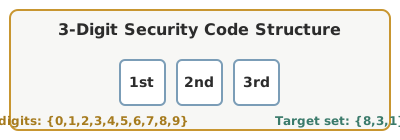
We have 10 digits available (0 through 9), and we need to form a 3-digit code where no digit repeats. We want to find the probability that this code contains exactly the digits 8, 3, and 1 in any arrangement.
Solution: Method 1 — Classical Probability Approach
We'll use the fundamental probability formula: P(event) = favorable outcomes ÷ total possible outcomes.
Step 1 — Calculate the total number of possible codes
Since we're forming a 3-digit code with no repeated digits from the set {0,1,2,3,4,5,6,7,8,9}:
- First position: 10 choices (any digit 0-9)
- Second position: 9 choices (any remaining digit)
- Third position: 8 choices (any remaining digit)
Step 2 — Calculate the favorable outcomes
We want codes that contain exactly the digits 8, 3, and 1. Since we need all three positions filled and these are the only three digits used, we're looking for all possible arrangements (permutations) of these three specific digits.
These arrangements are: 831, 813, 381, 318, 183, 138
Step 3 — Apply the probability formula
Step 4 — Convert to decimal
Solution: Method 2 — Sequential Selection Approach
Let's think about this problem as selecting digits one by one, where we want exactly the set {8, 3, 1}.
Step 1 — Probability of selecting one of our target digits first
We want the first digit to be either 8, 3, or 1.
Step 2 — Probability of selecting another target digit second
Given that we picked one of our target digits first, we have 2 remaining target digits out of 9 remaining total digits.
Step 3 — Probability of selecting the final target digit third
Given that we picked two of our target digits, we need the last specific target digit out of 8 remaining total digits.
Step 4 — Multiply the sequential probabilities
Since we need all three events to happen in sequence:
Verification
Let's verify our answer by checking it makes sense:
Method 1 Check
We said there are 6 favorable outcomes out of 720 total. Let's list the favorable outcomes:
- 831, 813, 381, 318, 183, 138
That's indeed 6 arrangements of the digits {8, 3, 1}. ✓
Method 2 Check
Using our sequential approach: (3/10) × (2/9) × (1/8) = 6/720 = 1/120. ✓
Reasonableness Check
With 720 total possible codes, finding one specific set of 3 digits should be rare. A probability of less than 1% seems reasonable. ✓
Watch Out for These Mistakes
✗ Mistaking this for a combination problem
Students sometimes think since we want "any order" that we should use C(10,3) = 120. This is wrong because security codes are ordered sequences—831 is different from 138.
✗ Forgetting that the total uses permutations too
Some students calculate favorable outcomes correctly as 6, but then use 10³ = 1000 for the total instead of 10 × 9 × 8 = 720. Remember: no repetition means fewer total possibilities.
✗ Calculating the probability of a specific sequence
Finding P(code is exactly 831) = 1/720 is different from finding P(code contains 8, 3, and 1 in any order) = 6/720. The word "any" means we count all arrangements.
How to Spot This Problem Type
Look for these key phrases that signal a permutation probability problem:
- "without replacement" or "cannot be repeated" — indicates the sample size decreases with each selection
- "in any order" — means you need to count all arrangements of the target set
- "3-digit code" or similar — signals that position matters (123 ≠ 321)
- "contains the numbers X, Y, Z" — you're looking for all codes made from exactly those digits
This problem structure appears in lottery problems, password security, and any scenario where you're selecting items sequentially without replacement.
The Pattern Behind This
This problem follows the general pattern for permutation probability with specific outcomes:
More specifically, when selecting r items from n items without replacement, where you want exactly a specific set of r items:
In our case: n = 10 (total digits), r = 3 (positions in code), and we want exactly one specific set of 3 digits.
So: P = 3! / P(10,3) = 6 / 720 = 1/120
Important limitation: This formula only works when you want exactly r specific items and all positions must be filled with those items.
Four "What-If?" Problems
First position: 9 choices (1-9, can't use 0), Second position: 9 choices (remaining digits including 0), Third position: 8 choices. Total = 9 × 9 × 8 = 648
Since our target digits {8, 3, 1} don't include 0, all 6 arrangements are still valid: 831, 813, 381, 318, 183, 138
P = 6/648 = 1/108 ≈ 0.93%
Check: 6/648 = 1/108. This is slightly higher than our original probability because there are fewer total possibilities. ✓
We want exactly one specific arrangement: 831. This is much more restrictive than "any order."
There is exactly 1 way to arrange the digits in the specific order 8-3-1
Total possible 3-digit codes with no repetition = 10 × 9 × 8 = 720
P = 1/720 ≈ 0.14%
This should be exactly 1/6 of our original answer: (1/120) × (1/6) = 1/720 ✓
Now our target set is {0, 8, 1} instead of {8, 3, 1}. The zero changes some arrangements because it can appear in the first position.
All arrangements of {0, 8, 1}: 081, 018, 801, 810, 108, 180. That's 3! = 6 arrangements
Total possible codes = 10 × 9 × 8 = 720 (leading zero is allowed)
P = 6/720 = 1/120 ≈ 0.83%
Same answer as the original! Including 0 doesn't change the probability when leading zeros are allowed. ✓
Even digits: {0, 2, 4, 6, 8}, Odd digits: {1, 3, 5, 7, 9}. We want codes using only odd digits.
Using only the 5 odd digits {1, 3, 5, 7, 9} with no repetition: 5 × 4 × 3 = 60
Total possible codes from all 10 digits = 10 × 9 × 8 = 720
P = 60/720 = 1/12 ≈ 8.33%
Check: 60/720 = 1/12. This is much higher than finding a specific set of 3 digits, which makes sense since we have multiple valid combinations of odd digits. ✓
Frequently Asked Questions
Use the multiplication principle: first digit has 10 choices (0-9), second digit has 9 remaining choices, third digit has 8 remaining choices. Total = 10 × 9 × 8 = 720 possible codes.
It means all arrangements of the specified digits count as favorable outcomes. In this problem, codes 831, 813, 381, 318, 183, and 138 all satisfy the condition since they all contain exactly the digits 8, 3, and 1.
Even though we know the three digits (8, 3, 1), they can be arranged in different positions within the code. Since order matters for security codes, we calculate 3! = 6 different arrangements of these three specific digits.
2026-09-17