




Arrow Shot Upward: Vertex and Root Problems
An arrow is shot vertically upward into the air with an initial vertical velocity of 60 m/s, and its height is given by h = −5t² + 60t where h is in meters and t is in seconds. How high does the arrow go? How long does the arrow stay in flight?
What This Problem Teaches
- Finding the vertex of a quadratic function to determine maximum values
- Solving quadratic equations by factoring to find zeros
- Interpreting the physical meaning of mathematical models
- Understanding how gravity affects projectile motion
- Connecting algebraic techniques to real-world physics applications
Visualizing the Motion
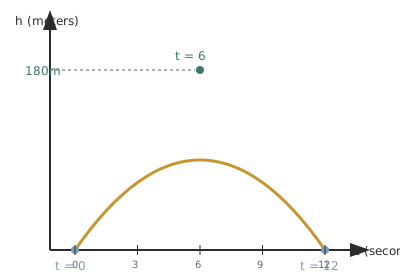
The arrow follows a parabolic path. We need to find the vertex (maximum height) and the x-intercepts (launch and landing times).
Solution: Method 1 — Vertex of the Parabola
The height equation h = −5t² + 60t is a quadratic function that opens downward (negative coefficient on t²). Its maximum occurs at the vertex.
Step 1 — Find the time at maximum height
For a quadratic in the form at² + bt + c, the t-coordinate of the vertex is:
Here, a = -5 and b = 60:
Step 2 — Calculate the maximum height
Substitute t = 6 into the height equation:
h = −5(36) + 360
h = −180 + 360 = 180 meters
Step 3 — Find the total flight time
The arrow is in flight from launch until it hits the ground (h = 0). Solve:
Factor out the common term:
This gives us: t = 0 or t = 12
t = 0 is the launch time, and t = 12 is the landing time.
Solution: Method 2 — Using Symmetry of Motion
Projectile motion under constant gravity is symmetric. The time to reach maximum height equals the time to fall back down.
Step 1 — Find when velocity equals zero
The velocity is the derivative of height: v = dh/dt = −10t + 60
At maximum height, velocity = 0:
10t = 60
t = 6 seconds
Step 2 — Apply symmetry for total flight time
Since motion is symmetric, if it takes 6 seconds to go up, it takes 6 seconds to come down.
Step 3 — Calculate maximum height
Substitute t = 6 into the height equation:
Verification
Let's check our answers by substituting back into the original equation:
Check maximum height at t = 6:
Check that the arrow lands at t = 12:
Check that the arrow launches at t = 0:
All checks pass! The symmetry also makes sense: the arrow takes 6 seconds up and 6 seconds down.
Common Pitfalls
✗ Mistake 1: Confusing the vertex formula
Some students write t = b/(2a) instead of t = -b/(2a). This gives t = 60/(-10) = -6, which is negative time and physically meaningless.
✗ Mistake 2: Using only the positive root
When solving −5t² + 60t = 0, students sometimes only report t = 12 and forget that t = 0 represents the launch. Both roots are meaningful: launch and landing.
✗ Mistake 3: Misinterpreting the physics
The coefficient -5 represents half the gravitational acceleration (g = 10 m/s²). Students sometimes think this is the full gravity value or confuse it with Earth's standard g ≈ 9.8 m/s².
The Physics Behind the Math
The equation h = −5t² + 60t comes from the kinematic formula for motion under constant acceleration:
Where:
h₀ = 0(starts at ground level)v₀ = 60 m/s(initial velocity upward)a = -g = -10 m/s²(gravity acts downward)
So ½at² = ½(-10)t² = -5t², giving us our equation. The negative sign on the t² term ensures the parabola opens downward, reflecting that gravity eventually dominates over the initial upward velocity.
Real Applications
- Ballistics: Artillery and missile trajectories use these same calculations to determine range and maximum altitude.
- Sports science: Analyzing the optimal angle and velocity for shot put, basketball shots, or golf ball trajectories.
- Safety engineering: Calculating fall distances and impact times for safety equipment design and emergency response planning.
What If?
With v₀ = 80 m/s: h = −5t² + 80t
t = -80/(2 × -5) = 80/10 = 8 seconds
h = −5(8)² + 80(8) = −320 + 640 = 320 meters
By symmetry: 2 × 8 = 16 seconds
At t = 16: h = −5(16)² + 80(16) = −1280 + 1280 = 0 ✓
Answer: 320 meters high, 16 seconds in flight
h = −5t² + 60t + 20 (adding 20m starting height)
t = -60/(2 × -5) = 6 seconds (same as before)
h = −5(6)² + 60(6) + 20 = −180 + 360 + 20 = 200 meters
−5t² + 60t + 20 = 0
Dividing by -5: t² − 12t − 4 = 0
Using quadratic formula: t = (12 ± √(144 + 16))/2 = (12 ± √160)/2 = (12 ± 4√10)/2t = 6 ± 2√10 ≈ 6 ± 6.32
Taking the positive root: t ≈ 12.32 seconds
Answer: 200 meters high, 12.32 seconds in flight
At the vertex, h_max = v₀²/(4 × 5) = v₀²/20
(This comes from substituting the vertex time into the height equation)
125 = v₀²/20v₀² = 125 × 20 = 2500v₀ = 50 m/s
The height equation is h = −5t² + 50t
Setting h = 0: −5t(t − 10) = 0
So t = 0 (launch) or t = 10 (landing)
At t = 5 (halfway): h = −5(25) + 50(5) = −125 + 250 = 125 ✓
Answer: Initial velocity 50 m/s, flight time 10 seconds
Arrow 1: h₁ = −5t² + 60t
Arrow 2 (launched at t = 4): h₂ = −5(t−4)² + 80(t−4) for t ≥ 4
h₂ = −5(t² − 8t + 16) + 80t − 320h₂ = −5t² + 40t − 80 + 80t − 320h₂ = −5t² + 120t − 400
−5t² + 60t = −5t² + 120t − 40060t = 120t − 400400 = 60tt = 400/60 = 20/3 ≈ 6.67 seconds
h = −5(20/3)² + 60(20/3) = −5(400/9) + 400 = −2000/9 + 3600/9 = 1600/9 ≈ 177.8 meters
Check Arrow 2 at t = 20/3: For Arrow 2, this is 20/3 − 4 = 8/3 seconds after launch.h₂ = −5(8/3)² + 80(8/3) = −5(64/9) + 640/3 = 1600/9 ✓
Answer: They meet at t = 6.67 seconds at height 177.8 meters
Frequently Asked Questions
2026-08-31