




Probability of At Least One Win Over Multiple Trials
What This Problem Teaches
- Using the complement rule to transform "at least one" into a more manageable calculation
- Setting up and solving exponential inequalities using logarithms
- Understanding the difference between individual trial probability and cumulative probability
- Recognizing when to round up in discrete probability problems
- Connecting geometric series to real-world repeated trials
Solution: Method 1 — The Complement Approach
The key insight is that "at least one win" is much easier to calculate by thinking about its opposite: "no wins at all."
Step 1 — Convert to loss probability
If Anuhab wins 57% of games, he loses 43% of games:
Step 2 — Express the complement rule
The probability of winning at least one game equals one minus the probability of losing all games:
where n is the number of games played.
Step 3 — Set up the inequality
We need this probability to exceed 99%:
Step 4 — Isolate the exponential term
Rearranging the inequality:
Step 5 — Apply logarithms
Taking the natural logarithm of both sides:
Since ln(0.43) ≈ -0.844 is negative, we flip the inequality when dividing:
Step 6 — Round up to the nearest integer
Since we need a whole number of games, and n must be greater than 5.46:
Solution: Method 2 — Visual Tracking of Losing Streaks
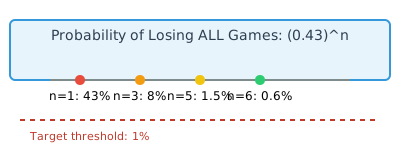
Instead of jumping straight to logarithms, let's build intuition by tracking how the probability of a complete losing streak decreases as we play more games.
Step 1 — Calculate successive losing streak probabilities
Let's compute (0.43)^n for increasing values of n:
Step 2 — Find where we cross the threshold
We need the losing streak probability to drop below 1% (so that the winning probability exceeds 99%). Looking at our calculations:
- After 5 games: P(all losses) = 1.5% > 1%, so P(at least one win) = 98.5% < 99%
- After 6 games: P(all losses) = 0.6% < 1%, so P(at least one win) = 99.4% > 99%
Step 3 — Conclusion
Six games is the minimum needed to guarantee better than 99% chance of at least one win.
Verification
Let's verify our answer by calculating the exact probabilities for 5 and 6 games:
Perfect! With 5 games, Anuhab has a 98.53% chance (not quite 99%), but with 6 games, he has a 99.37% chance, which exceeds our target.
Common Pitfalls
Mistake 1: Trying to add individual probabilities
This is wrong because probabilities don't add linearly when dealing with "at least one" scenarios. You can't have more than 100% probability, and this approach ignores the overlap between different winning scenarios.
Mistake 2: Using the wrong complement
The complement of "at least one win" is "zero wins" (all losses), not "exactly one loss." The correct complement is 1 - P(all losses) = 1 - (0.43)^n.
Mistake 3: Forgetting to flip the inequality sign
Since ln(0.43) is negative, dividing both sides by it flips the inequality direction. The correct result is n > ln(0.01) / ln(0.43), giving us the minimum number of games needed.
The Underlying Pattern
This problem exemplifies the general formula for "at least one success" problems:
where p is the probability of success on each individual trial.
To find the minimum trials needed for a target probability T:
In our problem: p = 0.57, T = 0.99, so n > ln(0.01) / ln(0.43) = 5.46, requiring 6 games.
Where This Shows Up in Real Life
- Medical testing: How many times should you repeat a test with 85% accuracy to be 99% confident of catching a condition?
- Quality control: If a manufacturing process has a 5% defect rate, how many items should you sample to be 95% sure of finding at least one defect?
- Network reliability: If each server has a 98% uptime, how many backup servers do you need to guarantee 99.9% system availability?
Recognizing This Problem Type
Watch for these telltale phrases that signal a complement probability problem:
- "At least one..." — usually best solved with 1 minus the probability of zero
- "What's the minimum number of trials..." — signals an inequality setup
- "Greater than X% chance" — you'll need to solve an inequality, not just calculate an exact probability
- Individual success probability + multiple trials — geometric probability with the complement rule
The structure is always: individual probability → repeated trials → "at least one" → complement rule → logarithmic inequality.
Four "What-If?" Problems
We need: 1 - (0.43)^n > 0.999, which gives us (0.43)^n < 0.001
n > ln(0.001) / ln(0.43) = (-6.908) / (-0.844) = 8.18
9 games are needed for 99.9% confidence
With 9 games: P(at least one win) = 1 - (0.43)^9 = 1 - 0.0004 = 99.96% > 99.9% ✓
Let p be Anuhab's win probability. Then: 1 - (1-p)^8 = 0.99
(1-p)^8 = 0.01
1-p = (0.01)^(1/8) = 0.6310
p = 1 - 0.6310 = 0.369 = 36.9%
With p = 0.369: 1 - (0.631)^8 = 1 - 0.01 = 99% ✓
P(at least 2) = 1 - P(0 wins) - P(exactly 1 win)
P(0 wins) = (0.43)^nP(exactly 1 win) = n × (0.57) × (0.43)^(n-1)
For n=5: P(0) = 0.0147, P(1) = 0.0692P(at least 2) = 1 - 0.0147 - 0.0692 = 0.916 = 91.6%
For n=4: P(at least 2) = 87.4% < 90%
5 games needed for >90% chance of at least 2 wins
P(correct) = 1/4 = 0.25P(wrong) = 3/4 = 0.75
1 - (0.75)^n > 0.99(0.75)^n < 0.01
n > ln(0.01) / ln(0.75) = (-4.605) / (-0.288) = 16.0
16 questions are needed
With 16 questions: P(at least one right) = 1 - (0.75)^16 = 1 - 0.0100 = 99.0% ✓
Frequently Asked Questions
2026-05-25