




Approximating Instantaneous Velocity with Average Velocity
What You Will Learn
- How to calculate average velocity using the difference quotient formula
- The relationship between average velocity and instantaneous velocity
- How decreasing time intervals approximate derivatives in calculus
- Pattern recognition for limit behavior in rate problems
- The fundamental concept behind differential calculus
Visualizing the Problem
Let's see what's happening graphically as we calculate average velocity over smaller and smaller intervals:
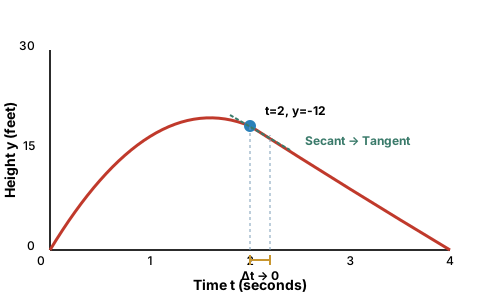
As the time interval Δt shrinks, the secant line connecting two points on the curve approaches the tangent line at t=2. The slope of this tangent line is the instantaneous velocity.
Solution: Method 1 — Direct Difference Quotient Calculation
Average velocity over an interval is the change in position divided by the change in time. We'll use the formula:
Step 1 — Calculate the starting position at t=2
First, let's find the ball's height when t = 2 seconds:
y(2) = 56 - 17(4)
y(2) = 56 - 68 = -12 feet
The negative height means the ball has already hit the ground and would be below the launch point.
Step 2 — Set up the general formula for y(2+Δt)
For any small time interval Δt, the height at time 2+Δt is:
= 56 + 28Δt - 17(4 + 4Δt + Δt²)
= 56 + 28Δt - 68 - 68Δt - 17Δt²
= -12 - 40Δt - 17Δt²
Step 3 — Calculate the change in position
The change in height over the interval is:
= -40Δt - 17Δt²
Step 4 — Apply the average velocity formula
Average velocity equals the change in position divided by the time interval:
= -40 - 17Δt
Step 5 — Calculate for each time interval
Now we substitute each given value of Δt:
| Time Interval (Δt) | Calculation | Average Velocity (ft/s) |
|---|---|---|
| 0.01s | -40 - 17(0.01) = -40 - 0.17 | -40.17 |
| 0.005s | -40 - 17(0.005) = -40 - 0.085 | -40.085 |
| 0.002s | -40 - 17(0.002) = -40 - 0.034 | -40.034 |
| 0.001s | -40 - 17(0.001) = -40 - 0.017 | -40.017 |
Solution: Method 2 — Velocity Function Approach
Instead of computing each average velocity separately, we can derive the instantaneous velocity function and compare our results to what calculus predicts.
Step 1 — Find the velocity function
The velocity function is the derivative of the position function:
v(t) = dy/dt = 28 - 34t
Step 2 — Calculate instantaneous velocity at t=2
The instantaneous velocity at t = 2 is:
Step 3 — Compare with our average velocities
Notice that as Δt approaches 0, our average velocity calculations approach -40 ft/s:
• Δt = 0.01s → Average velocity = -40.17 ft/s
• Δt = 0.005s → Average velocity = -40.085 ft/s
• Δt = 0.002s → Average velocity = -40.034 ft/s
• Δt = 0.001s → Average velocity = -40.017 ft/s
• As Δt → 0 → Instantaneous velocity = -40 ft/s
This demonstrates the fundamental theorem of calculus: the derivative is the limit of the difference quotient.
For Δt = 0.01s: -40.17 ft/s
For Δt = 0.005s: -40.085 ft/s
For Δt = 0.002s: -40.034 ft/s
For Δt = 0.001s: -40.017 ft/s
These approach the instantaneous velocity of -40 ft/s at t=2
Verification
Let's verify one of our calculations by computing the average velocity for Δt = 0.01s from scratch:
y(2.01) = 28(2.01) - 17(2.01)²
= 56.28 - 17(4.0401)
= 56.28 - 68.6817 = -12.4017 ft
Average velocity = (-12.4017 - (-12)) / 0.01
= -0.4017 / 0.01 = -40.17 ft/s ✓
We can also verify using our simplified formula -40 - 17Δt:
The Broader Principle
This problem illustrates the fundamental concept of derivatives in calculus. For any position function y = f(t), the instantaneous velocity at time t = a is:
The general pattern for our specific function y = 28t - 17t² gives us the average velocity formula:
As Δt approaches zero, this becomes the instantaneous velocity v(a) = 28 - 34a, which is exactly the derivative of our position function.
Watch Out For These
(2+Δt)² = 4 + 4Δt + Δt², NOT 4 + 2Δt + Δt²Students often forget the middle term should be
2·2·Δt = 4Δt.
When
y(2) = -12, calculating y(2+Δt) - y(2) requires careful attention to signs.(-12 - 40Δt - 17Δt²) - (-12) = -40Δt - 17Δt², not -40Δt - 17Δt² - 24The expression
(-40Δt - 17Δt²) / Δt simplifies to -40 - 17Δt.Don't leave it as a complex fraction—factor first, then divide.
At t=2, the ball is moving downward, so negative velocity is correct.
Don't assume velocity must be positive—direction matters in physics!
Does This Seem Reasonable?
Let's check if our answers make physical sense by examining the motion:
| Time Point | Height y(t) | Physical Meaning |
|---|---|---|
| t = 0 | y(0) = 0 ft | Ball starts at ground level |
| t = 28/34 ≈ 0.82s | Maximum height ≈ 11.5 ft | Ball reaches peak (v = 0) |
| t = 28/17 ≈ 1.65s | y ≈ 0 ft | Ball returns to ground |
| t = 2s | y = -12 ft | Ball is 12 ft below launch point |
At t=2 seconds, the ball has been falling for about 0.35 seconds after hitting the ground. The increasingly negative velocity (approaching -40 ft/s) makes sense because:
- Gravity on this alien planet accelerates objects at 34 ft/s² downward
- The ball has been accelerating downward for over a second
- An instantaneous velocity of -40 ft/s at t=2 means the ball is moving quite fast downward
Real Applications
- Space Mission Planning: Engineers calculate velocity changes for spacecraft using similar difference quotient methods when planning orbital maneuvers around planets with different gravitational fields.
- Sports Analytics: High-speed cameras track projectile motion of balls, and instantaneous velocity calculations help optimize throwing angles and release points for maximum distance.
- Earthquake Seismology: Geologists analyze ground motion data using velocity calculations to determine the intensity and direction of seismic waves, helping predict structural damage.
What Comes After This
This problem is your introduction to differential calculus. The next level includes:
- Formal Limits: Learning rigorous ε-δ definitions and limit laws to prove that derivatives exist
- Related Rates: When the position function involves multiple changing variables (like wind resistance proportional to velocity squared)
- Optimization: Finding maximum height, minimum time problems using derivative techniques
Try this harder version: A projectile's height is given by y = 30t - 16t² + kt³, where k represents air resistance. For what value of k does the projectile have zero acceleration at t = 1 second?
What If?
y(1) = 28(1) - 17(1)² = 28 - 17 = 11 feet
y(1+Δt) = 28(1+Δt) - 17(1+Δt)² = 28 + 28Δt - 17(1 + 2Δt + Δt²) = 28 + 28Δt - 17 - 34Δt - 17Δt² = 11 - 6Δt - 17Δt²
Average velocity = [y(1+Δt) - y(1)]/Δt = [(11 - 6Δt - 17Δt²) - 11]/Δt = (-6Δt - 17Δt²)/Δt = -6 - 17Δt
Δt = 0.01s: -6 - 17(0.01) = -6.17 ft/s
Δt = 0.005s: -6 - 17(0.005) = -6.085 ft/s
Δt = 0.002s: -6 - 17(0.002) = -6.034 ft/s
Δt = 0.001s: -6 - 17(0.001) = -6.017 ft/s
Instantaneous velocity: v(1) = 28 - 34(1) = -6 ft/s. Our average velocities approach this value as Δt → 0.
Answer: -6.17, -6.085, -6.034, -6.017 ft/s respectively, approaching instantaneous velocity of -6 ft/s.
Maximum height occurs when v(t) = 0. Using v(t) = 28 - 34t:28 - 34t = 0t = 28/34 = 14/17 ≈ 0.824 seconds
y(14/17) = 28(14/17) - 17(14/17)²= 28(14/17) - 17(196/289)= 392/17 - 17(196/289)= 392/17 - 196/17 = 196/17 ≈ 11.53 feet
At maximum height, v(14/17) = 28 - 34(14/17) = 28 - 28 = 0 ft/s, confirming our calculation.
The ball reaches its peak after about 0.824 seconds at a height of approximately 11.53 feet, then begins falling back down.
Answer: Maximum height of 196/17 ≈ 11.53 feet occurs at t = 14/17 ≈ 0.824 seconds, with instantaneous velocity of 0 ft/s.
For y = 28t - 16t², the velocity function is v(t) = 28 - 32t
y(2) = 28(2) - 16(4) = 56 - 64 = -8 feet
y(2+Δt) = 28(2+Δt) - 16(2+Δt)² = -8 - 32Δt - 16Δt²
Average velocity = (-32Δt - 16Δt²)/Δt = -32 - 16Δt
Δt = 0.01s: -32 - 16(0.01) = -32.16 ft/s
Δt = 0.005s: -32 - 16(0.005) = -32.08 ft/s
Δt = 0.002s: -32 - 16(0.002) = -32.032 ft/s
Δt = 0.001s: -32 - 16(0.001) = -32.016 ft/s
Earth's instantaneous velocity at t=2 is v(2) = -32 ft/s vs. -40 ft/s on the alien planet. The alien planet has stronger gravity (34 ft/s² vs. 32 ft/s²).
Answer: Earth velocities are -32.16, -32.08, -32.032, -32.016 ft/s, approaching -32 ft/s (less negative than the alien planet due to weaker gravity).
We know that average velocity = -40 - 17Δt from our original problem.
-40.1 = -40 - 17Δt-0.1 = -17ΔtΔt = 0.1/17 ≈ 0.00588 seconds
-40.01 = -40 - 17Δt-0.01 = -17ΔtΔt = 0.01/17 ≈ 0.000588 seconds
Check: -40 - 17(0.1/17) = -40 - 0.1 = -40.1 ✓
Check: -40 - 17(0.01/17) = -40 - 0.01 = -40.01 ✓
As we require average velocity closer to the instantaneous value (-40 ft/s), the time interval must become smaller, demonstrating the limit process.
Answer: For average velocity -40.1 ft/s: Δt ≈ 0.00588s. For average velocity -40.01 ft/s: Δt ≈ 0.000588s.
Frequently Asked Questions
2026-10-17