




Finding Current Speed: Boat Distance-Rate-Time Problem
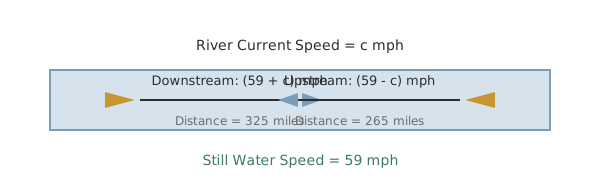
Skills This Problem Builds
- Setting up equations when two different trips take equal time
- Understanding how current affects effective speed (addition downstream, subtraction upstream)
- Cross-multiplying rational equations and solving linear systems
- Recognizing the distance-rate-time relationship in motion problems
- Checking answers by verifying that calculated times are actually equal
Solution: Method 1 — The Equal Time Setup
The key insight is that both trips take the same amount of time. Since time = distance ÷ rate, we can write two time expressions and set them equal.
Step 1 — Define the variables and effective speeds
Let c = the speed of the current in mph. When the boat travels with the current, its effective speed is 59 + c mph. When traveling against the current, its effective speed is 59 - c mph.
Step 2 — Write expressions for the travel times
Using the formula time = distance ÷ rate:
Time downstream = 325/(59 + c)Time upstream = 265/(59 - c)Step 3 — Set the times equal
Since the problem states both trips take the same amount of time:
325/(59 + c) = 265/(59 - c)Step 4 — Cross multiply to eliminate the fractions
Cross multiplying gives us:
325(59 - c) = 265(59 + c)Step 5 — Expand both sides
Distributing on both sides:
325 × 59 - 325c = 265 × 59 + 265c19,175 - 325c = 15,635 + 265cStep 6 — Solve for c
Collect like terms by adding 325c to both sides and subtracting 15,635 from both sides:
19,175 - 15,635 = 265c + 325c3,540 = 590cc = 3,540 ÷ 590 = 6Solution: Method 2 — Fractional Form Analysis
Instead of cross-multiplying immediately, we can rearrange the equation to see the relationship more clearly.
Step 1 — Start with the time equality
325/(59 + c) = 265/(59 - c)Step 2 — Take reciprocals of both sides
This gives us the rates in terms of time:
(59 + c)/325 = (59 - c)/265Step 3 — Cross multiply this form
265(59 + c) = 325(59 - c)Step 4 — Expand and solve
Expanding:
265 × 59 + 265c = 325 × 59 - 325c15,635 + 265c = 19,175 - 325c590c = 19,175 - 15,635 = 3,540c = 6This confirms our answer: the current speed is 6 mph.
Verification
Let's check that both trips actually take the same time when the current speed is 6 mph:
Downstream trip:
Speed = 59 + 6 = 65 mphTime = 325 ÷ 65 = 5 hoursUpstream trip:
Speed = 59 - 6 = 53 mphTime = 265 ÷ 53 = 5 hours✓ Both trips take exactly 5 hours, confirming our answer is correct.
Common Pitfalls
Some students write downstream speed as
59 + c and upstream speed as 59 + c as well, forgetting that current opposes upstream motion. The upstream speed must be 59 - c.
Writing
325 = 265 because "they travel for the same time." The distances are different—it's the times that are equal, leading to 325/(59+c) = 265/(59-c).
Getting the wrong products when expanding
325(59-c) and 265(59+c). Double-check: 325 × 59 = 19,175 and 265 × 59 = 15,635.
The Pattern Behind This
This problem follows the general current/wind pattern:
If two trips take equal time:distance_with/(speed_still + current) = distance_against/(speed_still - current)Cross multiplying always gives:
distance_with × (speed_still - current) = distance_against × (speed_still + current)This structure appears in airplane wind problems, river current problems, and even escalator problems. The key is recognizing that one force helps motion while the same force opposes it in the opposite direction.
Reality Check
Our answer of 6 mph for the current speed makes intuitive sense. The boat travels farther downstream (325 vs 265 miles) in the same time, which requires the downstream speed to be higher. With a 6 mph current:
- Downstream speed: 65 mph (about 10% faster than still water)
- Upstream speed: 53 mph (about 10% slower than still water)
- Distance ratio: 325/265 ≈ 1.23, Speed ratio: 65/53 ≈ 1.23 ✓
The proportional increase in distance matches the proportional increase in speed, which is exactly what we'd expect for equal time periods.
Extend Your Thinking
From the original problem, the current speed is 6 mph.
Downstream speed = 59 + 6 = 65 mph
Time = 325 ÷ 65 = 5 hours
Upstream speed = 59 - 6 = 53 mph
Time = 265 ÷ 53 = 5 hours
Each trip takes 5 hours.
Let b = boat speed in still water360/(b + 4) = 280/(b - 4)
360(b - 4) = 280(b + 4)
360b - 1440 = 280b + 112080b = 2560b = 32
Downstream: 360 ÷ 36 = 10 hours
Upstream: 280 ÷ 28 = 10 hours ✓
The boat's speed in still water is 32 mph.
Time downstream = 120/(45 + c)
Time upstream = 120/(45 - c)
Total time = 5.5 hours
120/(45 + c) + 120/(45 - c) = 5.5
[120(45 - c) + 120(45 + c)]/[(45 + c)(45 - c)] = 5.5[5400 - 120c + 5400 + 120c]/(2025 - c²) = 5.510800/(2025 - c²) = 5.5
10800 = 5.5(2025 - c²)10800 = 11137.5 - 5.5c²5.5c² = 337.5c² = 61.36c = 7.84 ≈ 8 mph
The current speed is approximately 8 mph.
Let w = wind speed500/(150 + w) + 400/(150 - w) = 6
[500(150 - w) + 400(150 + w)]/[(150 + w)(150 - w)] = 6[75000 - 500w + 60000 + 400w]/(22500 - w²) = 6[135000 - 100w]/(22500 - w²) = 6
135000 - 100w = 6(22500 - w²)135000 - 100w = 135000 - 6w²6w² - 100w = 02w(3w - 50) = 0
w = 0 or w = 50/3 ≈ 16.67
Since we need wind, w = 16.67 mph
The wind speed is approximately 16.7 mph.
Frequently Asked Questions
2026-08-26