




Using Radioactive Decay to Estimate Age: Carbon-14 Dating
What This Problem Teaches
- How to apply the exponential decay formula to real archaeological dating
- Using logarithms to solve for time when the exponent is unknown
- Converting between percentages and decimal ratios in scientific calculations
- Understanding half-life as a measurable decay constant
- Interpreting exponential models in terms of successive halvings
Visualizing the Decay
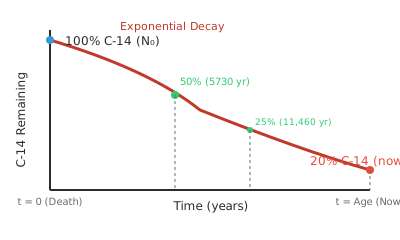
The skull contains 20% of its original carbon-14, placing it between 2 and 3 half-lives old.
Solution: Method 1 — The Exponential Decay Formula
Radioactive decay follows a predictable exponential pattern. We'll use the standard decay formula and solve for time using logarithms.
Step 1 — Set up the exponential decay formula
The amount of a radioactive substance remaining after time t is given by:
Where N₀ is the original amount, t is time elapsed, and T is the half-life.
Step 2 — Substitute the known values
We know that N(t)/N₀ = 0.20 (20% remains) and the half-life T = 5730 years:
Step 3 — Take the natural logarithm of both sides
To solve for the exponent, we apply the natural logarithm to both sides:
ln(0.20) = (t/5730) × ln(1/2)
Step 4 — Solve for t
Isolate t by multiplying both sides by 5730 and dividing by ln(1/2):
t = 5730 × (-1.609)/(-0.693)
t = 5730 × 2.322
t ≈ 13,307 years
Step 5 — Round to the nearest thousand
Since we're estimating to the nearest thousand years:
Solution: Method 2 — The Half-Life Counting Approach
Instead of using logarithms, we can think about how many half-lives it takes to reach 20% and estimate from there.
Step 1 — Track the successive halvings
Starting with 100% carbon-14, each half-life reduces the amount by half:
After 1 half-life (5,730 years): 50%
After 2 half-lives (11,460 years): 25%
After 3 half-lives (17,190 years): 12.5%
Step 2 — Locate 20% between half-life markers
Since 20% falls between 25% (2 half-lives) and 12.5% (3 half-lives), the skull's age is between 11,460 and 17,190 years.
Step 3 — Estimate more precisely
20% is closer to 25% than to 12.5%. It's about 20% of the way from 25% down to 12.5%:
Age ≈ 2.32 half-lives × 5730 years ≈ 13,300 years
Step 4 — Round to nearest thousand
This gives us the same result: approximately 13,000 years.
Verification
Let's check our answer by substituting back into the decay formula:
= (1/2)^2.27
= 0.208 ≈ 0.21
This gives us about 21%, which is very close to the stated 20%. The small difference comes from our rounding to the nearest thousand years. ✓
Common Pitfalls
Writing N(t) = N₀ × (2)^(t/5730) instead of (1/2)^(t/5730). This would show growth, not decay. Remember: each half-life cuts the amount in half, so we multiply by 1/2, not 2.
Thinking that "20% remaining" means "80% decay rate per year." The 20% is what's left total after all the time has passed, not an annual rate. Don't use 0.80 as a yearly multiplier.
Writing t = ln(0.20)/ln(0.5) and omitting the factor of 5730. The exponent in the original formula is t/5730, so when you solve for that entire expression, you must multiply by 5730 to get t alone.
The Underlying Pattern
The general formula for any radioactive decay problem is:
Where N/N₀ is the fraction remaining, and T is the half-life of the substance.
Since ln(1/2) = -ln(2), this can also be written as:
This second form is sometimes easier to use because N₀/N represents "how many times larger the original amount was" — which feels more intuitive than working with fractions less than 1.
Where This Shows Up in Real Life
- Archaeological dating: Museums and research institutions use carbon-14 dating to determine the age of organic artifacts, bones, and wood samples up to about 50,000 years old.
- Nuclear medicine: Doctors use similar decay calculations to determine proper dosing schedules for radioactive treatments and to track how long radioactive tracers remain in patients' bodies.
- Nuclear power: Engineers use decay formulas to predict when nuclear waste will reach safe levels and to calculate fuel rod replacement schedules in reactors.
What If?
Using N(t) = N₀(1/2)^(t/5730), we substitute N(t)/N₀ = 0.08:
0.08 = (1/2)^(t/5730)
ln(0.08) = (t/5730) × ln(0.5)
-2.526 = (t/5730) × (-0.693)
t = 5730 × (-2.526)/(-0.693)
t = 5730 × 3.645 = 20,886 years
Answer: 21,000 years
Check: (1/2)^(21000/5730) = (1/2)^3.67 ≈ 0.079 ≈ 8% ✓
We know t = 18,000 years and want to find N(t)/N₀:
N(t)/N₀ = (1/2)^(18000/5730)
18,000 ÷ 5730 = 3.14 half-lives
(1/2)^3.14 = 0.114
Answer: 11.4% of the original carbon-14 remains
This makes sense: after 3 full half-lives (17,190 years), only 12.5% would remain, so 11.4% at 18,000 years is reasonable.
Using T = 1.25 billion years = 1,250,000,000 years:
0.15 = (1/2)^(t/1,250,000,000)
ln(0.15) = (t/1,250,000,000) × ln(0.5)
-1.897 = (t/1,250,000,000) × (-0.693)
t = 1,250,000,000 × (-1.897)/(-0.693)
t = 1,250,000,000 × 2.737 = 3,421,250,000 years
Answer: 3.4 billion years old
This is reasonable for very ancient rocks — some Earth samples are indeed this old.
We already calculated this: approximately 13,300 years old.
For 12% remaining: 0.12 = (1/2)^(t/5730)
t = 5730 × ln(0.12)/ln(0.5) = 5730 × 3.05 = 17,477 years
Skull B age - Skull A age = 17,477 - 13,307 = 4,170 years
Skull B is approximately 4,200 years older than Skull A
This makes archaeological sense — the deeper or older layer would have less C-14 remaining.
Frequently Asked Questions
2026-08-14