




Pediatric IV Furosemide Dosing: Safe Range Calculation
What This Problem Teaches
- Converting weight-based dosing ranges (mg/kg/day) into specific daily dose limits
- Understanding medication frequency notation (q12h, q8h) and calculating total daily doses
- Applying dimensional analysis with units of mass, time, and frequency
- Clinical decision-making for pediatric medication safety
- Systematic verification of prescribed orders against established safety parameters
Visualizing the Problem
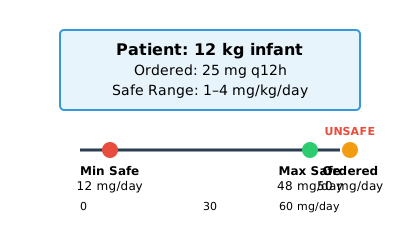
Let's create a visual representation showing the patient parameters and safe dosing range:
Solution: Method 1 — Daily Dose Range Verification
When evaluating pediatric medication safety, we calculate the safe daily dose range first, then compare the ordered total against those limits.
Step 1 — Calculate the minimum safe daily dose
The safe range starts at 1 mg/kg/day. For our 12 kg patient:
Step 2 — Calculate the maximum safe daily dose
The upper limit of the safe range is 4 mg/kg/day:
Step 3 — Convert the ordered frequency to daily total
The order is for 25 mg q12h (every 12 hours). In a 24-hour day:
Ordered daily dose = 25 mg/dose × 2 doses/day = 50 mg/day
Step 4 — Compare ordered dose against safe range
Now we can evaluate the safety of the order:
Ordered dose: 50 mg/day
50 mg/day > 48 mg/day → UNSAFE (exceeds maximum)
| Dose Type | Calculation | Result | Status |
|---|---|---|---|
| Minimum Safe | 1 mg/kg/day × 12 kg | 12 mg/day | ✓ Safe lower bound |
| Maximum Safe | 4 mg/kg/day × 12 kg | 48 mg/day | ✓ Safe upper bound |
| Ordered Dose | 25 mg × 2 doses/day | 50 mg/day | ✗ UNSAFE - Overdose |
Solution: Method 2 — Per-Dose Safety Validation
Alternatively, we can work backwards from the ordered frequency to find the safe single-dose range, then check if 25 mg fits within it.
Step 1 — Establish the safe daily range
From the previous method, we know the safe daily range is 12–48 mg/day.
Step 2 — Convert daily range to per-dose range for q12h dosing
Since q12h means 2 doses per day, each individual dose should be:
Maximum per-dose = 48 mg/day ÷ 2 doses/day = 24 mg/dose
Step 3 — Evaluate the ordered single dose
The order calls for 25 mg per dose:
Ordered per-dose: 25 mg/dose
25 mg > 24 mg → UNSAFE (exceeds maximum single dose)
Step 4 — Verify frequency constraint
The safe dosing guidelines also specify "every 6–12 hours." The ordered q12h frequency is acceptable (12 hours is within the 6–12 hour range), but the dose amount is too high.
Verification
Let's double-check our calculations by working through the unit conversions step-by-step:
Maximum: 4 mg/kg/day × 12 kg = 48 mg/day ✓
Ordered: 25 mg/dose × (24 hours/day ÷ 12 hours/dose) = 25 mg/dose × 2 doses/day = 50 mg/day ✓
We can also verify using the per-dose approach:
Ordered per-dose = 25 mg/dose
25 mg/dose > 24 mg/dose → Confirms unsafe status ✓
Critical Safety Considerations
Watch Out For These
Some students compare 25 mg directly to the 1–4 mg/kg range without accounting for frequency. The 1–4 mg/kg is per day, not per dose.
q12h means every 12 hours, which is 2 doses per 24-hour day, not 12 doses per day. Getting this wrong leads to massive undercalculation of the daily total.
Forgetting to multiply by the patient's weight in kg. The safe range is 1–4 mg/kg/day, but this must be scaled by the 12 kg weight to get the actual mg/day limits for this specific patient.
In nursing and medical practice, exceeding safe dose ranges is never acceptable, even by small amounts. A 2 mg/day overage may seem minor mathematically, but represents a 4% overdose that could cause harm to an infant.
Recognizing This Problem Type
You'll encounter pediatric dosing calculations whenever you see these elements together:
- Weight-based dosing: "mg/kg/day" or "mcg/kg/dose" in the safety range
- Frequency notation: q6h, q8h, q12h, BID, TID, QID
- Patient weight: Given in kg (especially important for pediatric patients)
- Safety verification: "Is this dose safe?" or "Within safe range?"
This calculation pattern appears across nursing fundamentals, pharmacology courses, and the NCLEX exam. The same structure applies whether you're working with furosemide, acetaminophen, antibiotics, or any weight-based medication.
Real-World Applications
Nursing Practice: Every pediatric medication order requires this verification before administration. Nurses are legally responsible for catching unsafe doses.
Pharmacy: Pharmacists perform these calculations when dispensing pediatric medications and may need to contact prescribers about unsafe orders.
Emergency Medicine: Weight-based dosing is critical for drugs like epinephrine, where rapid calculation under pressure can be life-saving.
The Underlying Pattern
All pediatric weight-based dosing follows the same structure:
Ordered Daily Dose = Single Dose × (24 hours ÷ Dosing Interval)
Safety Check = Is Ordered Daily Dose within Daily Dose Range?
This pattern works for any medication with weight-based dosing guidelines. The key insight is recognizing when you need to convert between per-dose and per-day amounts, and ensuring your units match when making comparisons.
For continuous infusions, the pattern extends to include rate calculations, but the same dimensional analysis principles apply.
What If?
For a 12 kg infant: Min = 1 × 12 = 12 mg/day, Max = 4 × 12 = 48 mg/day
q8h means every 8 hours: 24 hours ÷ 8 hours = 3 doses/day
Ordered daily dose = 15 mg/dose × 3 doses/day = 45 mg/day
Safe range: 12–48 mg/day
Ordered: 45 mg/day
Since 12 ≤ 45 ≤ 48, this order is SAFE
Guidelines allow dosing every 6–12 hours. q8h (every 8 hours) falls within this range, so the frequency is also appropriate.
From our safe range: 4 mg/kg/day × 12 kg = 48 mg/day maximum
q6h means every 6 hours: 24 hours ÷ 6 hours = 4 doses/day
Maximum per-dose = 48 mg/day ÷ 4 doses/day = 12 mg/dose
q6h (every 6 hours) is at the lower limit of the acceptable 6–12 hour range, so this frequency is appropriate for more frequent, smaller doses.
Maximum safe dose = 12 mg q6h
q12h means 2 doses per day: 30 mg/dose × 2 doses/day = 60 mg/day
If this is exactly the maximum safe dose:4 mg/kg/day × Weight = 60 mg/day
Weight = 60 mg/day ÷ 4 mg/kg/day = 15 kg
For a 15 kg patient:
Min safe = 1 × 15 = 15 mg/day
Max safe = 4 × 15 = 60 mg/day
Ordered = 60 mg/day ✓
Patient weight = 15 kg
For 12 kg infant: 12–48 mg/day is safe
q12h = 2 doses per day
Min per-dose = 12 mg/day ÷ 2 = 6 mg/dose
Max per-dose = 48 mg/day ÷ 2 = 24 mg/dose
Midpoint = (6 mg + 24 mg) ÷ 2 = 15 mg/dose
Proposed order: 15 mg q12h
Daily dose = 15 mg × 2 = 30 mg/day
Check: 12 ≤ 30 ≤ 48 ✓ Safe
Safe per-dose range: 6–24 mg q12h
Corrected order: Furosemide 15 mg IV q12h
Frequently Asked Questions
Multiply the patient's weight in kg by the dosing range in mg/kg/day. For a 12 kg infant with a safe range of 1-4 mg/kg/day: minimum = 1 × 12 = 12 mg/day, maximum = 4 × 12 = 48 mg/day. Then compare the ordered total daily dose against this range.
q12h means "every 12 hours" in medical notation. This results in 2 doses per day (24 hours ÷ 12 hours = 2). So a 25 mg q12h order gives a total daily dose of 25 mg × 2 = 50 mg/day.
Children's doses are weight-based and have narrow safety margins. A calculation error can quickly lead to dangerous overdosing or ineffective underdosing. In this problem, the ordered 50 mg/day exceeds the 48 mg/day maximum for a 12 kg infant, making it unsafe.
2026-08-18