




Conditional Probability: Interview Order Problem
Four current employees and seven noncurrent employees are waiting to be interviewed for jobs. If they are all selected in random order, find the probability that no current employee will be interviewed until at least two noncurrent employees have been interviewed.
What You Will Learn
- Constraint translation: Converting complex conditional language into precise mathematical conditions
- Sequential probability: Using permutations to analyze ordered arrangements with positional restrictions
- Combinatorial reasoning: Breaking complex counting problems into manageable pieces
- Probability verification: Checking answers using logical bounds and alternative approaches
- Language precision: Distinguishing "until at least" from "until exactly" in probability contexts
Visualizing the Problem
Let's represent the interview queue to understand what we're looking for:
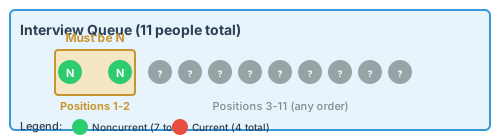
The condition "no current employee interviewed until at least two noncurrent employees" means positions 1 and 2 must both be filled by noncurrent employees. After that, any arrangement is allowed.
Solution: Method 1 — Direct Favorable Sequence Counting
Step 1 — Translate the constraint precisely
The phrase "no current employee will be interviewed until at least two noncurrent employees have been interviewed" means that the first current employee cannot appear in position 1 or position 2. This is equivalent to saying: both positions 1 and 2 must be filled by noncurrent employees.
Step 2 — Count total possible arrangements
We have 11 people total (4 current + 7 noncurrent) being arranged in a line. The total number of possible interview orders is:
Step 3 — Count favorable arrangements
For arrangements that satisfy our condition, we need:
- Position 1: Must be one of the 7 noncurrent employees
- Position 2: Must be one of the remaining 6 noncurrent employees
- Positions 3-11: Can be any arrangement of the remaining 9 people
We count this step by step:
Step 4 — Calculate the probability
The probability is the ratio of favorable to total arrangements:
Step 5 — Simplify the fraction
We can reduce this fraction by finding the GCD of 42 and 110:
Solution: Method 2 — Conditional Probability Approach
We can also think of this as selecting people one at a time, where we need specific outcomes for the first two selections.
Step 1 — Probability the first person is noncurrent
Initially, we have 7 noncurrent and 4 current employees (11 total):
Step 2 — Probability the second person is also noncurrent
Given that the first person selected was noncurrent, we now have 6 noncurrent and 4 current employees remaining (10 total):
Step 3 — Apply the multiplication principle
Since we need both events to occur, we multiply the probabilities:
This confirms our answer from Method 1. The remaining 9 positions can be filled in any order without affecting our condition, so we don't need to consider them.
Verification
Let's verify our answer makes sense by checking it against logical bounds:
Boundary checks
- Upper bound: If we only needed 1 noncurrent employee first, the probability would be 7/11 ≈ 0.636
- Our answer: 21/55 ≈ 0.382, which is less than 7/11 ✓
- Lower bound: If we needed all 7 noncurrent employees first, the probability would be much smaller
Alternative calculation check
Using our combinatorial method:
Decimal verification
Converting to decimal: 21 ÷ 55 = 0.381818... ≈ 0.382 ✓
The answer is reasonable—requiring two specific types in the first two positions should be less likely than requiring just one, but not extremely rare.
Watch Out For These
Wrong thinking: "Until at least two noncurrent" means we need exactly 2 noncurrent employees before any current employee.
Why it's wrong: "At least two" means 2 or more. The condition is satisfied as soon as 2 noncurrent employees are interviewed, regardless of what happens after position 2.
Wrong calculation: C(7,2) × C(9,9) / C(11,11) or similar combination-based approach.
Why it's wrong: Interview order matters! Selecting person A then person B for positions 1-2 is different from selecting person B then person A. We need P(7,2) = 7×6, not C(7,2) = 21.
Wrong calculation: Simply calculating (7/11) × (6/10) = 21/55 without considering what this represents.
Why it's misleading: While this gives the right answer, it's important to understand that this works because the constraint only applies to the first two positions. The remaining 9 positions can be in any order.
The Pattern Behind This
This problem belongs to the family of positional constraint problems in combinatorics. The general pattern is:
For our specific case:
- Constrained positions: Positions 1-2 (must be noncurrent)
- Available for constraint: 7 noncurrent employees
- Ways to fill constrained positions: P(7,2) = 7×6 = 42
- Remaining items: 9 people for 9 positions = 9!
- Total arrangements: 11!
The alternative conditional probability approach (Method 2) works here because once we've satisfied the constraint for positions 1-2, the arrangement of remaining positions doesn't matter for our condition.
How to Spot This Problem Type
Look for these telltale signs that signal a positional constraint probability problem:
- "Until at least..." or "before any..." language
- Random ordering or "selected in random order"
- Two distinct groups with constraints on their relative positions
- Sequential selection where order matters
- "No [Type A] until at least [number] of [Type B]"
- "The first [number] people must be [condition]"
- "Before any [Type A] is selected, at least [number] [Type B]"
These problems often appear in contexts involving:
- Job interviews and hiring sequences
- Committee selections with constraints
- Tournament brackets and game sequences
- Quality control and sampling procedures
What-If Problems
Now the first three positions must all be noncurrent employees.
Position 1: 7 choices
Position 2: 6 choices
Position 3: 5 choices
Positions 4-11: 8! arrangements
Favorable = 7 × 6 × 5 × 8! = 210 × 40,320 = 8,467,200
P = (210 × 8!) / 11! = 210 / (11 × 10 × 9) = 210 / 990 = 7/33
7/33 ≈ 0.212, which is less than our original answer of 21/55 ≈ 0.382 ✓
Answer: 7/33 or approximately 0.212
We have 11 people total: 3 current + 8 noncurrent. Same constraint: first two positions must be noncurrent.
Position 1: 8 choices (any noncurrent)
Position 2: 7 choices (remaining noncurrent)
Positions 3-11: 9! arrangements
Favorable = 8 × 7 × 9! = 56 × 362,880 = 20,321,280
P = (56 × 9!) / 11! = 56 / (11 × 10) = 56/110 = 28/55
28/55 ≈ 0.509, which is higher than our original 21/55 ≈ 0.382 because there are more noncurrent employees ✓
Answer: 28/55 or approximately 0.509
For k noncurrent employees first, the probability is:P = [7 × 6 × 5 × ... × (7-k+1) × (11-k)!] / 11!
P = [P(7,k) × (11-k)!] / 11! = P(7,k) / [11 × 10 × ... × (12-k)]
For k = 4: P = P(7,4) / (11 × 10 × 9 × 8) = 840 / 7920 = 7/66
For k = 5: P = P(7,5) / (11 × 10 × 9 × 8 × 7) = 2520 / 55440 = 1/22
For k = 6: P = P(7,6) / (11 × 10 × 9 × 8 × 7 × 6) = 5040 / 332640 = 1/66
We need P = 1/11. Testing k = 7:P = 7! / 11! × 4! = 5040 / (11 × 10 × 9 × 8 × 7 × 6 × 5) = 5040 / 55440 = 1/11 ✓
Answer: k = 7
We need: positions 1-2 are noncurrent, position 3 is current, and this is the first current employee.
Position 1: 7 choices (noncurrent)
Position 2: 6 choices (remaining noncurrent)
Position 3: 4 choices (any current)
Positions 4-11: 8! arrangements (remaining people)
Favorable = 7 × 6 × 4 × 8! = 168 × 40,320 = 6,773,760
P = (168 × 8!) / 11! = 168 / (11 × 10 × 9) = 168 / 990 = 28/165
28/165 ≈ 0.170, which is less than 21/55 ≈ 0.382 because we're adding the constraint that position 3 must be current ✓
Answer: 28/165 or approximately 0.170
Frequently Asked Questions
2026-08-30