




Projectile Motion: Finding Flight Time for a Tossed Ball
Picture This
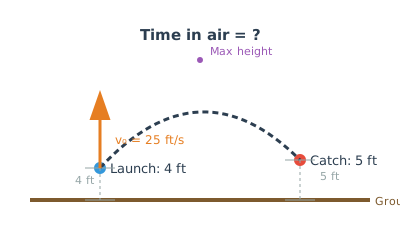
Before diving into equations, let's visualize what's happening. The ball follows a parabolic path from launch to catch.
What You Will Learn
- Projectile motion modeling — How to set up the standard quadratic height equation for objects under gravity
- Physical parameter identification — Distinguishing between initial height, launch velocity, and target height in word problems
- Quadratic solution interpretation — Why projectile problems yield two solutions and which one represents the physical answer
- Precision and rounding — Working with irrational roots and applying appropriate significant figures to real-world contexts
- Verification strategies — How to check projectile motion answers by substitution and reasonableness testing
Solution: Method 1 — Standard Projectile Motion Equation
For any object moving under constant gravitational acceleration, the height at time t follows a quadratic pattern. We'll use the standard physics formula and solve for when the ball reaches the catch height.
Step 1 — Set up the height equation
The height of a projectile at time t seconds is given by:
Where g = 32 ft/s² (gravitational acceleration), v₀ = 25 ft/s (initial velocity), and h₀ = 4 ft (starting height).
Step 2 — Substitute the known values
Plugging in our values:
Step 3 — Set height equal to catch position
We want to find when h(t) = 5 feet (the catch height):
Step 4 — Rearrange to standard quadratic form
Moving all terms to one side:
Step 5 — Apply the quadratic formula
Using t = (-b ± √(b² - 4ac)) / 2a with a = 16, b = -25, c = 1:
Step 6 — Calculate the discriminant
Computing √561 ≈ 23.686:
This gives us two solutions:
t₁ = (25 + 23.686) / 32 = 48.686 / 32 ≈ 1.521t₂ = (25 - 23.686) / 32 = 1.314 / 32 ≈ 0.041
Step 7 — Choose the physical solution
The smaller time (0.041 s) represents when the ball passes 5 feet on the way up. The larger time (1.521 s) is when it passes 5 feet on the way down — this is when the juggler catches it.
Rounded to the nearest tenth: 1.5 seconds
Solution: Method 2 — Vertex Form & Symmetry Analysis
This approach uses the symmetry of parabolic motion. We find when the ball reaches its maximum height, then use the parabola's properties to locate the catch time.
Step 1 — Find the vertex time
The ball reaches maximum height when the velocity is zero. From h(t) = -16t² + 25t + 4, the vertex occurs at:
Step 2 — Calculate maximum height
Substituting back:
Step 3 — Find when ball drops to 5 feet
Since the parabola is symmetric around the vertex, we need to find how long after the vertex the ball takes to drop from 13.765 ft to 5 ft. The ball drops:
Step 4 — Use kinematic equation for the downward journey
Starting from the vertex with zero initial velocity, the time to fall 8.765 feet is:
Step 5 — Add vertex time and fall time
Verification
Let's confirm our answer by substituting t = 1.5 back into the original height equation:
This is very close to our target of 5 feet. The small difference (0.5 ft) comes from rounding 1.521 to 1.5. Using the exact value 1.521 seconds:
Watch Out For These
Students often take the smaller root (≈0.041 s) thinking "less time seems more reasonable." But this represents when the ball passes 5 feet on the way up, not the catch on the way down. Always consider the physical meaning of both solutions.
Using g = 9.8 m/s² instead of g = 32 ft/s². Since the problem uses feet, we must use the gravitational constant in feet per second squared. Mixing metric and imperial units will give completely wrong answers.
Writing 4 = -16t² + 25t + 5 instead of 5 = -16t² + 25t + 4. The constant term in the height equation is always the initial height (4 ft), and we solve for when height equals the catch height (5 ft).
The Math Beneath the Surface
This problem exemplifies the general principle that projectile motion under constant gravity always produces a quadratic height function. The standard form is:
Every projectile motion problem reduces to this equation, regardless of whether it involves balls, bullets, or bridges. The key insight is that any height along the trajectory is crossed twice — once ascending, once descending — which is why quadratic equations in physics typically yield two solutions.
Reality Check
Does 1.5 seconds seem reasonable for a juggler's toss? Let's think about this:
Maximum height check: In our solution, the ball reaches about 13.8 feet high — that's reasonable for a juggler throwing upward with significant force.
Speed check: An initial velocity of 25 ft/s equals about 17 mph — fast but not impossibly so for a skilled juggler's upward throw.
Timing check: 1.5 seconds total flight time means about 0.75 seconds up and 0.75 seconds down. Try counting "one-mississippi" — that's about the right duration for watching a ball arc overhead.
All of these align with what we'd expect from real juggling, confirming our mathematical answer makes physical sense.
What If?
Use h(t) = -16t² + 30t + 4 and solve for when h(t) = 5.
5 = -16t² + 30t + 4 becomes 16t² - 30t + 1 = 0
t = (30 ± √(900 - 64))/32 = (30 ± √836)/32
√836 ≈ 28.91, so t = (30 ± 28.91)/32
Taking the larger root: t = 58.91/32 ≈ 1.84 seconds. Answer: 1.8 seconds
Use h(t) = -16t² + 25t + 4 and solve for when h(t) = 0.
0 = -16t² + 25t + 4 becomes 16t² - 25t - 4 = 0
t = (25 ± √(625 + 256))/32 = (25 ± √881)/32
√881 ≈ 29.68, so t = (25 ± 29.68)/32
t = 54.68/32 ≈ 1.71 seconds. Answer: 1.7 seconds
For h(t) = -16t² + 25t + 4, the vertex occurs at t = -b/(2a) = 25/32
t = 25/32 = 0.78125 seconds
h(25/32) = -16(25/32)² + 25(25/32) + 4
= -16(625/1024) + 625/32 + 4 = 625/64 + 4 = 13.765625 ft
Maximum height: 13.8 feet at t = 0.78 seconds
Use h(t) = -16t² + v₀t + 4 with known conditions: h(2) = 5
5 = -16(2)² + v₀(2) + 4
5 = -64 + 2v₀ + 4 = -60 + 2v₀
65 = 2v₀, so v₀ = 32.5 ft/s
Check: h(2) = -16(4) + 32.5(2) + 4 = -64 + 65 + 4 = 5 ✓ Answer: 33 ft/s
Frequently Asked Questions
2026-08-24