




Chemical Mixture Problem: Blending Two Solutions
What This Problem Teaches
- Setting up systems of equations from real-world constraints
- Understanding the relationship between concentration percentages and actual amounts
- Solving linear systems using substitution or elimination
- Converting between different representations of the same mathematical relationship
- Verifying solutions by checking both volume and concentration requirements
Visualizing the Problem
Let's see what we're mixing and what we want to achieve:
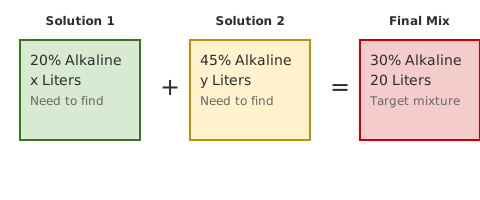
We need to find the values of x and y that satisfy both the volume requirement and the concentration requirement.
Solution: Method 1 — The System of Equations Approach
This is the algebraic foundation for all mixture problems. We'll set up two equations that capture the two constraints we must satisfy.
Step 1 — Define the variables clearly
Let x = liters of the 20% alkaline solution and y = liters of the 45% alkaline solution that we need to mix.
Step 2 — Set up the volume equation
The total volume of our final mixture must be 20 liters. Since we're adding x liters of one solution to y liters of another:
Step 3 — Set up the alkaline content equation
Here's the key insight: the amount of pure alkaline in the final mixture equals the sum of pure alkaline from each solution.
- Pure alkaline from 20% solution:
0.20xliters - Pure alkaline from 45% solution:
0.45yliters - Pure alkaline in final 30% mixture:
0.30 × 20 = 6liters
Step 4 — Solve the system using substitution
From the first equation, we can express y in terms of x:
Substitute this into the alkaline equation:
Step 5 — Solve for x
Distribute and simplify:
-0.25x + 9 = 6
-0.25x = -3
x = 12
Step 6 — Find y
Substitute back to find y:
Solution: Method 2 — The Weighted Average Approach
This method uses the concept of weighted averages and is often faster for mixture problems. The final concentration is a weighted average of the starting concentrations.
Step 1 — Find the distance from target
Calculate how far each starting concentration is from our target of 30%:
- 20% is
30 - 20 = 10percentage points below the target - 45% is
45 - 30 = 15percentage points above the target
Step 2 — Set up the inverse ratio
The amounts needed are in the inverse ratio of these distances. Since 45% is further from 30% than 20% is, we need more of the 20% solution:
Step 3 — Calculate the amounts
With a total of 20 liters and a ratio of 3:2, we have 5 parts total:
- 20% solution:
(3/5) × 20 = 12liters - 45% solution:
(2/5) × 20 = 8liters
Verification
Let's confirm our answer satisfies both constraints:
Volume Check
Concentration Check
Calculate the total pure alkaline:
= 2.4 + 3.6 = 6 liters
Check the final concentration:
Both constraints are satisfied, confirming our solution is correct.
Common Pitfalls
✗ Mistake 1: Averaging the concentrations directly
Students often think: "I want 30%, so I'll average 20% and 45% to get 32.5%. Close enough!" This ignores the fact that you need different amounts of each solution. The average gives you the concentration only if you use equal volumes.
✗ Mistake 2: Using percentages instead of decimals in calculations
Writing 20x + 45y = 30 × 20 instead of 0.20x + 0.45y = 0.30 × 20. This gives 20 times the correct amount of pure alkaline and leads to impossible negative answers.
✗ Mistake 3: Confusing "percentage of total" with "amount of pure ingredient"
Setting up 0.20x + 0.45y = 0.30 × 20 instead of 0.20x + 0.45y = 6. Remember: 30% of 20 liters means 6 liters of pure alkaline, not 0.30 × 20 = 6 in the equation.
The Pattern Behind This
All two-solution mixture problems follow this same structure. For any mixture problem where you want V liters of C% concentration using solutions of A% and B%:
Concentration equation: (A/100)x + (B/100)y = (C/100)V
The weighted average approach gives you the ratio directly:
C is between A and B. You can't mix 20% and 45% solutions to get 60% concentration!
Reality Check
Does our answer make intuitive sense?
| Observation | Why it makes sense |
|---|---|
| We need more of the 20% solution (12L vs 8L) | The 20% solution is only 10 points below our target, while the 45% solution is 15 points above. We need more of the "closer" solution to balance out the "farther" one. |
| The amounts are whole numbers | This isn't guaranteed, but it's common in textbook problems designed to have clean answers. |
| If we used equal amounts (10L each) | We'd get (20% + 45%)/2 = 32.5% concentration, which is too high. So we definitely need more of the weaker solution. |
Where This Shows Up in Real Life
- Pharmaceutical compounding: Pharmacists regularly mix solutions of different drug concentrations to achieve prescribed dosages.
- Metallurgy and alloys: Creating steel with specific carbon content by mixing different carbon-percentage alloys.
- Food and beverage industry: Mixing fruit juices of different sugar concentrations, or blending wines of different alcohol percentages.
- Agricultural applications: Mixing fertilizers with different nitrogen concentrations to achieve optimal soil nutrition.
How to Spot This Problem Type
Watch for these key phrases and structures:
- "Mix solutions of X% and Y% to get Z%" — Classic mixture language
- "How many liters/gallons/units of each..." — Asking for individual quantities
- Three percentages mentioned — Two starting concentrations plus one target
- A total volume specified — The constraint that creates the system
- Chemistry, pharmacy, or cooking context — Real-world scenarios where mixing is common
What If?
Test your understanding with these variations:
Let x = liters of 20% solution, y = liters of 45% solution
Volume: x + y = 15
Alkaline: 0.20x + 0.45y = 0.25 × 15 = 3.75
From volume equation: y = 15 - x
Substitute: 0.20x + 0.45(15 - x) = 3.75
0.20x + 6.75 - 0.45x = 3.75
-0.25x = -3
x = 12
y = 15 - 12 = 3
Volume: 12 + 3 = 15 ✓
Alkaline: 0.20(12) + 0.45(3) = 2.4 + 1.35 = 3.75 ✓
Answer: 12 liters of 20% solution, 3 liters of 45% solution
Equal amounts of 20% and 45% gives average concentration:
(20% + 45%)/2 = 32.5%
Let w = liters of water to add
Pure alkaline in original: 0.325 × 10 = 3.25 liters
Pure alkaline after adding water: still 3.25 liters
New concentration = 25% = 0.25
3.25/(10 + w) = 0.25
3.25 = 0.25(10 + w)
3.25 = 2.5 + 0.25w
0.75 = 0.25w
w = 3
Final volume: 10 + 3 = 13 liters
Final concentration: 3.25/13 = 0.25 = 25% ✓
Answer: Add 3 liters of water
Let x = concentration of stronger solution (as decimal)
Total volume: 12 + 8 = 20 liters
Final concentration: 32% = 0.32
Total pure alkaline in final mixture:
0.32 × 20 = 6.4 liters
Pure alkaline from 20% solution: 0.20 × 12 = 2.4 liters
Pure alkaline from stronger solution: x × 8 = 8x liters
2.4 + 8x = 6.4
8x = 6.4 - 2.4 = 4
x = 0.5 = 50%
Total alkaline: 2.4 + 0.50(8) = 2.4 + 4 = 6.4 ✓
Final concentration: 6.4/20 = 0.32 = 32% ✓
Answer: The stronger solution was 50% alkaline
For 30% concentration, we already found the unique solution:
12 liters of 20% + 8 liters of 45% = 20 liters of 30%
This ratio is mathematically required - there's no choice to optimize!
Cost of 20% solution: 12 × $3 = $36
Cost of 45% solution: 8 × $7 = $56
Total cost: $36 + $56 = $92
The concentration constraint completely determines the mixture. Unlike problems where you have a range of acceptable concentrations, here we need exactly 30%.
If we could accept different concentrations:
All 20% solution (20L): $60 total, but only 20% concentration
All 45% solution (20L): $140 total, but 45% concentration
Minimum cost: $92
Mix: 12L of 20% solution + 8L of 45% solution
This is the only way to achieve exactly 30% concentration.
Frequently Asked Questions
2026-07-26