




Solve for Velocity Using Momentum Conservation
What You Will Learn
- How to apply conservation of momentum to systems with no external forces
- Understanding the difference between relative and absolute reference frames
- Converting between relative velocities using algebraic relationships
- Recognizing when the center of mass remains fixed in physics problems
- Setting up and solving momentum equations for multi-object systems
Visualizing the Problem
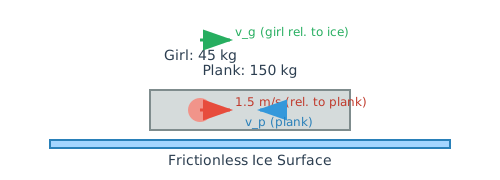
The girl walks right relative to the plank, but the plank recoils left to conserve momentum.
Solution: Method 1 — Momentum Conservation Approach
Step 1 — Define the system and coordinate system
Let's define rightward as positive and consider all velocities relative to the ice surface.
m_p = 150 kg (mass of plank)
v_g = velocity of girl relative to ice (unknown)
v_p = velocity of plank relative to ice (unknown)
Step 2 — Apply conservation of momentum
Since there are no external horizontal forces on the system, momentum is conserved. The system starts at rest, so the initial momentum is zero.
0 = m_g × v_g + m_p × v_p
0 = 45v_g + 150v_p
Step 3 — Use the relative velocity relationship
The girl walks at 1.5 m/s to the right relative to the plank. This gives us the relationship between the two velocities.
Therefore: v_p = v_g - 1.5
Step 4 — Substitute and solve
Substitute the relative velocity relationship into the momentum equation.
45v_g + 150(v_g - 1.5) = 0
45v_g + 150v_g - 225 = 0
195v_g = 225
v_g = 225/195 = 15/13 ≈ 1.15 m/s
Step 5 — Find the plank's velocity
Using our relationship from Step 3:
The negative sign indicates the plank moves leftward, which makes physical sense.
Solution: Method 2 — Center of Mass Analysis
Step 1 — Understand the center of mass principle
With no external horizontal forces, the center of mass of the system remains stationary. Since both objects start at rest, the center of mass stays fixed in space.
Step 2 — Set up the center of mass equation
If the center of mass doesn't move, then the weighted average velocity of the system is zero.
Therefore: m_g × v_g + m_p × v_p = 0
Step 3 — Express one velocity in terms of the other
From the momentum equation:
v_p = -45v_g/150 = -3v_g/10
Step 4 — Apply the relative velocity constraint
The girl moves 1.5 m/s faster than the plank (rightward):
v_g - (-3v_g/10) = 1.5
v_g + 3v_g/10 = 1.5
(10v_g + 3v_g)/10 = 1.5
13v_g/10 = 1.5
v_g = 15/13 ≈ 1.15 m/s
Verification
Let's check our answer by verifying momentum conservation:
Plank's velocity: v_p = (15/13) - 1.5 = -9/26 m/s
Plank's momentum: 150 kg × (-9/26) m/s = -1350/26 = -675/13 kg⋅m/s
Total momentum: 675/13 + (-675/13) = 0 ✓
We can also verify the relative velocity:
Does This Seem Reasonable?
The answer passes several sanity checks:
The girl moves slower than her walking speed: She walks at 1.5 m/s relative to the plank but only moves at 1.15 m/s relative to the ice. This makes sense because the plank recoils backward.
The plank moves backward: The plank's velocity is negative (leftward), which is exactly what we expect from Newton's third law—as the girl pushes backward on the plank to move forward, the plank pushes forward on the girl.
Mass ratio check: The plank is about 3.3 times heavier than the girl, so it should move about 3.3 times slower. Indeed, |v_p|/|v_g| = 0.35/1.15 ≈ 0.30, which is approximately 1/3.3.
Common Pitfalls
This ignores the fact that the plank itself is moving. The girl walks at 1.5 m/s relative to the plank, but the plank is recoiling, so her speed relative to the stationary ice is different.
Some students only consider the girl's momentum: 45 × 1.5 = 67.5 kg⋅m/s, and conclude this must be conserved. But this ignores that the plank also has momentum that must be included.
The relationship v_g - v_p = 1.5 means the girl moves 1.5 m/s faster than the plank in the positive direction. Writing it as v_p - v_g = 1.5 would give the wrong answer.
The Underlying Pattern
This problem follows a general pattern for momentum conservation with relative motion. For two objects with masses m₁ and m₂, initially at rest, where object 1 moves with velocity v_rel relative to object 2:
v₂ = -(m₁ × v_rel)/(m₁ + m₂)
In our case, with m₁ = 45 kg (girl), m₂ = 150 kg (plank), and v_rel = 1.5 m/s:
v_plank = -(45 × 1.5)/(45 + 150) = -67.5/195 = -9/26 m/s
This formula works whenever two objects push off each other on a frictionless surface, whether it's a person jumping off a boat, a cannon firing a cannonball, or astronauts pushing apart in space.
Where This Shows Up in Real Life
Ice skating and hockey: When two skaters push off each other, they move in opposite directions with velocities inversely related to their masses, just like this problem.
Rocket propulsion: Rockets work by ejecting mass (exhaust) in one direction, causing the rocket to accelerate in the opposite direction according to conservation of momentum.
Firearms recoil: When a bullet is fired from a gun, the bullet goes forward and the gun recoils backward. The gun moves much slower than the bullet because it's much more massive.
What If?
Same setup: 45v_g + 150v_p = 0
Now v_g - v_p = 2.0, so v_p = v_g - 2.0
45v_g + 150(v_g - 2.0) = 0195v_g = 300v_g = 20/13 ≈ 1.54 m/s
Girl: 45 × (20/13) = 900/13
Plank: 150 × (-6/13) = -900/13
Total momentum = 0 ✓
Answer: 20/13 m/s ≈ 1.54 m/s to the right
45(1.0) + 150v_p = 0v_p = -45/150 = -0.3 m/s
v_rel = v_g - v_p = 1.0 - (-0.3) = 1.3 m/s
Check momentum: 45(1.0) + 150(-0.3) = 45 - 45 = 0 ✓
Answer: The girl was walking at 1.3 m/s relative to the plank
60v_person + 90v_plank = 0
v_person - v_plank = 1.5v_plank = v_person - 1.5
60v_person + 90(v_person - 1.5) = 0150v_person = 135v_person = 0.9 m/s
v_plank = 0.9 - 1.5 = -0.6 m/s
Answer: 0.9 m/s to the right
p_initial = (45 + 150) × 2.0 = 390 kg⋅m/s
45v_g + 150v_p = 390
v_g - v_p = 1.5, so v_p = v_g - 1.5
45v_g + 150(v_g - 1.5) = 390195v_g = 390 + 225 = 615v_g = 615/195 = 41/13 ≈ 3.15 m/s
Answer: 41/13 m/s ≈ 3.15 m/s to the right
Frequently Asked Questions
2026-09-07