




Copper Alloy Mixture: Blending Two Metals Algebraically
What This Problem Teaches
- Mass balance equations — tracking how components combine in mixtures
- Setting up systems where one variable constrains another
- Weighted averages and why simple averaging fails in real scenarios
- Unit consistency — keeping percentages as decimals throughout calculations
- Real-world modeling of industrial processes like metallurgy
Visualizing the Mixture
Let's see what we're working with:
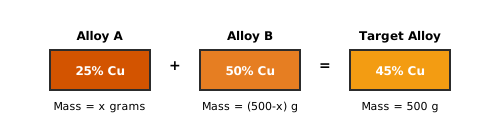
The key insight: the total mass of pure copper from both source alloys must equal the pure copper in our final mixture.
Solution: Method 1 — The Mass Balance Approach
Step 1 — Define your variable
Let x = mass (in grams) of the 25% copper alloy we need.
Then (500 - x) = mass of the 50% copper alloy we need.
This ensures our total mass constraint is automatically satisfied: x + (500 - x) = 500 grams.
Step 2 — Set up the copper mass equation
Track the pure copper from each source:
Copper from 50% alloy: 0.50(500 - x)
Copper in final mixture: 0.45 × 500 = 225
The mass balance equation becomes:
Step 3 — Solve for x
Distribute the 0.50:
Combine like terms:
Isolate the variable:
-0.25x = -25
x = 100
Step 4 — Find both quantities
Mass of 25% copper alloy: x = 100 g
Mass of 50% copper alloy: 500 - x = 500 - 100 = 400 g
Solution: Method 2 — The Weighted Average (Teeter-Totter) Model
Step 1 — Visualize the concentration balance
Think of 45% as a balance point on a line between 25% and 50%. The "distances" from this balance point determine the mixing ratio.
Distance from 45% to 50% = 50 - 45 = 5 units
Step 2 — Apply the teeter-totter principle
The alloy farther from the target concentration (25% alloy) requires less mass to balance. The ratio is inversely proportional to distances:
Step 3 — Calculate the actual masses
If the ratio is 1:4, then out of 5 total parts, the 25% alloy gets 1 part:
50% alloy mass = (4/5) × 500 = 400 g
Verification
Let's check our answer by calculating the copper content:
| Alloy | Mass (g) | Copper % | Pure Copper (g) |
|---|---|---|---|
| 25% alloy | 100 | 25% | 100 × 0.25 = 25 |
| 50% alloy | 400 | 50% | 400 × 0.50 = 200 |
| Final mixture | 500 | 45% | 25 + 200 = 225 |
Perfect! 225 ÷ 500 = 0.45 = 45% ✓
Common Pitfalls
"The average of 25% and 50% is 37.5%, so I need equal amounts."
Why it's wrong: Simple averaging only works if you use equal masses. To get 45% (not 37.5%), you need unequal amounts that weight the average toward the higher concentration.
Writing:
x + (500 - x) = 500Why it's wrong: This equation is always true and tells us nothing. The constraint that matters is the copper mass, not the total mass.
Writing:
25x + 50(500-x) = 45(500)Why it's wrong: This treats 25% as 25, not 0.25. The equation becomes about 2500% copper, which is physically impossible. Always convert percentages to decimals in calculations.
The General Pattern
For any mixture problem with two components, the setup follows this template:
The key relationships are:
- Mass constraint: amount₁ + amount₂ = total amount
- Component constraint: pure substance from both sources = pure substance in mixture
- Weighted average principle: mixing ratio is inversely related to distance from target
Where This Shows Up in Real Life
- Metallurgy: Steel production requires precise mixing of iron ore with different carbon content alloys to achieve target steel grades.
- Pharmacy: Compounding medications by mixing solutions of different active ingredient concentrations.
- Food industry: Blending different fat content milks, mixing flour with different protein contents, creating custom spice blends.
- Chemical engineering: Creating industrial solutions with specific concentrations for manufacturing processes.
What If? — Four Extension Problems
Let x = mass of 25% alloy, then (600 - x) = mass of 50% alloy.
0.25x + 0.50(600 - x) = 0.30(600)
0.25x + 300 - 0.50x = 180
-0.25x = 180 - 300 = -120
x = 480
480 g of 25% alloy, 120 g of 50% alloy
Copper: 480(0.25) + 120(0.50) = 120 + 60 = 180 g
Percentage: 180/600 = 0.30 = 30% ✓
Let x = grams of pure copper to add.
Final mass = 300 + x grams
Current copper: 300 × 0.40 = 120 g
Added copper: x × 1.00 = x g
Total copper needed: 0.60(300 + x)
120 + x = 0.60(300 + x)
120 + x = 180 + 0.6x
0.4x = 60
x = 150
Add 150 g of pure copper
Total copper: 120 + 150 = 270 g
Total mass: 300 + 150 = 450 g
Percentage: 270/450 = 0.60 = 60% ✓
Let x = mass of 20% alloy
Then 2x = mass of 35% alloy
And 1000 - x - 2x = 1000 - 3x = mass of 60% alloy
0.20(x) + 0.35(2x) + 0.60(1000-3x) = 0.40(1000)
0.20x + 0.70x + 600 - 1.80x = 400
0.90x - 1.80x + 600 = 400
-0.90x = -200
x = 222.22... ≈ 222 g
222 g of 20% alloy, 444 g of 35% alloy, 334 g of 60% alloy
Copper: 222(0.20) + 444(0.35) + 334(0.60) = 44.4 + 155.4 + 200.4 = 400.2 g ≈ 400 g
Percentage: 400/1000 = 40% ✓
25% alloy mass = 500 - 300 = 200 g
Copper from 25% alloy: 200 × 0.25 = 50 g
Copper from 50% alloy: 300 × 0.50 = 150 g
Total copper: 50 + 150 = 200 g
Final percentage: 200 ÷ 500 = 0.40 = 40%
But the problem states 42%. Let's solve algebraically.
Let x = mass of 25% alloy
0.25x + 0.50(300) = 0.42(x + 300)
0.25x + 150 = 0.42x + 126
24 = 0.17x, so x ≈ 141 g
141 g of the 25% copper alloy
(Total mass would be 441 g, not 500 g as originally stated)
Frequently Asked Questions
2026-08-28