




How to Solve Zinc Alloy Mixture Problems
What This Problem Teaches
- Setting up systems of equations from conservation principles
- Converting percentage compositions to algebraic expressions
- Understanding weighted averages in mixture problems
- Solving real-world problems using substitution method
- Verifying answers through multiple calculation paths
Let's Draw It
Before diving into equations, let's visualize what's happening in this mixture:
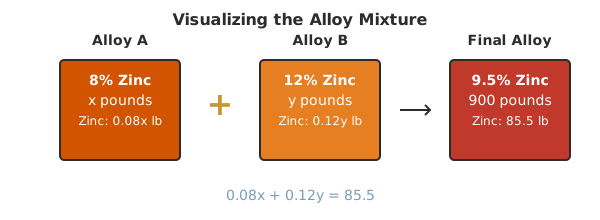
This diagram shows the key insight: zinc is conserved. The total zinc from both input alloys must equal the zinc in the final mixture.
Solution: Method 1 — System of Equations
This is a classic two-component mixture problem. We need to track both the total mass and the component of interest (zinc).
Step 1 — Define variables
Let x = pounds of 8% zinc alloy
Let y = pounds of 12% zinc alloy
Step 2 — Set up the mass balance equation
The total mass of both alloys must equal the final mass:
Step 3 — Set up the zinc balance equation
The zinc from both alloys must equal the zinc in the final mixture:
- Zinc from 8% alloy:
0.08xpounds - Zinc from 12% alloy:
0.12ypounds - Zinc in final mixture:
0.095 × 900 = 85.5pounds
Step 4 — Solve using substitution
From equation 1: y = 900 - x
Substitute into equation 2:
0.08x + 108 - 0.12x = 85.5
-0.04x + 108 = 85.5
-0.04x = 85.5 - 108
-0.04x = -22.5
x = 562.5
Step 5 — Find the second unknown
Using y = 900 - x:
Solution: Method 2 — Alligation Method
Alligation is a visual method that uses the "distances" between percentages to find ratios directly.
Step 1 — Set up the alligation diagram
Draw a diagram with the percentages:
| | |
\ /|\ /
\ / | \ /
\ / | \ /
\ / | \ /
\ | /
\ | /
\ | /
\ | /
\|/
Step 2 — Calculate the differences
Find the absolute differences from the target percentage:
- Distance from 8% to 9.5%:
|9.5 - 8| = 1.5 - Distance from 12% to 9.5%:
|12 - 9.5| = 2.5
Step 3 — Determine the ratio
The ratio is inverse to the distances:
Step 4 — Calculate the actual amounts
With a total of 900 pounds and a ratio of 5:3:
- Total parts:
5 + 3 = 8 - 8% alloy:
(5/8) × 900 = 562.5pounds - 12% alloy:
(3/8) × 900 = 337.5pounds
Verification
Let's verify our answer using both conservation principles:
Mass Conservation Check
Zinc Conservation Check
Zinc from 12% alloy: 0.12 × 337.5 = 40.5 lb
Total zinc: 45.0 + 40.5 = 85.5 lb ✓
Final Percentage Check
All checks confirm our answer is correct!
Watch Out For These
Why it's wrong: This assumes equal amounts of each alloy, but we need 9.5%, which is closer to 8% than to 12%, indicating we need more of the 8% alloy.
Why it's wrong: The percentages must be converted to decimals (0.08x, 0.12y) and the right side must be the actual zinc content (85.5), not the percentage.
Why it's wrong: The right side should be 9.5% of 900 pounds = 85.5 pounds, not just 9.5.
Does This Seem Reasonable?
Let's check if our answer passes the common-sense test:
| Scenario | 8% Alloy | 12% Alloy | Result |
|---|---|---|---|
| Equal amounts | 450 lb | 450 lb | 10% zinc |
| Our answer | 562.5 lb | 337.5 lb | 9.5% zinc |
| All 8% alloy | 900 lb | 0 lb | 8% zinc |
| All 12% alloy | 0 lb | 900 lb | 12% zinc |
Perfect! Since 9.5% is between 8% and 12%, and closer to 8%, it makes sense that we need more 8% alloy (562.5 lb) than 12% alloy (337.5 lb). The ratio of about 5:3 fits the mathematical relationship we'd expect.
The Pattern Behind This
Every two-component mixture problem follows this same structure:
Mass equation:
x + y = TotalComponent equation:
p₁x + p₂y = p₃ × TotalWhere
p₁, p₂, and p₃ are the percentages (as decimals) of the component in alloy 1, alloy 2, and the final mixture respectively.
The alligation method gives us a shortcut formula for the ratio:
This works because the "lever principle" – the amounts are inversely proportional to their distances from the target composition.
Where This Shows Up in Real Life
- Metallurgy: Creating specific alloy compositions for aircraft parts, jewelry, and industrial applications
- Pharmacy: Mixing solutions with different drug concentrations to achieve prescribed dosages
- Food industry: Blending different fat content milks or mixing coffee beans with different caffeine levels
- Chemistry: Preparing solutions with specific molar concentrations for laboratory experiments
What If?
Let x = pounds of 8% alloy, y = pounds of 12% alloy
Mass: x + y = 900
Zinc: 0.08x + 0.12y = 0.10 × 900 = 90
From equation 1: y = 900 - x
0.08x + 0.12(900 - x) = 90
0.08x + 108 - 0.12x = 90
-0.04x = -18
x = 450
y = 900 - 450 = 450
Answer: 450 pounds of each alloy
Check: 0.08(450) + 0.12(450) = 36 + 54 = 90 ✓
This makes perfect sense - 10% is exactly halfway between 8% and 12%!
Zinc from 8% alloy: 0.08 × 600 = 48 pounds
Zinc from 12% alloy: 0.12 × 300 = 36 pounds
Total zinc: 48 + 36 = 84 pounds
Total mass: 600 + 300 = 900 pounds
Zinc percentage: 84 ÷ 900 = 0.0933... = 9.33%
Answer: 9.33% zinc
(600/900)(8%) + (300/900)(12%) = (2/3)(8%) + (1/3)(12%)
= 5.33% + 4% = 9.33% ✓
Let y = pounds of 10% zinc alloy
Let z = pounds of 15% zinc alloy
We know: 400 pounds of 6% zinc alloy
Mass: 400 + y + z = 1200, so y + z = 800
Zinc: 0.06(400) + 0.10y + 0.15z = 0.12(1200)
Simplifying: 24 + 0.10y + 0.15z = 144
So: 0.10y + 0.15z = 120
From equation 1: z = 800 - y
Substitute: 0.10y + 0.15(800 - y) = 120
0.10y + 120 - 0.15y = 120
-0.05y = 0, so y = 0
Therefore: z = 800 - 0 = 800
Answer: 0 pounds of 10% alloy, 800 pounds of 15% alloy
Check: 0.06(400) + 0.15(800) = 24 + 120 = 144 ✓
Percentage: 144/1200 = 0.12 = 12% ✓
We must use all 250 pounds of 12% zinc alloy to maximize production.
Let x = pounds of 8% zinc alloy needed
Total mixture = x + 250 pounds
Zinc from 8% alloy: 0.08x
Zinc from 12% alloy: 0.12(250) = 30
Target zinc percentage: 9.5%
Equation: 0.08x + 30 = 0.095(x + 250)
0.08x + 30 = 0.095x + 23.75
30 - 23.75 = 0.095x - 0.08x
6.25 = 0.015x
x = 6.25 ÷ 0.015 = 416.67 pounds
Maximum 9.5% alloy: 416.67 + 250 = 666.67 pounds
Answer: 666.67 pounds maximum, using 416.67 pounds of 8% alloy
Verify: (0.08×416.67 + 0.12×250) ÷ 666.67 = 63.33 ÷ 666.67 = 0.095 = 9.5% ✓
Frequently Asked Questions
2026-08-17