




From Average to Instantaneous Velocity: A Calculus Foundation
What You Will Learn
- How to calculate average velocity from a position function using the difference quotient
- The geometric meaning of average velocity as the slope of a secant line
- How average velocity over shrinking intervals approaches instantaneous velocity
- The conceptual bridge from algebra to calculus through limiting behavior
- Real-world interpretation of velocity calculations in projectile motion
Visualizing the Problem
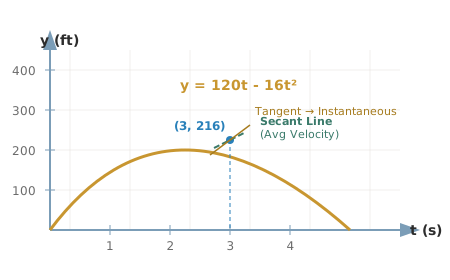
The parabolic path shows the ball's height over time. As time intervals shrink around t = 3, the secant line approaches the tangent line, and average velocity approaches instantaneous velocity.
Solution: Method 1 — The Difference Quotient Approach
Average velocity over a time interval equals the change in position divided by the change in time. For the interval [t, t+h], this becomes the difference quotient.
Average Velocity = [y(t+h) - y(t)] / hStep 1 — Find the position at t = 3
First, we calculate the ball's height when our interval begins:
y(3) = 120(3) - 16(3)² = 360 - 16(9) = 360 - 144 = 216 ftStep 2 — Calculate average velocity for each interval
For each part, we'll find y(3 + h) where h is the interval duration, then apply our formula.
Part a) h = 0.2 seconds:
y(3.2) = 120(3.2) - 16(3.2)²

                = 384 - 16(10.24)

                = 384 - 163.84 = 220.16 ft
Average Velocity = (220.16 - 216) / 0.2 = 4.16 / 0.2 = 20.8 ft/sPart b) h = 0.01 seconds:
y(3.01) = 120(3.01) - 16(3.01)²

                = 361.2 - 16(9.0601)

                = 361.2 - 144.9616 = 216.2384 ft
Average Velocity = (216.2384 - 216) / 0.01 = 0.2384 / 0.01 = 23.84 ft/sPart c) h = 0.001 seconds:
y(3.001) = 120(3.001) - 16(3.001)²

                = 360.12 - 16(9.006001)

                = 360.12 - 144.096016 = 216.023984 ft
Average Velocity = (216.023984 - 216) / 0.001 = 0.023984 / 0.001 = 23.984 ft/sStep 3 — Estimate instantaneous velocity
Looking at our sequence of average velocities:
- 0.2 seconds: 20.8 ft/s
- 0.01 seconds: 23.84 ft/s
- 0.001 seconds: 23.984 ft/s
As the time interval shrinks toward zero, the average velocities approach 24 ft/s.
Solution: Method 2 — The Symbolic Limit Approach
Instead of computing individual cases, we can derive a general formula for average velocity over [3, 3+h] and observe its limiting behavior.
Step 1 — Set up the general difference quotient
Average Velocity = [y(3+h) - y(3)] / hStep 2 — Expand y(3+h)
y(3+h) = 120(3+h) - 16(3+h)²

                = 120(3+h) - 16(9 + 6h + h²)

                = 360 + 120h - 144 - 96h - 16h²

                = 216 + 24h - 16h²
Step 3 — Substitute and simplify
Average Velocity = [(216 + 24h - 16h²) - 216] / h

                = (24h - 16h²) / h

                = h(24 - 16h) / h

                = 24 - 16h
Step 4 — Apply to each interval
- h = 0.2:
24 - 16(0.2) = 24 - 3.2 = 20.8 ft/s - h = 0.01:
24 - 16(0.01) = 24 - 0.16 = 23.84 ft/s - h = 0.001:
24 - 16(0.001) = 24 - 0.016 = 23.984 ft/s
As h approaches 0, 24 - 16h approaches 24 ft/s.
Solution: Method 3 — The Derivative Approach
The instantaneous velocity is the derivative of the position function. We can find this directly using calculus.
Step 1 — Find the velocity function
The velocity function is the derivative of position:
v(t) = dy/dt = d/dt[120t - 16t²] = 120 - 32tStep 2 — Evaluate at t = 3
v(3) = 120 - 32(3) = 120 - 96 = 24 ft/sThis confirms our limiting result: the instantaneous velocity at t = 3 is exactly 24 ft/s.
a) 0.2 seconds: 20.8 ft/s
b) 0.01 seconds: 23.84 ft/s
c) 0.001 seconds: 23.984 ft/s
Instantaneous velocity at t = 3: 24 ft/s
Verification
We can verify our work multiple ways:
Check Method 2 against Method 1
Using our formula 24 - 16h:
- h = 0.2:
24 - 16(0.2) = 20.8 ✓ - h = 0.01:
24 - 16(0.01) = 23.84 ✓ - h = 0.001:
24 - 16(0.001) = 23.984 ✓
Verify the limiting behavior
The derivative gives us the exact instantaneous velocity: v(3) = 120 - 32(3) = 24 ft/s. Our sequence clearly approaches this value as the intervals shrink.
Physical reasonableness check
At t = 3, the ball is moving upward but slowing down (gravity is decelerating it). The positive velocity of 24 ft/s makes physical sense for this stage of the ball's flight.
Watch Out For These
✗ Mistake 1: Confusing velocity with speed or forgetting units
Velocity has both magnitude AND direction, and at t = 3, the ball is still moving upward. The answer is +24 ft/s, not just "24" or "24 ft/s downward."
✗ Mistake 2: Using the wrong interval endpoints
For "lasting 0.2 seconds," the interval is [3, 3.2], not [2.8, 3.2]. The interval begins at t = 3 and has duration 0.2.
✗ Mistake 3: Arithmetic errors in the quadratic expansion
When calculating (3.2)² = 10.24, not 6.4. Double-check your arithmetic, especially with decimals. The quadratic term dominates the calculation.
✗ Mistake 4: Expecting the average velocities to be equal
The average velocities are 20.8, 23.84, and 23.984 ft/s — they're not the same! This is the whole point: they're approaching the instantaneous velocity as the interval shrinks.
The Calculus Connection
This problem embodies the fundamental concept of calculus: the derivative as a limit of difference quotients.
Instantaneous Velocity = lim[h→0] [y(t+h) - y(t)] / h = dy/dtThe pattern in our results demonstrates how calculus emerges naturally from algebra. As we make the time intervals smaller and smaller, we're approximating the instantaneous rate of change — the slope of the tangent line to the position curve.
For any quadratic position function y = at² + bt + c, the velocity function is always v = 2at + b. In our case, with y = -16t² + 120t, we get v = -32t + 120.
The coefficient -32 ft/s² represents gravitational acceleration (twice the -16 in the position function), while 120 ft/s is the initial upward velocity.
Real Applications
This calculation appears throughout science and engineering:
- Engineering: Analyzing the motion of rockets, where engineers need instantaneous velocity for trajectory corrections and fuel consumption calculations.
- Sports Science: Determining a basketball's velocity at release to optimize shooting technique and predict trajectory accuracy.
- Safety Analysis: Calculating impact velocities for objects dropped from buildings or vehicles, crucial for safety regulations and protective equipment design.
- Economics: The same mathematical technique applies to marginal cost analysis — finding instantaneous rates of change in cost functions.
What If?
Different Starting Time
Using the same height function y = 120t - 16t², find the average velocity for the time period beginning at t = 4 seconds and lasting 0.1 seconds. Then estimate the instantaneous velocity at t = 4. Is the ball going up or down?
y(4) = 120(4) - 16(4)² = 480 - 256 = 224 ft
y(4.1) = 120(4.1) - 16(4.1)² = 492 - 16(16.81) = 492 - 268.96 = 223.04 ft
Average Velocity = (223.04 - 224) / 0.1 = -0.96 / 0.1 = -9.6 ft/s
v(t) = 120 - 32t, so v(4) = 120 - 32(4) = -8 ft/s
Answer: Average velocity is -9.6 ft/s, instantaneous velocity is -8 ft/s. The negative values mean the ball is moving downward at t = 4.
Find the Turning Point
At what exact time is the instantaneous velocity of the ball equal to 0 ft/s? What is the physical significance of this moment, and what is the ball's height at this time?
Instantaneous velocity is v(t) = 120 - 32t. Set this equal to zero: 120 - 32t = 0
32t = 120, so t = 120/32 = 3.75 seconds
y(3.75) = 120(3.75) - 16(3.75)² = 450 - 16(14.0625) = 450 - 225 = 225 ft
Answer: At t = 3.75 seconds, the velocity is 0 ft/s and the ball reaches its maximum height of 225 ft. This is the turning point where the ball stops moving upward and begins to fall.
Ball from Building Top
Suppose the ball is thrown from the top of a 50-ft building, so its height is y = 50 + 120t - 16t². Find the average velocity from t = 2 to t = 2.5 seconds. How does adding the constant affect velocity calculations?
y(2) = 50 + 120(2) - 16(2)² = 50 + 240 - 64 = 226 ft
y(2.5) = 50 + 120(2.5) - 16(2.5)² = 50 + 300 - 16(6.25) = 50 + 300 - 100 = 250 ft
Average Velocity = (250 - 226) / (2.5 - 2) = 24 / 0.5 = 48 ft/s
The constant 50 cancels out in the difference quotient! Velocity depends only on the rate of change, not the starting height. The velocity function is still v(t) = 120 - 32t.
Answer: Average velocity is 48 ft/s. Adding a constant to position doesn't change velocity — derivatives eliminate constants.
Projectile with Different Gravity
On the Moon, gravity is about 1/6 of Earth's, so a ball thrown upward with the same initial velocity follows y = 120t - (8/3)t². Find the average velocity from t = 5 to t = 5.1 seconds and compare the motion to Earth.
y(5) = 120(5) - (8/3)(5)² = 600 - (8/3)(25) = 600 - 200/3 = 600 - 66.67 = 533.33 ft
y(5.1) = 120(5.1) - (8/3)(5.1)² = 612 - (8/3)(26.01) = 612 - 69.36 = 542.64 ft
Average Velocity = (542.64 - 533.33) / 0.1 = 9.31 / 0.1 = 93.1 ft/s
On Earth at t = 5: v(5) = 120 - 32(5) = -40 ft/s (falling)
On Moon at t = 5: v(5) = 120 - (16/3)(5) = 120 - 26.67 = 93.33 ft/s (still rising!)
Answer: Average velocity is 93.1 ft/s. On the Moon, the ball is still rising at t = 5, while on Earth it would be falling rapidly. Weaker gravity dramatically changes the motion.
Frequently Asked Questions
2026-09-14