




How Far Does the Block Slide? (Energy & Friction)
What This Problem Teaches
- Conservation of mechanical energy on frictionless surfaces
- Converting potential energy to kinetic energy and then to heat via friction
- Using the work-energy theorem to analyze energy dissipation
- Recognizing when mass cancels out of physics equations
- Setting up energy balance equations for multi-stage motion problems
Solution: Method 1 — Energy Conservation Approach
The key insight here is that energy transforms but is never lost. The block's initial potential energy becomes kinetic energy at the bottom, which then dissipates completely as heat through friction work.
Step 1 — Identify the energy transformations
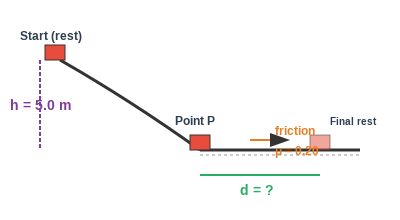
Initially, the block has only gravitational potential energy: PE = mgh where h = 5.0 m. At point P (bottom of ramp), this converts entirely to kinetic energy since the ramp is frictionless. On the horizontal surface, friction does negative work until all kinetic energy is dissipated.
Step 2 — Apply conservation of energy for the entire journey
From start to final rest, the total energy change is zero. The initial potential energy equals the work done against friction:
Initial PE = Work done by frictionmgh = W_frictionStep 3 — Express the work done by friction
The friction force is f = μN = μmg (where N = mg on a horizontal surface). The work done by friction over distance d is:
W_friction = f × d = μmgdStep 4 — Set up and solve the energy equation
Substituting into our energy balance:
mgh = μmgdNotice that mass m and gravitational acceleration g appear on both sides, so they cancel:
h = μdd = h/μ = 5.0 m / 0.20 = 25 mSolution: Method 2 — Two-Stage Energy Analysis
Instead of treating the problem as one energy transformation, we can analyze it in two distinct stages: ramp descent and horizontal sliding.
Step 1 — Find the speed at point P
On the frictionless ramp, mechanical energy is conserved. Converting potential to kinetic energy:
mgh = ½mv²v = √(2gh) = √(2 × 9.8 × 5.0) = √98 = 9.90 m/sStep 2 — Apply work-energy theorem on horizontal surface
The block enters the horizontal surface with kinetic energy KE = ½mv² and comes to rest (final KE = 0). The friction force does negative work:
W_friction = ΔKE = KE_final - KE_initial = 0 - ½mv²-μmgd = -½mv²Step 3 — Solve for the sliding distance
Simplifying the equation (note the negative signs cancel):
μmgd = ½mv²μgd = ½v²d = v²/(2μg) = (9.90)²/(2 × 0.20 × 9.8) = 98/(3.92) = 25 mVerification
Let's check our answer by working backwards. If the block slides 25 m with μ = 0.20, the work done against friction is:
W_friction = μmgd = 0.20 × mg × 25 = 5mg joulesThe initial potential energy was:
PE_initial = mgh = mg × 5.0 = 5mg joules✓ These match exactly, confirming that all the initial potential energy is dissipated by friction work.
We can also check units: d = h/μ gives us [m]/[dimensionless] = [m] ✓
Common Pitfalls
Some students write: mgh = ½mv² + μmgd, thinking the block still has kinetic energy at the end. This is wrong because the problem asks for the distance "before it comes to rest" — meaning final velocity is zero.
Writing f = μN where N = mg cos θ for the horizontal surface. On a horizontal surface, θ = 0° and cos θ = 1, so N = mg exactly. The cosine factor only appears on inclined surfaces.
The friction force and displacement are in opposite directions, making the work negative: W = -fd. However, when using energy conservation, we typically write the work done against friction as positive, which equals the energy dissipated.
Keeping mass in the final answer: d = mgh/(μmg). Students sometimes think a heavier block slides farther, but mass cancels out — heavier blocks have both more initial energy AND more friction force in the same proportion.
The Underlying Pattern
This problem reveals a beautiful and counterintuitive result: the sliding distance depends only on the height and friction coefficient, not on the mass of the block or the steepness of the ramp.
d = h/μThis formula works for any frictionless ramp configuration. Whether the ramp is steep or gradual, curved or straight, the sliding distance is always the height divided by the friction coefficient.
The physics behind this is that mass appears in every energy term, creating a perfect cancellation. A heavier block has more gravitational potential energy (proportional to m), but it also experiences more friction force (also proportional to m). The extra energy is exactly balanced by the extra friction.
This same mathematical structure appears in many physics problems where both the "driving force" and "resistance force" scale with the same quantity.
Where Students Go Wrong
The most common error isn't computational — it's conceptual. Students often struggle to identify what form of energy exists at each stage of the motion.
At the top: only potential energy (block at rest)
At point P: only kinetic energy (potential energy converted)
At the end: no mechanical energy (all converted to heat via friction)
The friction doesn't "use up energy" in the sense of destroying it. Energy is conserved — it's just transformed from organized mechanical motion into random thermal motion (heat). This distinction becomes crucial in thermodynamics.
Real Applications
Automotive safety: This same calculation determines stopping distances for cars. Highway engineers use d = v²/(2μg) to design safe following distances and runaway truck ramps.
Ski resort design: Ski jump landing slopes use controlled friction to bring skiers to a safe stop. The relationship between height, speed, and stopping distance is critical for safety calculations.
Spacecraft reentry: When spacecraft enter atmospheres, they convert enormous orbital kinetic energy into heat through atmospheric friction. The controlled dissipation of this energy is essential for safe landings.
Four "What-If?" Problems
Using d = h/μ where h = 8.0 m and μ = 0.25.
d = 8.0/0.25 = 32 m
Initial PE = mg(8.0), friction work = 0.25mg(32) = 8mg ✓
Answer: 32 meters
mgh = μmgd, which simplifies to h = μd
h = 0.15 × 40.0 = 6.0 m
PE = mg(6.0), friction work = 0.15mg(40) = 6mg ✓
Answer: 6.0 meters height
Work by friction in first 20.0 m: W₁ = μ₁mgd₁ = 0.10mg(20.0) = 2mg
Initial PE: 6mg, energy left: 6mg - 2mg = 4mg
4mg = μ₂mgd₂, so d₂ = 4/(0.30) = 13.3 m
Total work: 2mg + 0.30mg(13.3) = 2mg + 4mg = 6mg ✓
Answer: 13.3 meters in the second section
Initial PE: mg(6.0), friction work on ramp: 0.05mg(10.0) = 0.5mg
KE at bottom: 6mg - 0.5mg = 5.5mg = ½mv²
5.5mg = ½mv², so v² = 11g = 11(9.8) = 107.8
v = 10.4 m/s
Using ½mv² = μmgd: d = v²/(2μg) = 107.8/(2×0.20×9.8) = 27.5 m
Remaining energy after ramp: 5.5mg
Horizontal distance: d = 5.5mg/(μmg) = 5.5/0.20 = 27.5 m
Answer: 27.5 meters horizontally
Frequently Asked Questions
2026-11-27