




Boat Speed and Current: Upstream-Downstream Problem
What This Problem Teaches
- Setting up systems of equations from motion problems with opposing forces
- Understanding how current affects effective speed in both directions
- Recognizing that distance = speed × time applies to each leg separately
- Solving systems using elimination method efficiently
- Interpreting solutions in context (boat speed must exceed current speed)
Picture This
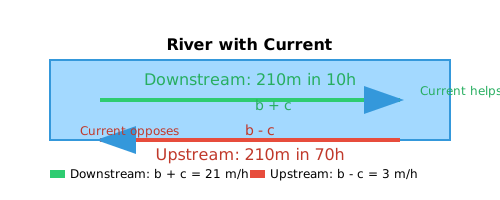
Solution: Method 1 — System of Effective Speeds
Step 1 — Define the variables
Let b = speed of boat in still water (m/h)
Let c = speed of current (m/h)
Step 2 — Identify effective speeds
When traveling downstream, the current helps the boat, so the effective speed is b + c.
When traveling upstream, the current opposes the boat, so the effective speed is b - c.
Step 3 — Apply distance = speed × time to each trip
For the downstream trip:
For the upstream trip:
Step 4 — Simplify both equations
Dividing the first equation by 10:
Dividing the second equation by 70:
Step 5 — Solve using elimination
Adding the two equations eliminates c:
2b = 24
b = 12
Step 6 — Find the current speed
Substitute b = 12 into either equation. Using the first:
c = 9
Solution: Method 2 — Working with Rates Directly
Step 1 — Calculate effective speeds from given data
Since distance = speed × time, we can find speed = distance ÷ time.
Downstream speed: 210 ÷ 10 = 21 m/h
Upstream speed: 210 ÷ 70 = 3 m/h
Step 2 — Recognize the symmetry
The current adds the same amount to downstream speed as it subtracts from upstream speed. So:
Downstream speed = boat speed + current speed = 21
Upstream speed = boat speed - current speed = 3
Step 3 — Use the average for boat speed
The boat's speed in still water is the average of its effective upstream and downstream speeds:
Step 4 — Find current speed from the difference
The current speed is half the difference between downstream and upstream speeds:
Verification
Let's check our answer by substituting back into the original conditions.
Check downstream trip:
Effective speed downstream: 12 + 9 = 21 m/h
Time to travel 210m: 210 ÷ 21 = 10 hours ✓
Check upstream trip:
Effective speed upstream: 12 - 9 = 3 m/h
Time to travel 210m: 210 ÷ 3 = 70 hours ✓
Both conditions are satisfied, confirming our answer.
Does This Seem Reasonable?
Let's examine whether these speeds make sense in context.
The boat speed (12 m/h) is greater than the current speed (9 m/h), which it must be for upstream travel to be possible. If the current were stronger than the boat, the boat would be swept downstream even when trying to go upstream.
The current is quite strong—it's 75% of the boat's still-water speed. This explains why the upstream trip took 7 times longer than the downstream trip (70 ÷ 10 = 7).
Common Pitfalls
✗ Mistake 1: Adding the times instead of working with speeds
Students sometimes try: "Total time is 80 hours for 420m, so average speed is 420 ÷ 80 = 5.25 m/h." This treats the problem as if the boat traveled at constant speed, ignoring that downstream and upstream are fundamentally different due to the current.
✗ Mistake 2: Confusing which direction gets which sign
Writing "upstream speed = b + c" and "downstream speed = b - c." Remember: downstream means "with the current" (current helps, so add), upstream means "against the current" (current hinders, so subtract).
✗ Mistake 3: Setting up the distance equation incorrectly
Writing "210 = b + c + 10" instead of "210 = (b + c) × 10." The parentheses are crucial—the entire effective speed gets multiplied by time, not just one component of speed.
The Pattern Behind This
For any upstream-downstream problem, if we know the distance d and times t₁ (downstream) and t₂ (upstream), we can use:
Current speed: c = (d/t₁ - d/t₂) ÷ 2
This works because:
d/t₁gives the downstream effective speed (b + c)d/t₂gives the upstream effective speed (b - c)- The average of (b + c) and (b - c) is b
- Half the difference between (b + c) and (b - c) is c
For our problem: b = (21 + 3)/2 = 12 and c = (21 - 3)/2 = 9.
Where This Shows Up in Real Life
Aviation: Pilots must account for headwinds and tailwinds when calculating flight times and fuel consumption. A 200 mph plane with a 50 mph tailwind covers ground at 250 mph, but only 150 mph against that same wind.
Ocean navigation: Ships deal with ocean currents constantly. The Gulf Stream, for instance, can add or subtract 2-5 mph from a ship's effective speed depending on direction.
Running and cycling: Athletes training on treadmills or stationary bikes versus outdoors must account for wind resistance, which always opposes motion.
What If?
Downstream speed: 360 ÷ 12 = 30 m/h
Upstream speed: 360 ÷ 90 = 4 m/h
Boat speed = average of effective speeds: (30 + 4) ÷ 2 = 17 m/h
Current speed = half the difference: (30 - 4) ÷ 2 = 13 m/h
Downstream: 17 + 13 = 30 m/h, time = 360 ÷ 30 = 12 h ✓
Upstream: 17 - 13 = 4 m/h, time = 360 ÷ 4 = 90 h ✓
Answer: Boat speed = 17 m/h, Current speed = 13 m/h
Downstream speed: 15 + 6 = 21 m/h
Upstream speed: 15 - 6 = 9 m/h
Time = distance ÷ speed = 168 ÷ 21 = 8 hours
Time = distance ÷ speed = 168 ÷ 9 = 56/3 = 18⅔ hours
Downstream: 21 × 8 = 168 m ✓
Upstream: 9 × 18⅔ = 9 × 56/3 = 168 m ✓
Answer: Downstream: 8 hours, Upstream: 18⅔ hours
Downstream speed: 240 ÷ 8 = 30 m/h
Since downstream speed = boat speed + current speed:
30 = b + 6
Therefore: b = 24 m/h
Upstream speed = boat speed - current speed
24 - 6 = 18 m/h
Time = 240 ÷ 18 = 40/3 = 13⅓ hours
Answer: Boat speed = 24 m/h, Upstream time = 13⅓ hours
Let d = distance, t = downstream time
Then upstream time = 5t
Downstream speed: d/t = b + 12
Upstream speed: d/(5t) = b - 12
From the equations: d/t = b + 12 and d/(5t) = (b + 12)/5
But also: d/(5t) = b - 12
So: (b + 12)/5 = b - 12
b + 12 = 5(b - 12)
b + 12 = 5b - 60
72 = 4b
b = 18 m/h
Downstream speed: 18 + 12 = 30 m/h
Upstream speed: 18 - 12 = 6 m/h
Ratio: 30 ÷ 6 = 5 ✓
Answer: Boat speed = 18 m/h
Frequently Asked Questions
2026-10-19