




Bus Rental Optimization: Minimize Transportation Costs
What This Problem Teaches
- Setting up optimization problems with multiple constraints
- Converting word problems into mathematical inequalities
- Finding feasible solutions within bounded regions
- Evaluating objective functions to find optimal solutions
- Balancing cost efficiency with resource limitations in real scenarios
Let's Set Up the Problem
This is a constrained optimization problem where we need to visualize the constraints and available options. Let's organize what we know:
| Bus Type | Capacity | Cost | Available | Cost per Seat |
|---|---|---|---|---|
| Large Bus | 50 students | $500 | 10 buses | $10.00 |
| Small Bus | 40 students | $300 | 8 buses | $7.50 |
Key insight: While small buses are more cost-efficient per seat, we're limited by having only 9 drivers total. This constraint forces us to find the optimal balance.
Solution: Method 1 — Constraint Analysis
Step 1 — Define variables and objective function
Let L = number of large buses and S = number of small buses.
We want to minimize the total cost: C = 500L + 300S
Step 2 — Write all constraints as inequalities
Driver constraint: L + S ≤ 9 (only 9 drivers available)
Availability constraints: L ≤ 10, S ≤ 8
Non-negative: L ≥ 0, S ≥ 0
Step 3 — Find feasible integer combinations
Since we can't use partial buses, we need integer solutions. Let's test combinations systematically, starting from the driver limit and working down:
| Large (L) | Small (S) | Total Drivers | Capacity | Meets 400? | Cost |
|---|---|---|---|---|---|
| 8 | 1 | 9 | 440 | ✓ | $4300 |
| 7 | 2 | 9 | 430 | ✓ | $4100 |
| 6 | 3 | 9 | 420 | ✓ | $3900 |
| 5 | 4 | 9 | 410 | ✓ | $3700 |
| 4 | 5 | 9 | 400 | ✓ | $3500 |
| 3 | 6 | 9 | 390 | ✗ | — |
Step 4 — Identify the minimum cost
The combination (4, 5) gives exactly 400 seats using all 9 drivers at the lowest cost of $3500.
Solution: Method 2 — Linear Programming with Graphical Analysis
Step 1 — Graph the feasible region
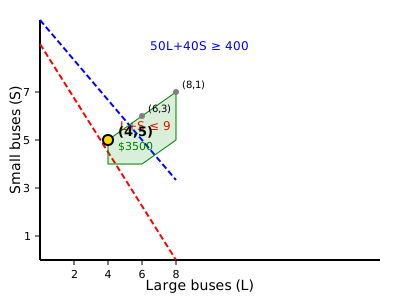
Let's visualize this problem on a coordinate system where L (large buses) is the x-axis and S (small buses) is the y-axis:
Step 2 — Evaluate corner points of feasible region
In linear programming, the optimal solution occurs at a vertex of the feasible region. We already identified these in Method 1, but graphically we can see that (4,5) is indeed at the intersection of our key constraints.
Step 3 — Confirm optimality
The cost function C = 500L + 300S has a slope that favors smaller buses. The point (4,5) represents the maximum use of cheaper small buses while still meeting the capacity requirement.
The Answer
Verification
Let's verify our solution satisfies all constraints:
Driver check: 4 + 5 = 9 drivers ✓
Availability check: 4 ≤ 10 large buses, 5 ≤ 8 small buses ✓
Cost calculation: 4($500) + 5($300) = $2000 + $1500 = $3500 ✓
Does This Make Sense?
Our answer passes several sanity checks:
- Capacity: We use exactly the minimum capacity needed (400 seats) with no waste
- Resource utilization: We use all 9 available drivers efficiently
- Cost efficiency: We maximize the use of cheaper small buses (cost $7.50/seat) while using the minimum necessary large buses (cost $10.00/seat)
- Boundary solution: This is a corner point solution, which is expected in linear programming
If we used fewer total buses, we couldn't seat all 400 students. If we used more buses, we'd exceed our driver limit or increase costs unnecessarily.
Common Pitfalls
✗ Ignoring the driver constraint
Some students calculate that 10 small buses would be cheapest ($3000) since small buses are more cost-efficient. But this requires 10 drivers when only 9 are available. Always check that your solution satisfies ALL constraints.
✗ Using fractional buses
Mathematical optimization might suggest using 4.8 large buses and 4.2 small buses, but you can't rent partial buses. The real-world constraint requires integer solutions, which changes the optimal answer.
✗ Minimizing buses instead of cost
The minimum number of buses would be 8 large buses (400 seats), but this costs $4000. We're minimizing cost, not the number of buses. Always optimize the correct objective function.
Recognizing This Problem Type
Watch for these keywords that signal a linear programming optimization problem:
- "Minimize cost" or "maximize profit" — indicates an objective function to optimize
- "Subject to" or "limited by" — introduces constraints that bound your solution
- Multiple resource limits — drivers, buses, capacity all create boundaries
- "How many of each type" — suggests you're choosing between alternatives
Similar problems appear in manufacturing (minimize production cost subject to demand), nutrition (minimize cost subject to dietary requirements), and scheduling (minimize staff while meeting coverage needs).
The Math Behind the Optimization
This problem demonstrates linear programming, where we optimize a linear objective function subject to linear constraints. The general form is:
Subject to: a₁₁x₁ + a₁₂x₂ + ... ≤ b₁
a₂₁x₁ + a₂₂x₂ + ... ≤ b₂
etc.
In our bus problem:
- Variables: L and S (number of each bus type)
- Objective function: Minimize 500L + 300S
- Constraints: Capacity, drivers, and availability limits
The Fundamental Theorem of Linear Programming guarantees that if an optimal solution exists, it occurs at a vertex of the feasible region. That's why we only needed to test the corner points.
Real-World Applications
This exact type of optimization appears frequently in:
- Transportation logistics: Airlines optimizing aircraft assignment to routes
- Manufacturing: Factories determining product mix to maximize profit within capacity constraints
- Resource allocation: Hospitals scheduling staff to minimize costs while meeting patient care requirements
- Investment portfolio: Balancing different asset types to minimize risk while achieving target returns
What If?
The school hires 3 additional drivers, giving them 12 total drivers. Bus availability and costs remain the same (10 large, 8 small). What is the new optimal combination and minimum cost for 400 students?
With 12 drivers: L + S ≤ 12, but still L ≤ 10 and S ≤ 8. Capacity: 50L + 40S ≥ 400.
Try S = 8 (maximum small buses): Need 50L + 40(8) ≥ 400, so 50L ≥ 80, thus L ≥ 1.6. Use L = 2.
Solution (2, 8): Uses 2 + 8 = 10 drivers ≤ 12 ✓. Capacity: 2(50) + 8(40) = 100 + 320 = 420 ≥ 400 ✓
Cost = 2($500) + 8($300) = $1000 + $2400 = $3400
This uses maximum small buses (cheapest per seat) while meeting capacity. New minimum cost: $3400, saving $100.
The school trip now includes 520 students instead of 400. All other constraints remain the same (9 drivers, 10 large/8 small buses available, same costs). Find the new minimum cost combination.
Need 50L + 40S ≥ 520 with L + S ≤ 9, L ≤ 10, S ≤ 8
Try L = 8, S = 1: Capacity = 8(50) + 1(40) = 440 < 520 ✗
Try L = 9, S = 0: Capacity = 9(50) = 450 < 520 ✗
Maximum possible capacity with 9 drivers: Use L = 8, S = 1 gives only 440 seats. Even L = 9, S = 0 gives only 450 seats.
With only 9 drivers, the school cannot transport 520 students. They need either more drivers or to reduce group size.
If forced to choose: Use all 9 drivers as L = 8, S = 1 for 440 students at cost $4300, leaving 80 students needing alternative transport.
The school has a fixed transportation budget of $3200. Using the same bus types and constraints (9 drivers, 10 large/8 small available), what is the maximum number of students they can transport?
Maximize 50L + 40S subject to 500L + 300S ≤ 3200, L + S ≤ 9
Try L = 2, S = 7: Cost = 2(500) + 7(300) = 1000 + 2100 = $3100 ≤ $3200 ✓
Students = 2(50) + 7(40) = 100 + 280 = 380
Try L = 3, S = 6: Cost = 3(500) + 6(300) = 1500 + 1800 = $3300 > $3200 ✗
Try L = 1, S = 8: Cost = 1(500) + 8(300) = 500 + 2400 = $2900 ≤ $3200 ✓
Students = 1(50) + 8(40) = 50 + 320 = 370
The combination (2, 7) gives 380 students for $3100, which is better than (1, 8) giving 370 students for $2900.
Maximum students: 380 using 2 large and 7 small buses, costing $3100 within the $3200 budget.
The rental company changes prices to $450 per large bus and $350 per small bus, but requires at least 2 buses of each type be rented. With 9 drivers and 400 students, what is the new optimal combination and cost?
Minimize 450L + 350S subject to: 50L + 40S ≥ 400, L + S ≤ 9, L ≥ 2, S ≥ 2
Start with L = 2, S = 2: Capacity = 2(50) + 2(40) = 100 + 80 = 180 < 400 ✗
Need more buses to reach 400 students.
Try L = 2, S = 7: Capacity = 100 + 280 = 380 < 400 ✗
Try L = 3, S = 6: Capacity = 150 + 240 = 390 < 400 ✗
Try L = 4, S = 5: Capacity = 200 + 200 = 400 ✓, Drivers = 9 ✓
Cost = 4($450) + 5($350) = $1800 + $1750 = $3550
This satisfies minimum requirements (L ≥ 2, S ≥ 2), meets capacity exactly, and uses all 9 drivers. New minimum cost: $3550
Frequently Asked Questions
2026-07-27