




Probability Without Replacement: Heart Then Diamond
What This Problem Teaches
- Conditional probability: How the outcome of one event affects the probability of subsequent events
- The multiplication rule: When to multiply probabilities versus add them for compound events
- Without replacement mechanics: Understanding how removing items changes the sample space
- Sequential event analysis: Breaking complex probability scenarios into manageable steps
- Fraction-to-decimal conversion: Expressing probability results in multiple useful formats
Let's Visualize This
Before diving into calculations, let's see what happens when we draw cards without replacement:
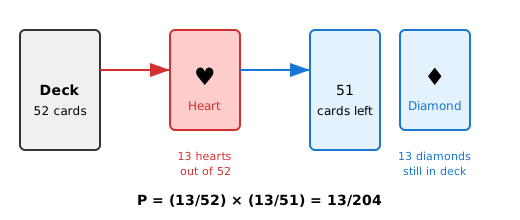
Notice how drawing the heart first reduces our total deck size from 52 to 51 cards, but doesn't affect the number of diamonds available.
Solution: Method 1 — The Sequential Probability Approach
For sequential events connected by "and," we multiply the individual probabilities. The key insight is that the second probability becomes conditional on the first event occurring.
Step 1 — Find the probability of drawing a heart first
In a standard deck, there are 13 hearts out of 52 total cards.
Step 2 — Find the probability of drawing a diamond second
After removing one heart, we have 51 cards remaining. Importantly, all 13 diamonds are still in the deck since we drew a heart, not a diamond.
Step 3 — Apply the multiplication rule
For both events to occur in sequence, we multiply their probabilities:
P(heart then diamond) = (13/52) × (13/51)
P(heart then diamond) = (1/4) × (13/51) = 13/204
Step 4 — Convert to decimal and round
Converting the fraction to decimal form:
Rounded to 4 decimal places: 0.0637
Solution: Method 2 — The Counting Approach
Instead of thinking about conditional probability, we can count favorable outcomes directly.
Step 1 — Count total possible ordered outcomes
For the first card, we have 52 choices. For the second card (without replacement), we have 51 choices.
Step 2 — Count favorable outcomes
For a heart first: 13 choices. For a diamond second (after drawing a heart): 13 choices.
Step 3 — Calculate the probability
P(heart then diamond) = 169/2,652 = 13/204 = 0.0637
Notice this gives us exactly the same answer as Method 1, confirming our result.
Verification
Let's verify our answer makes sense by checking it multiple ways:
Fraction check
Our fraction 13/204 is already in lowest terms since gcd(13, 204) = 1.
Decimal verification
Let's verify our decimal conversion:
Rounded to 4 decimal places: 0.0637 ✓
Range check
The probability should be less than either individual probability:
P(diamond) = 13/51 ≈ 0.255
Our answer: 0.0637 < 0.25 ✓
This makes sense because requiring both events to happen in sequence should be less likely than either event alone.
Watch Out For These Pitfalls
P = (13/52) × (13/52) = 0.0625Why it's wrong: This treats the problem as "with replacement." After drawing the first card, only 51 cards remain.
P = 13/52 + 13/51 = 0.505Why it's wrong: Addition is for "or" scenarios (heart OR diamond). For sequential "and" events, you multiply.
P = (13/52) × (12/51)Why it's wrong: Drawing a heart doesn't reduce the number of diamonds. All 13 diamonds remain in the 51-card deck.
P = 0.25 × 0.25 = 0.0625Why it's wrong: Rounding 13/51 to 0.25 introduces error. Always work with exact fractions until the final step.
The General Formula
This problem illustrates the multiplication rule for conditional probability. For any two sequential events A and B without replacement:
More specifically, for drawing different suits from a deck:
Where n₁ and n₂ are the number of cards of each suit (13 for standard suits).
How to Spot This Problem Type
You're dealing with a "without replacement" probability problem when you see these key phrases:
- "not replaced" or "without replacement" — the dead giveaway
- "then" or "and then" — signals sequential events requiring multiplication
- Two or more draws from a finite collection (deck, bag, jar)
- Order matters — "heart then diamond" is different from "diamond then heart"
Example variations you might see:
- Drawing colored balls from a bag
- Selecting students from a class
- Choosing committee members
- Quality control sampling in manufacturing
Real Applications
- Medical testing: Drawing blood samples from different patients for testing — once a sample is drawn, that patient isn't available for immediate re-sampling.
- Quality control: Testing manufactured items where tested items are removed from the batch, affecting the probability calculations for subsequent tests.
- Survey research: Selecting participants for follow-up interviews where each selected person is no longer available for future selection rounds.
What If?
There are 13 diamonds out of 52 cards: P(diamond) = 13/52 = 1/4
After drawing a diamond, 51 cards remain, with all 13 hearts still available: P(heart | diamond drawn) = 13/51
P(diamond then heart) = (13/52) × (13/51) = 13/204 = 0.0637
Same result! This makes sense because we're still drawing one heart and one diamond, just in different order. The multiplication is commutative when the suits are different.
P(heart) = 13/52 = 1/4
Since the heart is replaced, we still have 52 cards with 13 diamonds: P(diamond) = 13/52 = 1/4
P(heart then diamond) = (1/4) × (1/4) = 1/16 = 0.0625
With replacement gives 0.0625 vs. without replacement gives 0.0637. The without replacement probability is slightly higher because after removing a heart, the remaining deck has a higher proportion of diamonds.
P(first heart) = 13/52 = 1/4
After drawing one heart, only 12 hearts remain out of 51 cards: P(second heart | first heart) = 12/51 = 4/17
P(heart then heart) = (13/52) × (12/51) = (1/4) × (4/17) = 4/68 = 1/17
1/17 = 0.058824... ≈ 0.0588
This is lower than our original answer (0.0588 < 0.0637) because drawing the same suit twice is harder—the second draw has fewer favorable outcomes.
P(heart) = 13/52 = 1/4
After drawing a heart, 51 cards remain with all 13 diamonds: P(diamond | heart) = 13/51
After drawing a heart and diamond, 50 cards remain with all 13 clubs: P(club | heart, diamond) = 13/50
P = (13/52) × (13/51) × (13/50) = (1/4) × (13/51) × (13/50) = 2197/132600
2197/132600 = 0.016567... ≈ 0.0166
Each additional card requirement makes the probability smaller: two cards gave 0.0637, three cards gives 0.0166.
Frequently Asked Questions
2026-11-08