




When Does Sarah Catch Up to Jackson in Gems?
What You Will Learn
- How to model "catch-up" scenarios where one person starts with an advantage
- Setting up equations when two quantities become equal at a future time
- Understanding how different rates affect the time needed to eliminate a gap
- Recognizing when to add initial amounts versus ongoing accumulation rates
- Verifying solutions by checking that both expressions yield the same result
Visualizing the Problem
Let's graph what's happening to see the catch-up point clearly:
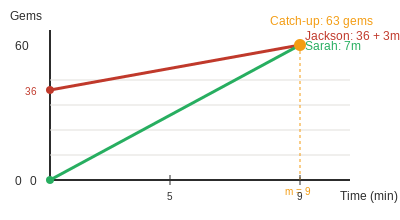
Jackson starts with 36 gems (red dot) and gains 3 per minute. Sarah starts at 0 gems (green dot) but gains 7 per minute. The lines cross when they have equal gems.
Solution: Method 1 — Equal Quantities Approach
The key insight is that when Sarah "catches up," both players have exactly the same number of gems. Let's define our variable and write expressions for each player's gem count.
Step 1 — Define the variable
Let m = the number of minutes after Sarah starts collecting gems.
Step 2 — Write Jackson's gem count
Jackson already has 36 gems when Sarah starts. After that, he earns 3 gems per minute for m minutes.
Jackson's gems = 36 + 3m
Step 3 — Write Sarah's gem count
Sarah starts with 0 gems and earns 7 gems per minute for m minutes.
Step 4 — Set up the equation
At the catch-up moment, both players have the same number of gems:
36 + 3m = 7m
Step 5 — Solve for m
Now we solve this linear equation:
36 = 7m - 3m (subtract 3m from both sides)
36 = 4m
m = 36 ÷ 4 = 9
Sarah catches up to Jackson after 9 minutes
Solution: Method 2 — Gap-Closing Rate
Here's a different way to think about it: focus on how fast Sarah closes the gap between them.
Step 1 — Identify the initial gap
When Sarah starts, Jackson is ahead by 36 gems.
Step 2 — Calculate the gap-closing rate
Each minute, Sarah gains 7 gems while Jackson gains only 3 gems. So the gap between them shrinks by:
Gap-closing rate = 7 - 3 = 4 gems per minute
Step 3 — Calculate time to close the gap
To close a 36-gem gap at 4 gems per minute:
Time = 36 ÷ 4 = 9 minutes
This confirms our answer: Sarah catches up in 9 minutes.
Verification
Let's check that both players have the same number of gems after 9 minutes:
- Jackson's gems:
36 + 3(9) = 36 + 27 = 63 gems - Sarah's gems:
7(9) = 63 gems
✓ Both have exactly 63 gems after 9 minutes, confirming our answer.
Watch Out For These
✗ Mistake 1: Forgetting Jackson's head start
Wrong: Setting up the equation as 3m = 7m
Why it's wrong: This assumes both players start with 0 gems, ignoring that Jackson already has 36 gems when the timing begins. The correct equation must include Jackson's initial 36 gems: 36 + 3m = 7m.
✗ Mistake 2: Mixing up who has which rate
Wrong: Writing Sarah's expression as 36 + 7m and Jackson's as 3m
Why it's wrong: This gives the head start to the wrong player. Jackson (3 gems/min) gets the head start, not Sarah (7 gems/min). Always match rates to the correct player.
✗ Mistake 3: Adding the rates instead of setting expressions equal
Wrong: Thinking the answer is 36 ÷ (3 + 7) = 3.6 minutes
Why it's wrong: This treats the problem like they're working together toward a total, but they're actually competing separately. We need the point where their individual totals become equal, not their combined rate.
The Pattern Behind This
This is a classic "catch-up" problem with a general structure you'll see again:
General Formula for Catch-Up Problems
When Person A has a head start and Person B has a faster rate:
Solving for time: Time = Head start ÷ (Faster rate - Slower rate)
In our problem: Time = 36 ÷ (7 - 3) = 9 minutes
This pattern appears whenever you need to find when two linear functions intersect, where one starts higher but grows slower than the other.
Real Applications
- Racing and sports: A runner with a head start being caught by a faster runner behind them
- Business and finance: A newer company with higher growth rates catching up to an established competitor
- Technology: Download speeds where one file started earlier but another is downloading faster
What If?
Jackson: 36 + 3m
Sarah: 15 + 7m (starts with bonus)
36 + 3m = 15 + 7m36 - 15 = 7m - 3m21 = 4mm = 5.25
Jackson: 36 + 3(5.25) = 51.75 gems
Sarah: 15 + 7(5.25) = 51.75 gems ✓
Answer: 5.25 minutes (5 minutes 15 seconds)
Let r = Jackson's rate
Jackson: 42 + r(6) = 42 + 6r
Sarah: 8(6) = 48
42 + 6r = 486r = 48 - 426r = 6r = 1
Jackson: 42 + 1(6) = 48 gems
Sarah: 8(6) = 48 gems ✓
Answer: Jackson earns 1 gem per minute
30 + 3m = 8m30 = 5mm = 6 minutes
30 + 3m = 5m30 = 2mm = 15 minutes
Sarah catches up in 6 minutes
Alex catches up in 15 minutes
Sarah wins the race to catch Jackson
Jackson: 30 + 3(6) = 48 gems
Sarah: 8(6) = 48 gems ✓
Answer: Sarah catches up first, after 6 minutes
After 5 minutes: 40 + 2(5) = 50 gems
Let t = minutes after Sarah joins
Jackson: 50 + 6t (now earning 6/min)
Sarah: 9t
50 + 6t = 9t50 = 3tt = 16⅔ minutes
Jackson: 50 + 6(16⅔) = 50 + 100 = 150 gems
Sarah: 9(16⅔) = 150 gems ✓
Answer: Sarah catches up 16⅔ minutes after she starts (16 minutes 40 seconds)
Frequently Asked Questions
2026-11-26