




Circular Motion: Centripetal Acceleration & Tension
What This Problem Teaches
- Converting between rotational frequency (rev/s) and linear velocity in circular motion
- Applying the centripetal acceleration formula: ac = v²/r
- Understanding the relationship between centripetal force and tension in horizontal circular motion
- Working with multiple connected physics concepts in a single problem
- Developing intuition for the magnitudes involved in rotational motion
Visualizing the Setup
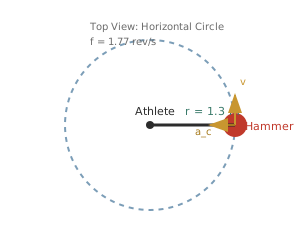
The hammer follows a circular path of radius 1.3 m. The velocity is always tangent to the circle, while the centripetal acceleration (and tension force) points toward the center.
Solution: The Linear Velocity Approach
Step 1 — Convert frequency to linear speed
The hammer completes 1.77 revolutions per second. In one revolution, it travels a distance equal to the circumference of the circle:
The linear speed is frequency times circumference:
Step 2 — Calculate centripetal acceleration
Centripetal acceleration is given by the formula ac = v²/r:
Step 3 — Find the tension in the chain
In horizontal circular motion, the chain tension provides the centripetal force. Using Newton's second law:
Solution: Method 2 — The Angular Velocity Route
Step 1 — Convert frequency to angular velocity
Angular velocity ω is related to frequency by ω = 2πf:
Step 2 — Use the rotational form of centripetal acceleration
Centripetal acceleration can also be expressed as ac = ω²r:
Step 3 — Calculate tension
The tension calculation remains the same:
Centripetal acceleration: 160.8 m/s²
Chain tension: 1047 N
Verification
Let's verify our answers by checking the dimensional analysis and magnitude:
Dimensional Check
Magnitude Check
The centripetal acceleration of 160.8 m/s² is about 16 times gravitational acceleration (16g). This is reasonable for an athletic hammer throw at high rotational speed.
The tension of 1047 N corresponds to supporting a weight of about 107 kg (235 lbs), which is plausible for a strong athlete whirling a heavy hammer at high speed.
Alternative Verification
We can verify by using the alternate formula ac = 4π²f²r:
Watch Out For These Mistakes
Some students write ac = (1.77)²/1.3 = 2.4 m/s². This treats frequency as if it were velocity, ignoring the need to convert rev/s to m/s.
Writing ac = v/r = 14.46/1.3 = 11.1 m/s² misses the quadratic relationship. Centripetal acceleration increases with the square of speed, not linearly.
Some students write T = mac + mg, but in horizontal circular motion, gravity acts vertically while tension acts horizontally. These forces are perpendicular, not additive.
Using ω = 1.77 rad/s directly instead of ω = 2π(1.77) = 11.12 rad/s. Remember: 1 revolution = 2π radians.
The Physics Behind This
This problem demonstrates several fundamental principles working together:
These three forms are equivalent and useful in different contexts. The v²/r form is intuitive when you know linear speed. The ω²r form is natural when working with angular motion. The 4π²f²r form is convenient when frequency is given directly.
The key insight is that circular motion requires constant acceleration toward the center, even though the speed is constant. This acceleration must be provided by some force—in this case, the tension in the chain.
The magnitude of this acceleration depends quadratically on the rotation rate. Double the frequency, and you quadruple both the centripetal acceleration and the required tension force.
Real Applications
- Engineering: Designing centrifuges for medical labs, where the centripetal acceleration can reach thousands of g's to separate blood components
- Automotive: Calculating maximum safe cornering speeds for vehicles, where tire friction provides the centripetal force
- Aerospace: Determining structural loads on rotating spacecraft components or helicopter rotors
- Athletics: Optimizing technique in hammer throw, discus, and other rotational sports
Four "What-If?" Problems
v = 2πrf = 2π(1.3)(2.2) = 18.0 m/s
ac = v²/r = (18.0)²/1.3 = 324/1.3 = 249.2 m/s²
T = mac = (6.51)(249.2) = 1622 N
The frequency increased by factor 2.2/1.77 = 1.24, so acceleration should increase by (1.24)² = 1.55. Indeed, 249.2/160.8 ≈ 1.55 ✓
Answer: ac = 249.2 m/s², T = 1622 N
ac = 160.8 m/s² (same calculation as before)
At the bottom, both tension and weight point toward the center (upward): T - mg = mac
T = mac + mg = (6.51)(160.8) + (6.51)(9.8) = 1047 + 63.8 = 1111 N
The tension is higher than horizontal motion by exactly the weight (mg = 63.8 N), which makes physical sense.
Answer: T = 1111 N
ac,max = Tmax/m = 1500/6.51 = 230.4 m/s²
vmax = √(ac,max × r) = √(230.4 × 1.3) = √299.5 = 17.31 m/s
fmax = vmax/(2πr) = 17.31/(2π × 1.3) = 17.31/8.17 = 2.12 rev/s
Check: ac = 4π²f²r = 4π²(2.12)²(1.3) = 230.4 m/s², so T = 6.51 × 230.4 = 1500 N ✓
Answer: fmax = 2.12 rev/s
Check if T = mac: 1296 = 7.2 × 180 = 1296 N ✓
We need another relationship. Use ac = ω²r, but first find ω from ac = 4π²f²r
From ac = v²/r, if we assume r = 1.5 m: v = √(180 × 1.5) = √270 = 16.43 m/s
Check: f = v/(2πr) = 16.43/(2π × 1.5) = 1.74 rev/s
ac = 4π²f²r = 4π²(1.74)²(1.5) = 180 m/s² ✓
Answer: r = 1.5 m, f = 1.74 rev/s
Frequently Asked Questions
2026-08-17