




Chase Problem: Catching Up at Different Speeds
What This Problem Teaches
- How to handle staggered start times in distance-rate-time problems
- Setting up equations where two moving objects travel equal distances
- Converting between total elapsed time and individual travel times
- Visualizing pursuit scenarios with head starts
- Checking answers using multiple calculation approaches
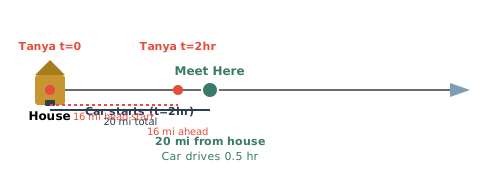
Solution: Method 1 — Equal Distance at Catch-Up
The key insight is that when you catch up to Tanya, both of you will have traveled the same total distance from your house.
Step 1 — Find Tanya's head start
Tanya runs for 2 hours before you start driving:
Step 2 — Set up the catch-up scenario
Let t = time (in hours) that you drive before catching up. When you catch up:
- You will have driven for
thours at 40 mph - Tanya will have been running for
(2 + t)hours total at 8 mph - Both distances from the house must be equal
Step 3 — Write the equal distance equation
40t = 8(2 + t)
Step 4 — Solve for catch-up time
40t = 16 + 8t
40t - 8t = 16
32t = 16
t = 0.5 hours
Step 5 — Calculate the distance from house
Using your travel: Distance = 40 mph × 0.5 hours = 20 miles
Solution: Method 2 — Relative Speed Approach
Think of this as a gap-closing problem. Tanya has a head start, and you're closing the gap at a certain rate.
Step 1 — Calculate the initial gap
When you start driving, Tanya is already 16 miles ahead (as calculated above).
Step 2 — Find the relative speed
You're gaining on Tanya at the difference in your speeds:
This means the gap closes at 32 miles per hour.
Step 3 — Calculate time to close the gap
Time to catch up = 16 miles ÷ 32 mph = 0.5 hours
Step 4 — Find distance from house
In 0.5 hours, you drive: 40 × 0.5 = 20 miles
Verification
Let's check our answer by verifying both people have traveled the same distance from the house:
She runs for 2.5 hours total: 8 mph × 2.5 hours = 20 miles ✓
Your total distance:
You drive for 0.5 hours: 40 mph × 0.5 hours = 20 miles ✓
Both distances equal 20 miles, confirming our answer is correct.
Watch Out For These
40t = 8t gives t = 0, which ignores that Tanya had a 2-hour head start. Always account for the time difference in pursuit problems.
40t = 8t instead of 40t = 8(2 + t). Remember: when you've been driving for t hours, Tanya has been running for 2 + t hours total.
The Pattern Behind This
Chase problems follow a general structure where you set equal the distances traveled by both moving objects. The key formula for staggered start problems is:
This pattern works whenever:
- Both objects travel along the same path
- One object has a head start in time
- Speeds remain constant
- You want to find when they're at the same location
How to Spot This Problem Type
Look for these key phrases that signal a chase/pursuit problem:
- "catches up" or "overtakes"
- "leaves X hours later" or "head start"
- "follows the same route" or "same path"
- "when will they meet" in the context of pursuit
These problems differ from "meeting in the middle" scenarios because one person starts before the other, rather than both starting simultaneously from different locations.
Why This Matters
Chase problems model many real situations:
- Emergency response: An ambulance catching up to a moving accident
- Navigation: A faster ship catching a slower one that left port earlier
- Sports: A cyclist making up time against a competitor with a head start
- Technology: Network packets or data streams with different transmission delays
Try These Variations
Distance = 6 mph × 3 hours = 18 miles
Let t = your driving time. When you catch up:Your distance = Sarah's distance45t = 6(3 + t)
45t = 18 + 6t39t = 18t = 18/39 = 6/13 hours ≈ 0.46 hours
Distance = 45 × (6/13) = 270/13 ≈ 20.8 miles
Sarah's total: 6 × (3 + 6/13) = 6 × 45/13 = 270/13 miles ✓
Answer: You'll catch up in about 28 minutes, 20.8 miles from the start.
After 20 minutes (1/3 hour) driving + 10 minutes stopped:
• You've driven 1/3 hour, traveled 40 × 1/3 = 13.33 miles
• Tanya has run for 2 + 1/3 + 1/6 = 2.5 hours total
• Tanya's distance: 8 × 2.5 = 20 miles
When you resume, Tanya is 20 - 13.33 = 6.67 miles ahead.
Let t = additional driving time to catch up:40t = 6.67 + 8t
32t = 6.67t = 6.67/32 ≈ 0.208 hours = 12.5 minutes
Total time from first start: 20 + 10 + 12.5 = 42.5 minutes
Your total distance: 13.33 + 40(0.208) = 21.67 miles
Tanya's distance: 8 × 2.708 = 21.67 miles ✓
Answer: 42.5 minutes total from when you first started.
From the original problem: You catch Tanya after 0.5 hours of driving.
This happens 2.5 hours after Tanya started.
When you catch Tanya (2.5 hours after Tanya started), your friend has been driving for:2.5 - 3 = -0.5 hours
This is negative, so your friend hasn't started yet!
Friend starts 3 hours after Tanya. Let t = friend's driving time:60t = 8(3 + t)60t = 24 + 8t52t = 24t = 24/52 = 6/13 ≈ 0.46 hours
• You: 0.5 hours after you start = 2.5 hours after Tanya starts
• Friend: 0.46 hours after friend starts = 3.46 hours after Tanya starts
At 2.5 hours: Tanya at 20 miles, you at 20 miles ✓
At 3.46 hours: Tanya at 27.7 miles, friend at 27.7 miles ✓
Answer: You catch Tanya first, after 30 minutes of driving.
Tanya will have run for: 2 + 0.75 = 2.75 hours
Her distance: 8 × 2.75 = 22 miles
You must travel 22 miles in 0.75 hours.
Let v = your required speed:v × 0.75 = 22
v = 22 ÷ 0.75 = 22 × (4/3) = 88/3 ≈ 29.33 mph
Gap to close: 16 miles
Relative speed: 29.33 - 8 = 21.33 mph
Time to close: 16 ÷ 21.33 = 0.75 hours ✓
29.33 mph is slower than the original 40 mph, which makes sense since you want to take longer (45 min vs 30 min) to catch up.
Answer: You must drive at 29.33 mph (or 88/3 mph exactly).
Frequently Asked Questions
2026-09-06