




Work Rate Problem: Combined Surveyor Efficiency
What This Problem Teaches
- Combined work rate calculation: How to add individual work rates to find the efficiency of a team working together
- Rate vs. time relationship: Understanding that work rates are the reciprocals of completion times
- Fraction addition with unlike denominators: Finding common denominators to combine fractional rates
- Reciprocal reasoning: Converting from a combined rate back to the time needed for completion
- Real-world collaboration modeling: How mathematical models predict the efficiency gains of teamwork
Visualizing the Problem
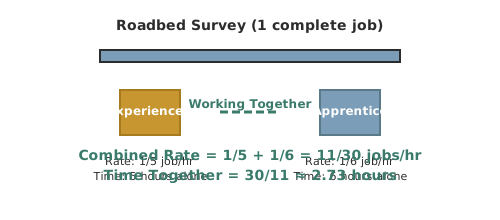
Solution: Method 1 — The Rate Addition Approach
Step 1 — Find individual work rates
The key insight is to convert each worker's completion time into a rate (fraction of job per hour):
Apprentice surveyor rate = 1 job ÷ 6 hours = 1/6 job per hour
Step 2 — Combine the work rates
When working together, their individual contributions add up. The combined rate is:
Step 3 — Add the fractions
To add fractions with different denominators, find the least common multiple of 5 and 6, which is 30:
1/6 = 5/30
Combined rate = 6/30 + 5/30 = 11/30 jobs per hour
Step 4 — Convert rate back to time
If they complete 11/30 of the job in 1 hour, how long for the complete job? Take the reciprocal:
Step 5 — Convert to hours and minutes
Converting the improper fraction to a mixed number:
8/11 × 60 minutes ≈ 43.6 minutes ≈ 44 minutes
Solution: Method 2 — The Work Completion Table
Step 1 — Set up the work completion table
Instead of working with rates directly, let's track how much work each person completes in the same time period:
| Time (hours) | Experienced Work | Apprentice Work | Total Work |
|---|---|---|---|
| 1 | 1/5 = 6/30 | 1/6 = 5/30 | 11/30 |
| 30/11 ≈ 2.73 | 6/11 | 5/11 | 1 (complete!) |
Step 2 — Find when total work equals 1
We need to find time t when the total work equals 1 complete job:
t(1/5 + 1/6) = 1
t(11/30) = 1
t = 30/11 hours
Step 3 — Verify using the table logic
At t = 30/11 hours, the experienced surveyor completes (1/5) × (30/11) = 6/11 of the job, and the apprentice completes (1/6) × (30/11) = 5/11 of the job. Together: 6/11 + 5/11 = 11/11 = 1 complete job. ✓
Verification
Let's check our answer by substituting back into the original problem structure:
Experienced surveyor completes: (30/11) ÷ 5 = 30/55 = 6/11 of the job
Apprentice surveyor completes: (30/11) ÷ 6 = 30/66 = 5/11 of the job
Total work completed: 6/11 + 5/11 = 11/11 = 1 complete job ✓
We can also verify this makes intuitive sense: both workers together should finish faster than either alone. Since the faster worker takes 5 hours alone, and the slower takes 6 hours, finishing in about 2.7 hours seems reasonable for their combined effort.
Watch Out For These
How to Spot This Problem Type
Work rate problems typically have these telltale signs:
- "Working together" or "combined effort" — signals that you need to add individual rates
- Two or more workers with different completion times — each worker's time converts to their individual rate
- "How long will it take" when multiple workers collaborate — you're looking for the reciprocal of the combined rate
- Context involving production, construction, or task completion — manufacturing widgets, painting houses, filling pools, or surveying land
- Individual times given, combined time unknown — the classic setup for rate addition problems
This same mathematical structure appears in electrical engineering (parallel resistors), network computing (parallel processing), and pharmacology (drug clearance rates). Learning to recognize the pattern serves you across many fields.
The General Formula
For any two-worker collaboration problem, the pattern is always the same:
then working together they take: 1 ÷ (1/t₁ + 1/t₂) time units
This simplifies to the more memorable form:
In our surveyor problem: (5 × 6) ÷ (5 + 6) = 30 ÷ 11 = 30/11 hours
Real Applications
- Construction project management: Estimating completion times when multiple crews with different productivity rates work on the same job site
- Network engineering: Calculating data transfer speeds when multiple connections work in parallel to download the same file
- Manufacturing optimization: Determining production schedules when different assembly lines with varying throughputs collaborate on the same order
- Medical pharmacology: Modeling how multiple elimination pathways (kidney and liver) work together to clear drugs from the body
Sanity Check
Our answer of 2 hours and 44 minutes passes several reasonableness tests:
| Scenario | Time Required |
|---|---|
| Experienced surveyor alone | 5 hours |
| Apprentice alone | 6 hours |
| Both working together | 2.73 hours |
| If both were as fast as experienced | 2.5 hours |
| If both were as slow as apprentice | 3 hours |
Our answer falls exactly where it should: faster than either worker alone, but between the "both experienced" and "both apprentice" scenarios. The collaboration provides genuine efficiency gains.
What If?
Experienced rate = 1/4 job per hour, Apprentice rate = 1/6 job per hour
Combined rate = 1/4 + 1/6. Common denominator is 12: 3/12 + 2/12 = 5/12 jobs per hour
Time = 1 ÷ (5/12) = 12/5 = 2.4 hours
2.4 hours = 2 hours and 24 minutes
In 2.4 hours: experienced completes 2.4/4 = 0.6, apprentice completes 2.4/6 = 0.4. Total: 0.6 + 0.4 = 1.0 ✓
Answer: 2 hours and 24 minutes
In 2 hours alone, apprentice completes 2 × (1/6) = 2/6 = 1/3 of the job
Work remaining = 1 - 1/3 = 2/3 of the job
Combined rate = 1/5 + 1/6 = 6/30 + 5/30 = 11/30 jobs per hour
Time for 2/3 job at 11/30 rate: (2/3) ÷ (11/30) = (2/3) × (30/11) = 20/11 hours
Total = 2 hours (apprentice alone) + 20/11 hours (together) = 22/11 + 20/11 = 42/11 hours ≈ 3.82 hours = 3 hours 49 minutes
Answer: 3 hours and 49 minutes total
Experienced: 1/5 job/hr, Apprentice: 1/6 job/hr, Intermediate: 1/8 job/hr
Combined rate = 1/5 + 1/6 + 1/8. LCM of 5, 6, 8 is 120.
1/5 = 24/120, 1/6 = 20/120, 1/8 = 15/120
Combined = 24/120 + 20/120 + 15/120 = 59/120 jobs per hour
Time = 1 ÷ (59/120) = 120/59 hours ≈ 2.03 hours
120/59 hours ≈ 2 hours 2 minutes
Answer: 2 hours and 2 minutes
Let x = apprentice's time alone. Combined rate equation: 1/5 + 1/x = 1/3
1/x = 1/3 - 1/5 = 5/15 - 3/15 = 2/15
If 1/x = 2/15, then x = 15/2 = 7.5 hours
Check: 1/5 + 1/7.5 = 1/5 + 2/15 = 3/15 + 2/15 = 5/15 = 1/3 ✓
Answer: The apprentice takes 7.5 hours working alone
Frequently Asked Questions
2026-10-31