




Finding Individual Work Rate from Combined Rate
What This Problem Teaches
- Rate addition principle: Individual work rates add together to give the combined rate
- Converting between time and rate: If a job takes t hours, the rate is 1/t jobs per hour
- Setting up rational equations: Work problems create equations with variables in denominators
- Solving for unknown rates: Using algebra to find the missing piece of a rate relationship
- Real-world rate reasoning: Understanding how cooperation speeds up task completion
Visualizing the Work Rates
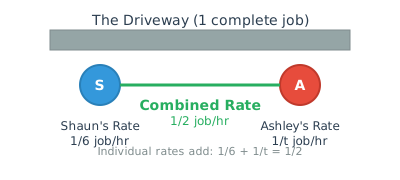
In work problems, think of each person contributing a fraction of the job per hour. These rates add together when people work simultaneously.
Solution: Method 1 — The Rate Addition Approach
Step 1 — Define the variable
Let t = the number of hours it takes Ashley to shovel the driveway alone.
Step 2 — Express individual work rates
Work rate = fraction of job completed per hour:
- Shaun's rate:
1/6driveway per hour (since he takes 6 hours alone) - Ashley's rate:
1/tdriveway per hour (since she takesthours alone)
Step 3 — Set up the rate equation
When working together, their rates add up. Since they complete the job in 2 hours together, their combined rate is 1/2 driveway per hour:
1/6 + 1/t = 1/2
Step 4 — Solve for t
Subtract Shaun's rate from both sides:
Find a common denominator (6):
Therefore:
Solution: Method 2 — Work Accomplished Analysis
Step 1 — Calculate work done in the joint time
In the 2 hours they work together, we know the entire driveway gets shoveled. Let's see how much each person contributes.
Step 2 — Find Shaun's contribution
Shaun works at 1/6 driveway per hour. In 2 hours:
Step 3 — Find Ashley's contribution
Since the whole job is done, Ashley must do the remaining portion:
Step 4 — Calculate Ashley's rate and time
Ashley completes 2/3 of the job in 2 hours, so her rate is:
To complete 1 whole driveway at this rate:
Verification
Let's check our answer by substituting back into the original rate equation:
This matches their combined rate of 1/2 driveway per hour (finishing in 2 hours). ✓
Alternative check: In 2 hours working together:
- Shaun completes:
2 × (1/6) = 1/3of the driveway - Ashley completes:
2 × (1/3) = 2/3of the driveway - Total completed:
1/3 + 2/3 = 1complete driveway ✓
Common Pitfalls
Students often think: "If Shaun takes 6 hours and together they take 2 hours, Ashley must take 6 - 2 = 4 hours." This ignores how rates actually combine.
Writing 6 + t = 2 confuses times with rates. Times don't add—rates do. The correct equation involves 1/6 + 1/t = 1/2.
Finding Ashley's rate as 1/3 and stopping there. Remember: if her rate is 1/3 job per hour, she takes 3 hours to complete 1 job.
Calculating 1/2 - 1/6 as 1/4 instead of 1/3. Always find a common denominator: 3/6 - 1/6 = 2/6 = 1/3.
Does This Answer Make Sense?
Ashley taking 3 hours alone is completely reasonable. Here's why:
- She's faster than Shaun: 3 hours vs. 6 hours means Ashley works twice as fast
- The improvement makes sense: Adding a faster worker should significantly reduce the combined time from 6 hours to 2 hours
- Rate comparison: Ashley's rate (1/3 per hour) is indeed twice Shaun's rate (1/6 per hour)
- Boundary check: If Ashley were infinitely fast, they'd finish in close to 0 hours. If she were infinitely slow, they'd still take about 6 hours. Our answer of 2 hours falls reasonably between these extremes.
The General Formula
For any work problem where you know one person's time and the combined time, here's the pattern:
then person B takes time b where:
1/a + 1/b = 1/c
Solving for b: b = (a × c)/(a - c)
In our problem: a = 6, c = 2, so:
Important limitation: This formula only works when the faster worker's time is less than the combined time. If a ≤ c, the problem setup is impossible.
Where This Shows Up in Real Life
- Computer processing: When multiple CPU cores work on the same task, their processing rates combine similarly
- Manufacturing: Assembly lines with workers of different speeds—knowing combined output to optimize staffing
- Network bandwidth: Combining multiple internet connections doubles your effective download rate
- Medical dosing: When multiple drugs clear from the body at different rates, calculating combined clearance
What If?
Let t = Ashley's time alone. Shaun's rate is 1/4, Ashley's is 1/t, combined is 1/3:1/4 + 1/t = 1/3
1/t = 1/3 - 1/4 = 4/12 - 3/12 = 1/12
Therefore t = 12
Ashley takes 12 hours alone vs. Shaun's 4 hours, so Ashley is slower than Shaun.
1/4 + 1/12 = 3/12 + 1/12 = 4/12 = 1/3 ✓
Answer: Ashley takes 12 hours alone (slower than Shaun)
Shaun's rate: 1/5 driveway per hour
Ashley's rate: 1/3 driveway per hour
Combined rate = 1/5 + 1/3 = 3/15 + 5/15 = 8/15 driveway per hour
Time = 1 ÷ (8/15) = 15/8 = 1.875 hours = 1 hour 52.5 minutes
In 1.875 hours: Shaun does 1.875 × (1/5) = 0.375, Ashley does 1.875 × (1/3) = 0.625
Total: 0.375 + 0.625 = 1 ✓
Answer: 1 hour and 52.5 minutes (or 15/8 hours)
Shaun: 1/6 per hour
Ashley: 1/3 per hour
Ben: 1/4 per hour
Combined rate = 1/6 + 1/3 + 1/4
Find common denominator (12): 2/12 + 4/12 + 3/12 = 9/12 = 3/4
Time = 1 ÷ (3/4) = 4/3 hours = 1 hour 20 minutes
In 4/3 hours each person completes: (4/3) × (1/6) + (4/3) × (1/3) + (4/3) × (1/4) = 2/9 + 4/9 + 3/9 = 9/9 = 1 ✓
Answer: 1 hour and 20 minutes (or 4/3 hours)
Let t = Ashley's time alone. Ashley works for 1 hour alone, then both work for 0.75 hours.
Shaun's rate: 1/4 per hour, Ashley's rate: 1/t per hour
Ashley's solo work: 1 × (1/t) = 1/t
Combined work: 0.75 × (1/4 + 1/t) = 0.75 × (1/4) + 0.75 × (1/t)
Total work = 1 complete job:1/t + 0.75/4 + 0.75/t = 11/t + 3/16 + 3/(4t) = 1(1 + 3/4)/t + 3/16 = 17/(4t) = 1 - 3/16 = 13/16
7/(4t) = 13/167 × 16 = 13 × 4t112 = 52tt = 112/52 = 28/13 ≈ 2.15 hours
Answer: Ashley would take 28/13 hours (about 2 hours 9 minutes) alone
Frequently Asked Questions
Add the individual rates together. If one person completes 1/6 of a job per hour and another completes 1/t jobs per hour, their combined rate is 1/6 + 1/t jobs per hour. In this problem, we know their combined rate is 1/2 job per hour (since they finish in 2 hours together), so 1/6 + 1/t = 1/2.
Work rate is jobs per unit time (like 1/6 job per hour), while completion time is the reciprocal (6 hours per job). If someone takes t hours to complete one job, their rate is 1/t jobs per hour. Here, Shaun takes 6 hours alone, so his rate is 1/6 job per hour.
Because rates add, not times. Averaging Shaun's 6 hours with Ashley's unknown time doesn't account for how much work each person actually does per hour. You must work with rates (jobs per hour), add those rates, then convert back to time. In this problem, the correct approach gives Ashley 3 hours, not an average.
2026-10-20