




Conditional Probability Word Problem: Flight Luggage Problem
What You Will Learn
- How to identify conditional probability problems where later events depend on earlier outcomes
- When and how to apply the law of total probability to find overall probabilities
- How to construct and interpret probability tree diagrams for multi-stage processes
- The distinction between conditional probability P(B|A) and independent events
- How to verify probability answers using the multiplication and addition rules
Picture This
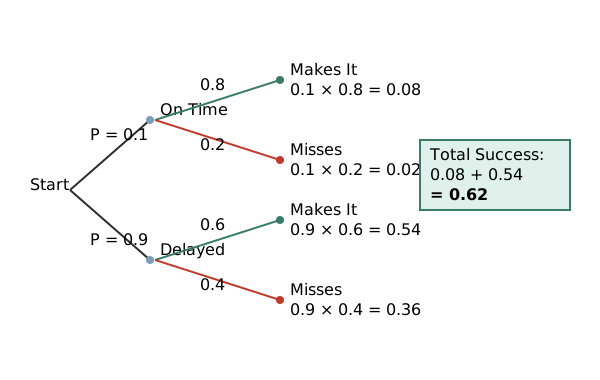
This tree diagram shows all possible paths for Leah's luggage. The key insight is that there are two different routes to success, each with its own probability that must be calculated separately and then combined.
Solution: Method 1 — The Law of Total Probability
This is a classic conditional probability problem where we need to find the overall probability by considering all possible scenarios that lead to our desired outcome.
Step 1 — Identify the paths to success
Leah's luggage can arrive with her in exactly two ways:
- Path 1: Flight is on time AND luggage makes the connection
- Path 2: Flight is delayed AND luggage makes the connection
Step 2 — Calculate the probability of Path 1
For the on-time scenario:
Step 3 — Calculate the probability of Path 2
For the delayed scenario:
Note that P(delayed) = 1 - P(on time) = 1 - 0.1 = 0.9.
Step 4 — Apply the law of total probability
Since these paths are mutually exclusive (the flight is either on time OR delayed, not both), we add their probabilities:
Solution: Method 2 — Organized Table Approach
Another way to see this problem is through a systematic breakdown of all possible outcomes and their probabilities.
Step 1 — Set up the probability table
Let's organize all four possible combinations of flight timing and luggage outcome:
| Flight Status | P(Flight Status) | Luggage Outcome | P(Luggage | Flight Status) | Joint Probability |
|---|---|---|---|---|
| On Time | 0.1 | Makes It | 0.8 | 0.1 × 0.8 = 0.08 |
| On Time | 0.1 | Misses | 0.2 | 0.1 × 0.2 = 0.02 |
| Delayed | 0.9 | Makes It | 0.6 | 0.9 × 0.6 = 0.54 |
| Delayed | 0.9 | Misses | 0.4 | 0.9 × 0.4 = 0.36 |
Step 2 — Identify successful outcomes
The highlighted rows represent scenarios where the luggage "Makes It" to Vancouver. We want the probability of either of these successful outcomes.
Step 3 — Sum the joint probabilities
As a verification, notice that all four joint probabilities sum to 1.00, as they should: 0.08 + 0.02 + 0.54 + 0.36 = 1.00 ✓
Verification
Let's check our answer using the fundamental rules of probability:
Verify that all probabilities are valid
- All conditional probabilities are between 0 and 1 ✓
- P(on time) + P(delayed) = 0.1 + 0.9 = 1.0 ✓
- For each flight status, the luggage probabilities sum to 1:
- On time: 0.8 + 0.2 = 1.0 ✓
- Delayed: 0.6 + 0.4 = 1.0 ✓
Verify our answer makes sense
Our answer of 0.62 should be between the two conditional probabilities (0.6 and 0.8), but closer to 0.6 since delays are much more likely than on-time flights (0.9 vs 0.1). Indeed:
The answer is much closer to 0.6, which makes sense given that 90% of the probability mass comes from the delayed-flight scenario.
Double-check by calculating P(luggage misses)
The probability the luggage misses should be 1 - 0.62 = 0.38. Let's verify:
Watch Out For These
Some students calculate just
0.1 × 0.8 = 0.08 and stop there. This only accounts for the on-time scenario and ignores the much more likely delayed-flight path to success.
Calculating
P(flight) × P(luggage) = 0.1 × 0.8 = 0.08 ignores that luggage success depends heavily on flight timing. You can't use just one conditional probability when they're different.
Computing
0.8 + 0.6 = 1.4 makes no sense – these are conditional probabilities that apply to different scenarios, not outcomes you can simply add together.
Since P(on time) = 0.1, then P(delayed) must be 0.9, not 0.1. This is a common reading error that leads to calculating
0.1 × 0.6 = 0.06 instead of 0.9 × 0.6 = 0.54.
The Pattern Behind This
This problem exemplifies the Law of Total Probability, one of the fundamental tools in probability theory. The general formula when an event A can occur through multiple mutually exclusive scenarios B₁, B₂, ..., Bₙ is:
In our specific case:
- A = "luggage arrives"
- B₁ = "flight on time", B₂ = "flight delayed"
- P(A|B₁) = 0.8, P(A|B₂) = 0.6
- P(B₁) = 0.1, P(B₂) = 0.9
So: P(A) = 0.8 × 0.1 + 0.6 × 0.9 = 0.08 + 0.54 = 0.62
This pattern appears everywhere: medical diagnosis (symptoms depend on disease), quality control (defect rates depend on production conditions), weather forecasting (rain probability depends on cloud types), and many more real-world scenarios.
How to Spot This Problem Type
Look for these tell-tale signs that signal a conditional probability problem requiring the law of total probability:
- "If... then..." language: "If the flight is on time, then..." or "Given that..., the probability is..."
- Multiple stages: The problem describes a sequence of events where later outcomes depend on earlier results
- Different probabilities for different scenarios: The same event has different probabilities depending on what happened earlier
- Conditional probability notation: Expressions like P(A|B) appearing in the problem or solution
- Two-way dependence: Event B affects the probability of event A, and you need the overall probability of A
Common contexts include: medical testing, manufacturing quality, transportation systems, communication networks, and any multi-step process where earlier failures affect later success rates.
Real Applications
This type of conditional probability calculation is essential in many professional contexts:
- Medical diagnosis: Disease probability depends on test results, but test accuracy varies with the disease being present or absent. Overall diagnosis probability requires considering both positive and negative test scenarios weighted by disease prevalence.
- Network reliability: Data packet success rates depend on network congestion levels. System performance analysts calculate overall delivery rates by considering peak and off-peak scenarios with their respective success probabilities.
- Financial risk assessment: Investment returns depend on market conditions. Portfolio managers calculate expected returns by weighting bull-market and bear-market scenarios by their likelihood and respective return rates.
- Quality control: Product defect rates vary with production conditions (temperature, humidity, shift timing). Overall defect probability considers all conditions weighted by how often each occurs.
What If?
P(on time) = 0.3, so P(delayed) = 1 - 0.3 = 0.7. Conditional probabilities unchanged.
P(arrives via on-time) = 0.3 × 0.8 = 0.24
P(arrives via delayed) = 0.7 × 0.6 = 0.42
P(luggage arrives) = 0.24 + 0.42 = 0.66
Answer 0.66 is between 0.6 and 0.8, and closer to 0.6 since delays (70%) still outweigh on-time flights (30%). Answer: 0.66 or 66%
P(first flight on time) = 0.2, P(first flight delayed) = 0.8
P(arrives via on-time) = 0.2 × 0.9 = 0.18
P(arrives via delayed) = 0.8 × 0.7 = 0.56
P(luggage arrives) = 0.18 + 0.56 = 0.74
0.74 lies between 0.7 and 0.9, weighted toward 0.7 since delays are more common. Answer: 0.74 or 74%
Using total probability: 0.75 = 0.2 × 0.9 + 0.8 × P(makes it | delayed)
0.2 × 0.9 = 0.18
0.75 = 0.18 + 0.8 × P(makes it | delayed)0.57 = 0.8 × P(makes it | delayed)
P(makes it | delayed) = 0.57 ÷ 0.8 = 0.7125
Check: 0.2 × 0.9 + 0.8 × 0.7125 = 0.18 + 0.57 = 0.75 ✓ Answer: 0.7125 or 71.25%
We want P(on time | luggage arrived). This is a Bayes' theorem problem.
P(on time | arrived) = P(arrived | on time) × P(on time) ÷ P(arrived)
From original problem: P(arrived | on time) = 0.8, P(on time) = 0.1, P(arrived) = 0.62
P(on time | arrived) = (0.8 × 0.1) ÷ 0.62 = 0.08 ÷ 0.62 ≈ 0.129
Even when luggage arrives successfully, there's only a 12.9% chance the flight was on time, since delays are so much more common. Answer: 0.129 or 12.9%
Frequently Asked Questions
2026-08-27