




Dimes and Nickels: Solving a Coin Problem
Thirty coins, all dimes and nickels, are worth $2.60. How many nickels are there?
Already Got the Answer?
n + d = 30 and 5n + 10d = 260 (value in cents).Answer:
n = 8 nickels (and d = 22 dimes).One-line check:
8(5) + 22(10) = 40 + 220 = 260¢ = $2.60 ✓
- If your answer was 22, you found the dimes. The question asks for nickels.
- If you got something odd, check that you converted $2.60 to 260 cents before building the equation.
Stay for the second and third methods, which solve this problem with no unknowns, and for the four extension problems at the bottom.
What You Will Learn
- Separating "how many" from "how much." Every coin problem hides two different quantities: a count of coins and a value in cents. Keeping them apart is the whole skill.
- Building a two-equation system from a story and solving it by substitution.
- Choosing a common unit. Why converting dollars to cents before writing any equation prevents the most common error.
- Reasoning without algebra. The "assume they're all dimes" trick and the weighted-average balance both reach the answer through logic about differences.
- Recognizing a pattern. This is the same structure as any "two kinds of thing, known total count, known total amount" problem, from ticket sales to chemical mixtures.
The Setup
Before writing any equation, let's organize what we know and what we don't. Each coin type gets a row, and each row tracks three things: how many coins, what each is worth, and the total value they contribute.
| Coin | Number of coins | Value of one coin | Total value |
|---|---|---|---|
| Nickels | n | 5¢ | 5n cents |
| Dimes | d | 10¢ | 10d cents |
| Total | 30 | — | 260 cents ($2.60) |
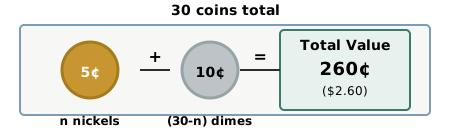
Once the table is filled in, here is the same problem as it will look when solved (22 dimes and 8 nickels), drawn to scale by coin count:
Solution: Method 1 — The Substitution Approach
This is the textbook route: translate the story into two equations, then use one to eliminate a variable from the other.
Step 1 — Name the unknowns and pick a unit
Let n be the number of nickels and d the number of dimes. The money total is given in dollars but the coins are worth 5 and 10 cents, so convert now:
Step 2 — Write one equation for the count
Every coin is either a nickel or a dime, and there are 30 coins:
Step 3 — Write one equation for the value
Each nickel contributes 5 cents and each dime 10 cents, so the total value in cents is:
Step 4 — Substitute
Solve the count equation for d: d = 30 − n. Since the question asks for nickels, replace d in the value equation so that only n remains:
Step 5 — Recover the other coin
There are 8 nickels and 22 dimes.
Solution: Method 2 — The "Everything Is a Dime" Trick
This method has no variables at all. You start with a deliberately wrong picture, measure how wrong it is, and fix it one coin at a time.
Step 1 — Pretend all 30 coins are dimes
Step 2 — Measure the error
The real total is 260¢, so the pretend pile is too rich by:
Step 3 — Fix it one swap at a time
Each time you replace a dime with a nickel, the total drops by 10¢ − 5¢ = 5¢. To remove 40¢ of excess, you need:
Eight dimes became nickels, so there are 8 nickels and 30 − 8 = 22 dimes.
300 − 260, the "5¢ per swap" is the coefficient of n you saw in −5n = −40. The algebra and the logic are the same calculation.
Solution: Method 3 — The Average-Coin Balance
Here is a third way to see it, built around the average value of a coin. It matters because it generalizes to mixture problems.
Step 1 — Find the average coin
Step 2 — Locate the average between 5¢ and 10¢
The average sits between the two coin values, like a balance point on a seesaw. Measure how far it is from each end:
Step 3 — Balance the seesaw
The average is closer to the dime, so dimes are more numerous. The balance rule says the counts are in the opposite ratio of the distances:
That makes 15 equal parts for 30 coins, so each part is 2 coins. Nickels: 4 × 2 = 8. Dimes: 11 × 2 = 22. Same answer, a third way.
The Answer
Verification
Check both original conditions, not just one. A wrong answer can satisfy the count and still miss on the money, or the reverse.
Count:8 + 22 = 30 coins ✓
Value:8 × 5¢ = 40¢ and 22 × 10¢ = 220¢, so 40 + 220 = 260¢ = $2.60 ✓
Independent check: Three different methods produced 8. That agreement is itself strong evidence.
What Trips People Up
Mixing units. The coin values are in dollars here but 260 is in cents. This equation says 30 coins are worth $260, and it produces nonsense. Choose one unit before writing the first equation. Cents are easier because they remove the decimals. If you prefer dollars, write 0.05n + 0.10d = 2.60.
Putting the count in the value equation. The number 30 counts coins, not cents. Each equation must have a consistent meaning. In the value equation, every term, including the right-hand side, is in cents.
Answering the wrong question. It is easy to solve for d first and stop. The question asks for nickels. Before you write your final answer, glance back at the question and make sure the number you boxed matches it.
Substituting without parentheses. When replacing d with 30 − n, the whole expression must be multiplied by 10: 10(30 − n). Dropping the parentheses changes the sign of the n term and leads to a wrong answer.
The Pattern Behind This
Coin problems are one instance of a very general structure: two kinds of item, a known total count, and a known total amount. If the two values per item are a (lower) and b (higher), there are N items, and the total amount is T, then the number of lower-value items is:
That is just Method 2 written as a formula: pretend all are the higher kind (bN), subtract the real total (T) to get the excess, and divide by the amount each swap removes (b − a). Here:
The same structure appears whenever you see "adult and child tickets," "two-price shipments," or "a mixture of two solutions."
When the Answer Isn't Neat
In most word problems, a decimal answer is perfectly fine. In coin problems, a non-integer answer carries a different message. Suppose the total were $2.62 instead of $2.60:
You cannot have 7.6 nickels. The method worked correctly. The problem itself is impossible, because every combination of 30 dimes and nickels has a total divisible by 5. When a count comes out fractional, check your arithmetic first. If the arithmetic is right, the problem as stated has no valid answer. This is a useful habit for judging whether a problem is well-posed.
Try These Variations
Four problems, roughly in order of difficulty. Try each on paper before clicking.
Thirty coins, all dimes and nickels, are worth $2.10. How many nickels are there?
$2.10 = 210¢
n + d = 30 and 5n + 10d = 210
d = 30 − n5n + 10(30 − n) = 210, so 300 − 5n = 210, giving −5n = −90 and n = 18.
d = 30 − 18 = 12
18(5) + 12(10) = 90 + 120 = 210¢ ✓ and 18 + 12 = 30 ✓. There are 18 nickels.
A jar contains only dimes and nickels worth $2.70 in all. There are 6 more dimes than nickels. How many coins are in the jar?
Let n = nickels. Then dimes d = n + 6. Value in cents: $2.70 = 270¢.
5n + 10(n + 6) = 270. No count is given this time. The "6 more" clue replaces it.
5n + 10n + 60 = 270, so 15n = 210 and n = 14.
d = 14 + 6 = 20, so the jar holds 14 + 20 = 34 coins.
14(5) + 20(10) = 70 + 200 = 270¢ ✓ and 20 − 14 = 6 ✓. The jar contains 34 coins.
Thirty coins, all nickels, dimes, and quarters, are worth $5.00. There are twice as many dimes as nickels. How many of each coin are there?
Let n = nickels. Dimes d = 2n. Quarters are whatever is left: q = 30 − n − 2n = 30 − 3n. Value: $5.00 = 500¢.
5n + 10(2n) + 25(30 − 3n) = 500
5n + 20n + 750 − 75n = 500, so −50n + 750 = 500, giving −50n = −250 and n = 5.
d = 2(5) = 10 and q = 30 − 15 = 15.
Count: 5 + 10 + 15 = 30 ✓. Value: 25 + 100 + 375 = 500¢ ✓. 5 nickels, 10 dimes, and 15 quarters.
Thirty coins, all dimes and nickels, are worth $2.60. A friend trades every nickel for a dime and every dime for a nickel, so the number of each kind is exchanged. What is the new total value?
From the main problem: 8 nickels and 22 dimes.
After the exchange, there are 22 nickels and 8 dimes. The total is still 30 coins.
22 × 5¢ = 110¢ and 8 × 10¢ = 80¢, so the new total is 110 + 80 = 190¢.
Pair each original coin count with its swapped partner: the original and new values together equal 8(5 + 10) + 22(10 + 5) = 30 × 15 = 450¢. Therefore the new value is 450 − 260 = 190¢.
Both routes give 190¢. The new total is $1.90.
Where This Leads
With two coin types, the problem is a system of two equations. With three or more types, you need additional relationships between the counts, which turns it into a larger system and eventually into matrix methods. The averaging idea from Method 3 leads directly to weighted averages and to chemical mixture problems, where "coins" become liters of solution at different concentrations. Here is a question to think about: if all 30 coins are dimes, nickels, and pennies and worth $2.60, how many solutions exist? Is there still a unique answer?
Frequently Asked Questions
2026-06-11