




Two Travelers Meeting at Same Time: Solve for Speed
What This Problem Teaches
- Setting up equations from distance-rate-time relationships
- Working with relative speeds (one person faster than another)
- Recognizing when equal times create solvable equations
- Cross-multiplying to eliminate fractions efficiently
- Checking answers by verifying both travelers' times match
Visualizing the Journey
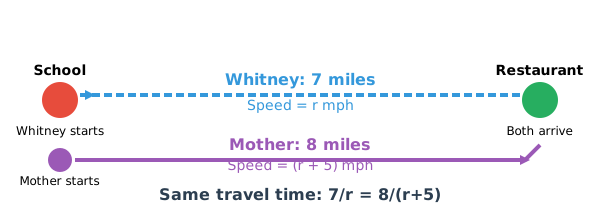
Solution: Method 1 — The Equal Times Approach
Step 1 — Define the variable
Let r = Whitney's speed in mph. Since her mother travels 5 mph faster, the mother's speed is (r + 5) mph.
Step 2 — Set up time expressions
Both travelers take the same amount of time to reach the restaurant. Using the formula Time = Distance ÷ Rate:
Mother's time = 8/(r + 5) hours
Step 3 — Create the equation
Since they arrive at the same time, their travel times are equal:
Step 4 — Cross-multiply to eliminate fractions
Cross-multiplication gives us:
7r + 35 = 8r
Step 5 — Solve for r
Subtract 7r from both sides:
35 = r
Solution: Method 2 — The Algebraic Substitution Method
Step 1 — Set up distance and rate variables
Let t = the travel time for both people (in hours). Since Distance = Rate × Time, we can write:
Mother: 8 = (r + 5) × t, so r + 5 = 8/t
Step 2 — Use the speed relationship
Since the mother travels 5 mph faster than Whitney:
Step 3 — Solve for t
Subtract 7/t from both sides:
1/t = 5
t = 1/5 = 0.2 hours
Step 4 — Find Whitney's speed
Using r = 7/t:
Verification
Let's check that both travelers indeed take the same time:
Whitney's travel time
Mother's travel time
Mother's speed = 35 + 5 = 40 mph
Both times equal 0.2 hours (12 minutes), confirming our answer is correct.
Watch Out For These Mistakes
Wrong approach: Letting Whitney's speed be (r + 5) and mother's speed be r.
Why it's wrong: The problem states the mother travels faster than Whitney, not the other way around. Always read carefully to see who is faster.
Wrong approach: Setting up 7 + 8 = 15 miles and trying to work from there.
Why it's wrong: This is a meeting problem, not a total distance problem. The key insight is that both people travel for the same amount of time, not that they cover the same total distance.
Wrong approach: From 7/r = 8/(r+5), writing 7(r+5) = 8 instead of 7(r+5) = 8r.
Why it's wrong: When cross-multiplying a/b = c/d, you get ad = bc. Here, that means 7(r+5) = 8r, not 7(r+5) = 8.
Recognizing This Problem Type
Distance-rate-time meeting problems have these telltale signs:
- "At the same time" - indicates simultaneous departure or arrival
- "X mph faster/slower" - creates a relative speed relationship
- Different distances - each person travels a different distance to the same destination
- "Find the speed" - asks for rate, not time or distance
Key insight: When two people start simultaneously and arrive simultaneously, they travel for exactly the same amount of time, even if they cover different distances at different speeds. This equal-time condition is what makes the problem solvable.
The Pattern Behind This
This problem follows the general pattern for simultaneous travel problems:
and person B travels distance d₂ at speed (s + k)
for the same time t, then:
d₁/s = d₂/(s + k)
Cross-multiplying gives us: d₁(s + k) = d₂s, which simplifies to d₁k = s(d₂ - d₁).
In our problem: d₁ = 7, d₂ = 8, k = 5, so 7 × 5 = s(8 - 7), giving us s = 35.
This formula works whenever you have two people traveling different distances at related speeds for the same duration.
Does This Seem Reasonable?
Let's do a sanity check on our answer of 35 mph:
Whitney: 35 mph for 7 miles takes 7/35 = 0.2 hours = 12 minutes
Mother: 40 mph for 8 miles takes 8/40 = 0.2 hours = 12 minutes
Both speeds are reasonable for city driving, and it makes sense that someone traveling a longer distance (8 vs 7 miles) would need to go faster (40 vs 35 mph) to arrive at the same time. The 5 mph speed difference is modest and realistic.
Reality check: If both people traveled the same speed, the person going 8 miles would take longer. Since they arrive simultaneously, the person going farther must travel faster - which matches our solution.
Four "What-If?" Problems
Let r = Whitney's speed, so mother's speed = r + 5
9/r = 12/(r + 5)
9(r + 5) = 12r9r + 45 = 12r
45 = 12r - 9r = 3rr = 15
Whitney: 9/15 = 0.6 hours
Mother: 12/20 = 0.6 hours ✓
Answer: Whitney's speed is 15 mph
Time = 7 miles ÷ 28 mph = 0.25 hours
Mother travels 8 miles in 0.25 hours
Speed = 8 ÷ 0.25 = 32 mph
32 - 28 = 4 mph faster
Whitney: 7/28 = 0.25 hours
Mother: 8/32 = 0.25 hours ✓
Answer: The mother travels 4 mph faster
Time = 7 ÷ 21 = 1/3 hour = 20 minutes
Mother leaves 4 minutes later, so has 20 - 4 = 16 minutes = 16/60 hours = 4/15 hours
Speed = Distance ÷ Time = 8 ÷ (4/15) = 8 × 15/4 = 30 mph
Whitney: travels 20 minutes
Mother: leaves 4 minutes late, travels 8 miles at 30 mph in 16 minutes
Both arrive after 20 minutes total ✓
Answer: The mother must travel at 30 mph
Whitney: r mph, Mother: r + 5 mph, Father: r + 8 mph
Whitney = Mother: 7/r = 8/(r + 5)
Whitney = Father: 7/r = 10/(r + 8)
7(r + 5) = 8r7r + 35 = 8rr = 35
7/35 = 10/(35 + 8)0.2 = 10/43
This gives 0.233..., not 0.2, so no solution exists with these constraints.
For a valid solution, father must be exactly 10 mph faster than Whitney.
Then: Whitney = 35 mph, Mother = 40 mph, Father = 45 mph
Answer: This system has no solution as stated. For simultaneous arrival, the father would need to be exactly 10 mph faster than Whitney.
Frequently Asked Questions
2026-08-04