




Dimes and Quarters: System of Equations
James has dimes and quarters saved up in his change jar. He has a total of 162 coins totaling $46.20. How many dimes does James currently have?
Already Got the Answer? Check It Here
Setup:d + q = 162 and 10d + 25q = 4620 (cents).
Algebra gives:d = −38, q = 200.
Verdict: No valid answer exists. 162 coins of dimes and quarters can total at most 162 × $0.25 = $40.50, which is less than $46.20. If your answer was a positive number of dimes, double-check your arithmetic; if you got −38, you did the algebra correctly and found the reason the problem is impossible.
What's Really Going On Here
Most coin problems hand you consistent numbers and ask you to turn the crank. This one is different: the crank turns perfectly, the algebra is flawless, and the result is still nonsense. That makes it a rare chance to practice something textbooks seldom teach.
- Building a two-equation system from a coin story, one equation for how many coins and one for how much they are worth.
- Keeping units consistent by converting dollars to cents before writing the value equation.
- Interpreting an algebraic answer in context: a negative count is the math's way of saying the story is impossible.
- Testing feasibility before solving by finding the smallest and largest totals the coins could possibly make.
- Recognizing a well-posed problem and knowing the difference between "I made a mistake" and "the problem is broken."
Solution: Method 1 — The Two-Equation System
The classic approach: translate each fact in the story into an equation, then solve the system by substitution. We will do exactly that and then examine honestly what the answer means.
Step 1 — Name the unknowns
Let d be the number of dimes and q be the number of quarters. Both are counts of physical coins, so in any real jar they must be whole numbers that are zero or larger.
Step 2 — Organize the information in a table
Here is what the problem looks like once each coin type gets its own row. Notice that the "total value" column is count × value per coin, and we work in cents so that no decimals get in the way ($46.20 = 4620 cents).
| Coin type | Count | Value per coin | Total value |
|---|---|---|---|
| Dimes | d | 10¢ | 10d |
| Quarters | q | 25¢ | 25q |
| Total | 162 | — | 4620¢ |
Step 3 — Write one equation for each column that has a total
The "Count" column gives the first equation and the "Total value" column gives the second:
d + q = 162 (coin count)10d + 25q = 4620 (value in cents)
Step 4 — Substitute and solve
From the first equation, q = 162 − d. Replace q in the second equation, distribute, and combine like terms:
10d + 25(162 − d) = 462010d + 4050 − 25d = 4620−15d + 4050 = 4620−15d = 570d = −38Then q = 162 − (−38) = 200.
Step 5 — Ask whether the answer can exist in a jar
The system says James has −38 dimes and 200 quarters. Arithmetically, that "works": 200 quarters are worth $50.00, and −38 dimes subtract $3.80, leaving $46.20. But a jar cannot contain a negative number of coins, and 200 quarters would already exceed the 162-coin limit.
This problem as stated has no valid solution because the only solution to the system requires a negative number of dimes (and more quarters than there are coins). Not a single pair of non-negative whole numbers satisfies both conditions.
Solution: Method 2 — The All-Dimes Swap Count
This method uses no variables at all. Start with an extreme jar and see how many coins you would need to change to reach the target.
Step 1 — Start with the cheapest possible jar
Suppose all 162 coins are dimes. The value is 162 × 10¢ = 1620¢ = $16.20.
Step 2 — Measure the gap
The target is 4620¢, so the jar is short by 4620 − 1620 = 3000¢.
Step 3 — Price one swap
Replacing one dime with one quarter keeps the coin count at 162 but adds 25¢ − 10¢ = 15¢ to the total.
Step 4 — Count the swaps needed
3000 ÷ 15 = 200 swapsWe would need to swap 200 dimes for quarters, but there are only 162 coins to swap. Even after swapping every single coin, we'd be short. Pushing the idea past its limit gives 162 − 200 = −38 dimes, the same −38 that the algebra found.
Two completely different routes land on the same impossible number, which is strong evidence that the arithmetic is right and the problem itself is the issue.
Solution: Method 3 — The Feasibility Ceiling
The fastest method needs no solving at all. Before writing a single equation, ask: what is the largest total 162 dimes-or-quarters could ever make?
Step 1 — Find the largest and smallest possible totals
The jar is worth the most when every coin is a quarter, and the least when every coin is a dime:
Maximum: 162 × $0.25 = $40.50Minimum: 162 × $0.10 = $16.20Step 2 — Compare with the stated total
Every achievable total is in the range $16.20 to $40.50. The problem claims $46.20, which is $5.70 above the ceiling.
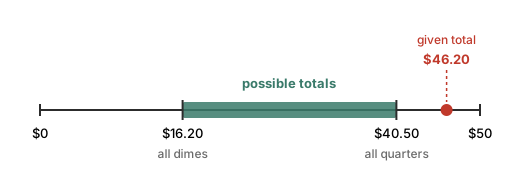
Step 3 — Conclude
No arrangement of 162 dimes and quarters totals $46.20, so there is no answer to find. This ceiling test takes about ten seconds, and it is a habit worth building: check that the target is reachable before you try to hit it.
The Answer
There is no valid number of dimes: 162 dimes and quarters can total at most $40.50, so $46.20 is impossible, and the algebra's only solution (d = −38 dimes, q = 200 quarters) cannot exist in a real jar.
Verification
Checking a "no solution" result means confirming two things: the algebra is correct, and the contradiction is real.
Check 1 — Does d = −38, q = 200 satisfy the equations?
Count: −38 + 200 = 162 ✓Value: 10(−38) + 25(200) = −380 + 5000 = 4620 ✓Both equations hold, so the algebra is right. The problem is the meaning of the numbers: a count of −38 is not physically possible.
Check 2 — An independent route to the same −38
All quarters gives $40.50 = 4050¢. The shortfall to 4620¢ is 570¢. Each dime-for-quarter swap moves the total by 15¢, and 570 ÷ 15 = 38. That is exactly the 38 "extra" coins hidden inside the negative sign, so the ceiling test and the algebra agree.
Check 3 — Would the method work on a feasible problem?
Change only the total to $37.50 (3750¢). Then 4050 − 15d = 3750 gives d = 20 and q = 142. Check: 20 + 142 = 162 and 200 + 3550 = 3750. ✓ The setup is sound; the original numbers are what fail.
What Trips People Up
Dropping the minus sign to "make it work" is tempting, but it breaks the equations. With 38 dimes and 124 quarters, the value is 380 + 3100 = 3480¢, not 4620¢. A negative answer for a count is a diagnostic message, not something to be repaired by hand.
Mixing dollars and cents is the most common setup error in coin problems. Here the dime is in dollars but the quarter is in cents, so the equation describes a different jar entirely. Pick one unit and use it for every coin and for the total: either 0.10d + 0.25q = 46.20 or 10d + 25q = 4620.
Silently altering the data is not solving the problem. There are many possible repairs (a different coin count, a different total, a third coin type), and they give different answers. For example, 162 coins at $37.50 gives 20 dimes, while 198 coins at $46.20 gives 22 dimes. Without knowing which number was misprinted, any "fix" is a guess. The honest answer is to report the contradiction and ask which value was intended.
Problems that are mis-copied or carelessly written exist, even in homework sets. The skill to practice is separating "my algebra is wrong" (re-check the arithmetic) from "the problem is inconsistent" (test with an independent method, like the feasibility ceiling above).
The Pattern Behind This: Totals Live in a Window
Every two-coin problem has a hidden structure. If you have n coins worth a and b cents each (with a < b), then starting from all cheap coins, each swap adds b − a cents. With k coins of the pricier type:
Total = n·a + k·(b − a), 0 ≤ k ≤ nSo the total must be between n·a and n·b, and must differ from n·a by a multiple of (b − a).For dimes and quarters, b − a = 15, and with n = 162 the formula becomes:
Total = 1620 + 15k, 0 ≤ k ≤ 162Possible totals: 1620¢, 1635¢, 1650¢, … up to 4050¢ ($16.20 to $40.50).Now the problem is easy to diagnose. The total 4620¢ passes the divisibility test (3000 ÷ 15 = 200, a whole number) but fails the window test (200 > 162). That is why the algebra produces a clean-looking integer, and why the answer looks so deceptively "almost right."
The same logic applies to every mixture problem, including solutions, alloys, and ticket sales: a mixture can never be richer than its richest ingredient or poorer than its poorest. When your computed answer lands outside the ingredients' range, a negative or "too big" count is how algebra reports it.
Try These Variations
These four problems are built to be solvable with whole numbers, so you can practice the full method on jars that can actually exist. They progress from repairing the original to working a case where $46.20 finally becomes possible.
James has dimes and quarters in his change jar. He has a total of 162 coins totaling $37.50. How many dimes does James have?
The range for 162 coins is $16.20 to $40.50, and $37.50 is inside it, so a solution may exist.
With d dimes and q quarters: d + q = 162 and 10d + 25q = 3750.
Using q = 162 − d: 10d + 4050 − 25d = 3750, so −15d = −300.
d = 20, then q = 162 − 20 = 142. James has 20 dimes (and 142 quarters).
Count: 20 + 142 = 162 ✓. Value: 10(20) + 25(142) = 200 + 3550 = 3750¢ = $37.50 ✓.
James has 162 coins, all of them dimes or quarters, totaling exactly $40.50. How many dimes does he have, and what does that tell you about the jar?
d + q = 162 and 10d + 25q = 4050 (since $40.50 = 4050¢).
With q = 162 − d: 10d + 4050 − 25d = 4050.
This simplifies to −15d = 0, so d = 0 and q = 162.
James has 0 dimes: the jar is all quarters. $40.50 is exactly the ceiling from the feasibility test, so the only possible jar at that total is the extreme one. A total any higher, like $46.20, falls off the edge.
0 + 162 = 162 ✓ and 25 × 162 = 4050¢ = $40.50 ✓.
James's jar holds 162 coins made up of nickels, dimes, and quarters, worth $17.10 in total. He has exactly twice as many dimes as quarters. How many nickels does he have?
Let q be the number of quarters. Then dimes d = 2q, and nickels n = 162 − 2q − q = 162 − 3q.
5n + 10d + 25q = 1710, which becomes 5(162 − 3q) + 10(2q) + 25q = 1710.
810 − 15q + 20q + 25q = 1710, so 30q + 810 = 1710 and 30q = 900.
q = 30, d = 60, and n = 162 − 90 = 72. James has 72 nickels.
Count: 72 + 60 + 30 = 162 ✓. Value: 360 + 600 + 750 = 1710¢ = $17.10 ✓. Dimes are twice quarters: 60 = 2 × 30 ✓.
James's jar holds only dimes and quarters worth $46.20, but this time nobody has counted the coins. He has 63 more quarters than dimes. How many coins are in the jar altogether?
Let d be the number of dimes. Then quarters q = d + 63. The total in cents is 4620.
10d + 25(d + 63) = 4620.
10d + 25d + 1575 = 4620 gives 35d = 3045, so d = 87.
q = 87 + 63 = 150, so the jar holds 87 + 150 = 237 coins: 237 coins.
Value: 10(87) + 25(150) = 870 + 3750 = 4620¢ = $46.20 ✓. Quarters minus dimes: 150 − 87 = 63 ✓. Notice that $46.20 is perfectly achievable with 237 coins (the window for 237 coins runs from $23.70 to $59.25). It was only the 162-coin limit that made the original problem impossible.
Frequently Asked Questions
2026-11-05