




Medication Dosage Problem: Total Tablets Required
What This Problem Teaches
- Converting between medication doses (mg) and number of tablets based on tablet strength
- Breaking complex multi-phase problems into manageable pieces
- Understanding medication tapering schedules and their practical implementation
- Unit conversion skills critical for healthcare professionals
- Systematic calculation methods to prevent potentially dangerous dosing errors
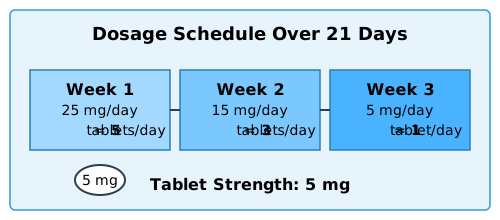
Solution: Method 1 — Phase-by-Phase Calculation
The most reliable approach for medication dosage problems is to calculate tablets needed for each phase separately, then add them together. This method minimizes errors and matches how pharmacists actually dispense medications.
Step 1 — Calculate tablets needed for Week 1 (25 mg daily)
First, determine how many tablets are needed per day in the first phase:
Tablets per day = 25 mg ÷ 5 mg per tablet = 5 tablets per day
Then multiply by the number of days in this phase:
Step 2 — Calculate tablets needed for Week 2 (15 mg daily)
Repeat the process for the second phase:
Week 2 total = 3 tablets/day × 7 days = 21 tablets
Step 3 — Calculate tablets needed for Week 3 (5 mg daily)
And for the final phase:
Week 3 total = 1 tablet/day × 7 days = 7 tablets
Step 4 — Add all phases together
Sum the tablets from all three phases:
Solution: Method 2 — Total Milligrams First
An alternative approach calculates the total milligrams needed across all phases, then converts that total to tablets. This method can be faster but requires more careful attention to avoid arithmetic errors.
Step 1 — Calculate total milligrams for each phase
Week 2: 15 mg/day × 7 days = 105 mg
Week 3: 5 mg/day × 7 days = 35 mg
Step 2 — Add up total milligrams needed
Step 3 — Convert total milligrams to tablets
Verification
Let's verify our answer using both methods to ensure accuracy:
Check using Method 1:
Week 2: 3 tablets/day × 7 days = 21 tablets ✓
Week 3: 1 tablet/day × 7 days = 7 tablets ✓
Total: 35 + 21 + 7 = 63 tablets ✓
Cross-check using Method 2:
Total tablets: 315 mg ÷ 5 mg/tablet = 63 tablets ✓
Both methods give the same answer, confirming our calculation is correct.
Common Pitfalls in Dosage Calculations
✗ Mistake 1: Forgetting to multiply by the number of days
Calculating 25 ÷ 5 = 5 and stopping there, forgetting that this is tablets per day, not total tablets. The correct calculation is 5 tablets/day × 7 days = 35 tablets for Week 1 alone.
✗ Mistake 2: Using the wrong tablet strength
Confusing the required dose with the tablet strength. Each tablet contains 5 mg, not 25 mg. So for the 25 mg dose, you need 25 ÷ 5 = 5 tablets, not 1 tablet.
✗ Mistake 3: Adding doses instead of tablets
Incorrectly adding 25 + 15 + 5 = 45 and thinking this is the answer. These are daily doses in mg, not tablet counts. Each phase must be calculated separately and then the tablet counts are added.
Clinical Safety Note: In healthcare settings, dosage calculation errors can have serious consequences. Always double-check calculations using a different method, and never skip the verification step.
Understanding Medication Tapers
This problem demonstrates a typical medication taper schedule. Tapering involves gradually reducing doses over time rather than stopping abruptly, which helps:
- Minimize withdrawal symptoms
- Allow the body to adjust to lower medication levels
- Reduce the risk of rebound effects
- Provide a safer discontinuation pathway
The pattern here (25 mg → 15 mg → 5 mg) represents decreases of 10 mg every week, following a linear reduction schedule that's common for many medications.
How to Spot This Problem Type
Medication dosage problems are easily recognizable by these key features:
- "Available in [X] mg tablets" — signals you need to convert doses to tablet counts
- Multi-phase schedules — different doses for different time periods
- "Daily for [X] days" — indicates you need to multiply by duration
- "Total tablets needed" — confirms you're calculating across the entire regimen
- Tapering language — "then," "followed by," or decreasing dose amounts
These problems frequently appear on nursing exams (NCLEX), pharmacy calculations, and healthcare certification tests. The calculation structure is always the same: convert dose to tablets per day, multiply by days, sum across phases.
Why This Matters in Healthcare
Accurate tablet calculations are fundamental to patient safety:
In Nursing Practice: Nurses must verify that patients receive exactly the prescribed dose. Over-dispensing wastes medication and may cause toxicity; under-dispensing compromises treatment effectiveness.
In Pharmacy: Pharmacists must dispense the correct quantity to ensure patients can complete their full course of treatment without running out of medication prematurely.
For Patients: Understanding tablet counts helps patients budget for medication costs and ensures they request refills at appropriate times.
What If? — Practice Variations
30 mg ÷ 5 mg = 6 tablets/day × 5 days = 30 tablets
20 mg ÷ 5 mg = 4 tablets/day × 10 days = 40 tablets
10 mg ÷ 5 mg = 2 tablets/day × 5 days = 10 tablets
30 + 40 + 10 = 80 tablets
Total mg: (30×5) + (20×10) + (10×5) = 150 + 200 + 50 = 400 mg
Total tablets: 400 mg ÷ 5 mg/tablet = 80 tablets ✓
Answer: 80 tablets
Total tablets = tablets from all three phases84 = (X÷5)×7 + ((X-10)÷5)×7 + ((X-20)÷5)×7
84 = (7÷5) × [X + (X-10) + (X-20)]84 = (7÷5) × [3X - 30]84 = (7/5) × (3X - 30)
84 × (5/7) = 3X - 3060 = 3X - 3090 = 3XX = 30
Week 1: 30 mg ÷ 5 × 7 = 42 tablets
Week 2: 20 mg ÷ 5 × 7 = 28 tablets
Week 3: 10 mg ÷ 5 × 7 = 14 tablets
Total: 42 + 28 + 14 = 84 tablets ✓
Answer: X = 30 mg (starting daily dose)
Loading dose: 40 mg ÷ 5 mg = 8 tablets (Day 1 only)
Days 2-7: 25 mg ÷ 5 mg = 5 tablets/day × 6 days = 30 tablets
Week 2: 15 mg ÷ 5 mg = 3 tablets/day × 7 days = 21 tablets
Week 3: 5 mg ÷ 5 mg = 1 tablet/day × 7 days = 7 tablets
Total: 8 + 30 + 21 + 7 = 66 tablets
Total mg: 40 + (25×6) + (15×7) + (5×7) = 40 + 150 + 105 + 35 = 330 mg
Total tablets: 330 ÷ 5 = 66 tablets ✓
Answer: 66 tablets
25 mg = 5×5mg + 0×2.5mg = 5 tablets/day (minimum possible)
Week 1 needs: 5×5mg tablets/day × 7 days = 35×5mg tablets
15 mg = 3×5mg + 0×2.5mg = 3 tablets/day
Week 2 needs: 3×5mg tablets/day × 7 days = 21×5mg tablets
5 mg = 1×5mg + 0×2.5mg = 1 tablet/day
Week 3 needs: 1×5mg tablet/day × 7 days = 7×5mg tablets
Total 5mg tablets: 35 + 21 + 7 = 63 tablets
Total 2.5mg tablets: 0 + 0 + 0 = 0 tablets
Total pills per day: 5, 3, 1 (respectively)
All required doses are multiples of 5mg, so using only 5mg tablets is already optimal. The 2.5mg tablets provide no advantage for minimizing daily pill count in this particular regimen.
Answer: 63 tablets of 5mg strength, 0 tablets of 2.5mg strength
Frequently Asked Questions
Calculate tablets needed for each phase separately, then add them up. For each phase: divide the daily dose by tablet strength to get tablets per day, then multiply by the number of days. In this problem: Week 1 needs 5 tablets/day × 7 days = 35 tablets, Week 2 needs 3 tablets/day × 7 days = 21 tablets, Week 3 needs 1 tablet/day × 7 days = 7 tablets, for a total of 63 tablets.
A medication taper is a gradual reduction in dose over time, used to safely discontinue medications or minimize side effects. This problem shows a typical taper: starting at 25mg daily, reducing to 15mg, then to 5mg over three weeks before stopping completely.
Divide the required dose by the tablet strength. If you need 25mg and each tablet contains 5mg, you need 25 ÷ 5 = 5 tablets. Always check that the required dose divides evenly by the tablet strength, or determine if partial tablets are acceptable.
2026-09-01