




Multi-Leg Journey Problem: Running and Flying Times
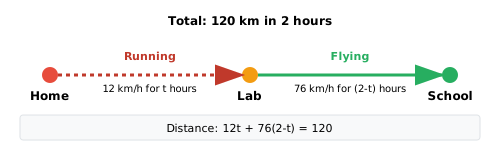
Eudora ran from her home to her laboratory at 12 km/h, then flew to school at 76 km/h. She traveled 120 km total in 2 hours. How long did she spend running and flying?
Already Got the Answer?
- Setup:
r + f = 2(time) and12r + 76f = 120(distance), whererandfare hours running and flying. - Answer: running
0.5 h(30 min), flying1.5 h(90 min). - One-line check:
12(0.5) + 76(1.5) = 6 + 114 = 120 kmand0.5 + 1.5 = 2 h. ✓
If your numbers match, skip ahead to the three-methods comparison, the pitfalls, and the four extension problems. That is where the page goes beyond the answer.
What's Really Going On Here
Two speeds, one total time, one total distance. The question looks like it should be easy, and yet the most tempting first move (averaging the speeds) is wrong. This problem is a clean place to learn why time, not distance or "number of legs," is the quantity that weights an average speed.
- Translate a two-leg trip into a system of two linear equations: one for total time, one for total distance.
- Use the relationship
distance = rate × timeseparately on each leg, then add the legs. - Recognize that average speed is a weighted average, weighted by time, and use that to solve the problem with almost no algebra.
- See a distance as an area under a speed–time graph, which is the first step toward calculus.
- Judge whether an answer is plausible by comparing it with the slowest and fastest possible trips.
If You See These Words...
This problem type announces itself with a recognizable shape:
- Two (or more) different speeds for consecutive parts of one trip.
- A total distance and a total time are both given, but neither leg is described individually.
- The question asks "how long at each speed" or "how far at each speed."
The same structure hides in disguise elsewhere: a hiker who walks and then jogs, a delivery that goes part by truck and part by plane, even a mixture problem where two solutions with different concentrations are blended. If a problem hands you two "rates," a total "amount," and a total "count," think two equations, two unknowns.
Solution: Method 1 — Two Equations, Two Unknowns
The most direct route is to name the unknown times, and let the two totals in the problem become two equations.
Step 1 — Define the unknowns
Time is what the question asks for, so time gets the variables. Let r be the hours Eudora spent running at 12 km/h, and f the hours she spent flying at 76 km/h.
Step 2 — Write the total-time equation
The two legs run back to back, so their times add up to the 2-hour total:
Step 3 — Write the total-distance equation
On each leg, distance is rate × time. Running covers 12r km and flying covers 76f km. Together they make 120 km:
Note that every term here is in kilometers. Speeds multiplied by hours give kilometers, so both sides of the equation have the same units.
Step 4 — Substitute and solve for the flying time
From the first equation, r = 2 − f. Replace r in the distance equation:
Step 5 — Find the running time
Go back to r = 2 − f:
So she ran for half an hour and flew for an hour and a half. As distances, that is 12 × 0.5 = 6 km on foot and 76 × 1.5 = 114 km in the air.
Solution: Method 2 — The Weighted-Average Approach
Here is a way to solve it that uses no variables at all. Start with a question about the whole trip: what was Eudora's average speed?
Step 1 — Find the overall average speed
Average speed is total distance divided by total time:
Step 2 — Locate 60 between the two speeds
An average speed of 60 has to fall between 12 and 76. Measure where it lands on that stretch:
The average sits 48/64 = 3/4 of the way from 12 up to 76.
Step 3 — Read that fraction as a share of time
A time-weighted average of two speeds sits p of the way toward the faster one exactly when the faster speed is used for a fraction p of the time. So she flew 3/4 of the trip's time:
Same answer, no system required. This is the lever or balance-point idea: 60 is much closer to 76 than to 12, so the trip must have been dominated by flying.
Solution: Method 3 — The Speed–Time Rectangle
The third approach is geometric. On a graph of speed against time, the area under the graph is the distance traveled, because a rectangle of height speed and width time has area equal to speed × time.
Step 1 — Draw the "all running" rectangle
Imagine Eudora ran the entire 2 hours. The rectangle would be 12 tall and 2 wide, with area 24 km. That falls 96 km short of the real 120 km.
Step 2 — Account for the missing area
During the flying portion, her speed was not 12 but 76, which is 64 km/h higher. That extra height, stretched over the flying time f, adds a block of area 64f. The block has to fill exactly the missing 96 km:
Step 3 — Finish with subtraction
The running time is whatever remains of the 2 hours: 2 − 1.5 = 0.5 hours.
Notice that Method 3 is Method 1 in picture form. The "24" is the constant term in 24 + 64f = 120, and the "64" is the speed difference that appeared when 76f − 12f was combined. The picture explains where those numbers come from.
The Answer
Running time:r = 0.5 hours = 30 minutes (covering 6 km)
Flying time:f = 1.5 hours = 1 hour 30 minutes (covering 114 km)
Together: 30 min + 90 min = 2 hours, and 6 km + 114 km = 120 km.
Verification
Substitute both values into both original conditions. A solution to a system has to satisfy every equation, not just one.
Time equation:r + f = 0.5 + 1.5 = 2 ✓
Distance equation:12(0.5) + 76(1.5) = 6 + 114 = 120 ✓
Independent check (Method 2): average speed 120 ÷ 2 = 60 km/h. Time-weighted: (0.5 × 12 + 1.5 × 76) ÷ 2 = 120 ÷ 2 = 60 ✓
Sanity Check
Before doing any algebra, you can bracket the answer. Two hours at the slow speed would give 24 km. Two hours at the fast speed would give 152 km. The real 120 km sits between those extremes, which tells you a mix is possible, and much closer to the fast end, so most of the time must have been spent flying.
| Scenario (2 hours total) | Running | Flying | Distance |
|---|---|---|---|
| All running | 2 h | 0 h | 24 km |
| Equal split | 1 h | 1 h | 88 km |
| Eudora's actual trip | 0.5 h | 1.5 h | 120 km |
| All flying | 0 h | 2 h | 152 km |
Each half-hour shifted from running to flying adds 0.5 × 64 = 32 km. Going from the equal split (88 km) up by 32 km gives 120 km. This is exactly what Eudora's trip does.
What Trips People Up
✗ Averaging the speeds:(12 + 76) ÷ 2 = 44 km/h, so time = 120 ÷ 44 ≈ 2.7 h.
This contradicts the given 2 hours, which is the signal that something is off. A simple average of speeds treats the two speeds as equally important, which is only true if she spent equal time at each. Here she didn't, so the real average is 60, not 44. Average speed is always total distance ÷ total time.
✗ Splitting the time evenly: "2 hours total, so 1 hour each."
That would give 12 + 76 = 88 km, not 120. Nothing in the problem says the legs take equal time. The distance equation is precisely what pins down how the 2 hours are divided.
✗ Putting distances in the time equation:12r + 76f = 2 or r + f = 120.
Each equation must add up quantities of the same kind. The first equation adds hours (r + f = 2); the second adds kilometers (12r + 76f = 120). If you ever add hours to kilometers, the units are warning you.
✗ Reporting 0.5 and 1.5 without units, or mixing them up: "She flew for 1.5" (hours? minutes?) or swapping the two because the decimals look small.
Always attach units. And remember that decimal hours are not minutes: 0.5 h is 30 minutes, 1.5 h is 90 minutes. A quick plausibility check: the faster leg should account for the bulk of the distance and, here, the bulk of the time.
The Pattern Behind This
For any trip with two constant speeds, a slow speed v₁ and a fast speed v₂, total time T, and total distance D, the "all slow" method generalizes into a single formula for the time spent at the fast speed:
Plugging in: t_fast = (120 − 12·2) ÷ (76 − 12) = 96 ÷ 64 = 1.5. The numerator is the distance shortfall of the all-slow trip. The denominator is how much extra distance each hour at the fast speed buys.
Feasibility limit. The formula only gives a sensible answer when v₁·T ≤ D ≤ v₂·T. Here, 24 ≤ 120 ≤ 152. If the distance were 200 km, no mix of these two speeds could cover it in 2 hours, and the formula would return a flying time greater than 2 hours. A negative or oversized time is the algebra's way of telling you the story is impossible.
This is the same mathematics as a mixture problem. Replace "speeds" with "concentrations," "time" with "volume," and "distance" with "amount of solute," and you have the same equations. Systems like quantity + quantity = total and rate × quantity + rate × quantity = grand total appear in coin problems, investment problems, and ticket-sales problems too.
Beyond the Textbook
- Logistics: A shipment goes by road for part of the journey and by air for the rest. Planners use exactly this time-and-distance split to decide how to meet a delivery deadline.
- Fuel economy: A hybrid car spends part of a trip in electric mode and part on gasoline. Overall efficiency is a weighted average, and the weights are not equal.
- Network and data transfers: A file transfer that runs at one speed on a fast link and another on a slow link has an overall throughput that is a time-weighted blend, not the plain average.
Where This Leads
Method 3 hints at calculus. When speed changes smoothly rather than in two steps, the distance is still the area under the speed–time curve, which is what an integral computes. A natural next question: if Eudora's speed grew steadily from 12 km/h to 76 km/h over 2 hours, how far would she travel? (The graph is a trapezoid, and the answer is the average of the two speeds times the time: 44 × 2 = 88 km. Interesting: here the plain average of speeds is correct, because speed changes uniformly in time.)
Extend Your Thinking
Try each one on paper first, then check your work with the solution. They get progressively harder.
Eudora again runs at 12 km/h and then flies at 76 km/h. This time she travels 100 km in a total of 3 hours. How long does she spend on each leg?
Let r = hours running and f = hours flying.
Time: r + f = 3. Distance: 12r + 76f = 100.
With r = 3 − f: 12(3 − f) + 76f = 100, which simplifies to 36 + 64f = 100.
64f = 64, so f = 1, and r = 3 − 1 = 2. She runs 2 hours and flies 1 hour.
Time: 2 + 1 = 3 ✓. Distance: 12(2) + 76(1) = 24 + 76 = 100 ✓.
On another day, Eudora ran at 12 km/h for 2.5 hours, then flew for 1.5 hours at a constant speed. The whole trip covered 210 km. How fast did she fly?
Let v = the flying speed in km/h. Now the times are known and a speed is missing.
Running: 12 × 2.5 = 30 km. Flying: v × 1.5 = 1.5v km.
30 + 1.5v = 210.
1.5v = 180, so v = 120. She flew at 120 km/h.
Flying distance: 120 × 1.5 = 180 km. Total: 30 + 180 = 210 km ✓.
Eudora runs at 12 km/h, flies at 76 km/h, and finally cycles at 24 km/h. She runs and cycles for exactly the same amount of time. The whole trip takes 5 hours and covers 206 km. How long does she spend on each leg?
Let t = hours running = hours cycling, and f = hours flying. Three unknowns shrink to two.
Time: t + f + t = 5, i.e. 2t + f = 5. Distance: 12t + 76f + 24t = 206, i.e. 36t + 76f = 206.
From the first, f = 5 − 2t. Then 36t + 76(5 − 2t) = 206, so 36t + 380 − 152t = 206, giving −116t = −174.
t = 1.5 and f = 5 − 3 = 2. She runs 1.5 h, flies 2 h, and cycles 1.5 h.
Time: 1.5 + 2 + 1.5 = 5 ✓. Distance: 12(1.5) + 76(2) + 24(1.5) = 18 + 152 + 36 = 206 ✓.
On one more trip, Eudora ran at 12 km/h and flew at 76 km/h. She was not told the distance. All she recorded was that the trip took 4 hours and that her average speed for the whole journey was 52 km/h. How long did she spend running and flying, and how far did she go?
Average speed is total distance ÷ total time, so distance = 52 × 4 = 208 km.
Time: r + f = 4. Distance: 12r + 76f = 208.
With r = 4 − f: 12(4 − f) + 76f = 208, so 48 + 64f = 208.
64f = 160, so f = 2.5, and r = 4 − 2.5 = 1.5. She ran 1.5 hours, flew 2.5 hours, and traveled 208 km.
Fraction of time flying: (52 − 12) ÷ (76 − 12) = 40/64 = 5/8, and 5/8 × 4 = 2.5 h ✓.
Distance: 12(1.5) + 76(2.5) = 18 + 190 = 208 ✓, and 208 ÷ 4 = 52 km/h ✓.
Frequently Asked Questions
How do you solve a distance-rate-time problem with two different speeds?
Why can't you just average two speeds to get the average speed of a trip?
Is there a shortcut for two-speed problems without solving a system of equations?
2026-08-05