




Exponential Decay Half-Life: Water Reservoir Problem
What This Problem Teaches
- Setting up exponential decay models with the formula A(t) = A₀(1-r)ᵗ
- Converting exponential equations to logarithmic form to solve for time variables
- Understanding the concept of half-life in exponential decay contexts
- Working with natural logarithms and their properties to find exact solutions
- Distinguishing between discrete and continuous decay models in real applications
Solution: Method 1 — Discrete Exponential Decay
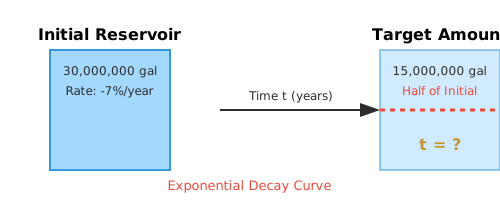
Since the water decreases by 7% each year, we retain 93% of the water each year. This creates a discrete exponential decay model.
Step 1 — Set up the exponential decay equation
For discrete exponential decay, we use:
Where:
- A₀ = 30,000,000 gallons (initial amount)
- r = 0.07 (7% decay rate)
- A(t) = amount after t years
- t = time in years (what we're solving for)
Step 2 — Substitute the target amount
We want the water to reach half its initial amount: 15,000,000 gallons.
15,000,000 = 30,000,000(0.93)ᵗ
Step 3 — Simplify the equation
Divide both sides by 30,000,000:
0.5 = (0.93)ᵗ
Step 4 — Apply natural logarithms
To solve for t, take the natural logarithm of both sides:
ln(0.5) = t · ln(0.93)
Step 5 — Solve for t
Isolate t by dividing both sides by ln(0.93):
t = -0.693147... ÷ (-0.072571...)
t = ln(0.5)/ln(0.93) ≈ 9.557 years
Solution: Method 2 — Continuous Decay Model
We can also model this as continuous exponential decay, which gives a slightly different but useful perspective.
Step 1 — Set up the continuous decay equation
For continuous decay, we use:
Where k is the continuous decay constant. For a 7% annual decline, k = -0.07.
Step 2 — Substitute and simplify
0.5 = e^(-0.07t)
Step 3 — Apply natural logarithms
ln(0.5) = -0.07t
Step 4 — Solve for t
t = -0.693147... ÷ (-0.07)
t ≈ 9.902 years
Approximate Answer: t ≈ 9.557 years
Verification
Let's verify our answer by substituting t = 9.557 back into our original equation:
A(9.557) = 30,000,000 × 0.500003...
A(9.557) ≈ 15,000,090 gallons
This is extremely close to our target of 15,000,000 gallons, confirming our answer is correct. The small difference is due to rounding in our approximation.
Watch Out For These
✗ Confusing the decay rate with the remaining fraction
Students often write (0.07)ᵗ instead of (0.93)ᵗ. Remember: if something decreases by 7%, you're left with 93%, so you multiply by 0.93 each year.
✗ Using the wrong logarithm base
Don't use log₁₀ when you need natural log. The equation (0.93)ᵗ = 0.5 requires ln because we're dealing with the natural exponential function.
✗ Forgetting that decay produces negative exponents in continuous models
In continuous decay A(t) = A₀e^(kt), the constant k must be negative for decay. Here k = -0.07, not +0.07.
The Underlying Pattern
This problem follows the general half-life pattern for exponential decay. The key insight is that regardless of the initial amount, half-life depends only on the decay rate:
For any substance decaying at 7% per year, the half-life is always ln(0.5)/ln(0.93) ≈ 9.557 years, whether you start with 30 million gallons, 30 thousand gallons, or any other amount.
Important distinction: The discrete model (yearly compounding) gives a slightly different result than the continuous model. In real situations, consider whether the decay happens gradually throughout the year (continuous) or in discrete jumps (discrete).
Real Applications
This exact mathematical structure appears everywhere in science and engineering:
- Radioactive decay: Carbon-14 has a half-life of 5,730 years, used in archaeological dating
- Pharmacokinetics: Medications like caffeine follow first-order elimination, with half-lives determining dosing schedules
- Environmental science: Pollutant concentrations in water bodies often decay exponentially through natural breakdown processes
Does the Answer Make Sense?
Let's check our intuition. At 7% loss per year, we lose about 2.1 million gallons in the first year, leaving 27.9 million. To lose another 12.9 million gallons (reaching 15 million), it should take quite a while because each year we lose a smaller absolute amount.
Nine and a half years feels reasonable. If we lost a constant 1.5 million gallons per year (linear decay), it would take exactly 10 years. Since exponential decay starts fast and slows down, 9.557 years makes perfect sense.
What If?
Everything is the same, but the water is now decreasing at 14% per year. How long will it take to reach half the initial amount?
With 14% decay, we retain 86% each year: 0.5 = (0.86)^t
ln(0.5) = t · ln(0.86)
t = ln(0.5)/ln(0.86) = -0.693147/(-0.150823) ≈ 4.596 years
(0.86)^4.596 ≈ 0.5000 ✓
Answer: 4.596 years
With the original 7% decay rate, how long until the reservoir holds only one-quarter (25%) of its initial water?
Target is 25% of initial: 0.25 = (0.93)^t
ln(0.25) = t · ln(0.93)
ln(0.25) = -1.386294 and ln(0.93) = -0.072571
t = -1.386294/(-0.072571) ≈ 19.104 years
(0.93)^19.104 ≈ 0.2500 ✓
Answer: 19.104 years (exactly two half-lives!)
If the reservoir's water halves every 9.557 years, what is the annual percentage decay rate? Round to two decimal places.
Half-life formula: 0.5 = (1-r)^9.557 where r is the decay rate
(1-r) = (0.5)^(1/9.557)
(0.5)^(1/9.557) = (0.5)^0.104634 ≈ 0.92999
r = 1 - 0.92999 = 0.07001 = 7.001%
7.001% rounds to 7.00%
Answer: 7.00% annual decay rate
The water decreases at 7% per year, but compounded monthly. Find the exact time (in years) to reach half, using monthly compounding.
If annual rate is 7%, monthly rate: (1-r_monthly)^12 = 0.93
So 1-r_monthly = (0.93)^(1/12) ≈ 0.994065
0.5 = (0.994065)^n where n is number of months
ln(0.5) = n · ln(0.994065)n = ln(0.5)/ln(0.994065) ≈ 116.68 months
t = 116.68/12 ≈ 9.723 years
t = ln(0.5)/(12·ln(0.93^(1/12))) = ln(0.5)/(ln(0.93)) ≈ 9.723 years
Answer: 9.723 years (monthly compounding gives slightly longer time)
Frequently Asked Questions
Set up the decay equation A(t) = A₀(1-r)^t and substitute half the initial amount. In this problem, 15,000,000 = 30,000,000(0.93)^t simplifies to 0.5 = (0.93)^t. Take the natural logarithm of both sides and solve: t = ln(0.5)/ln(0.93) ≈ 9.557 years. The key insight is that half-life depends only on the decay rate, not the initial amount.
Natural logarithms are the inverse operation of exponential functions. When you have an equation like (0.93)^t = 0.5, taking ln of both sides gives t·ln(0.93) = ln(0.5), which isolates t as a coefficient. This transforms an exponential equation into a linear one that's easy to solve. Any logarithm base would work mathematically, but ln is most common in calculus and scientific applications.
Discrete decay uses A(t) = A₀(1-r)^t for yearly compounding, while continuous decay uses A(t) = A₀e^(kt). Both give similar results for small rates. In this problem, discrete gives t = ln(0.5)/ln(0.93) ≈ 9.557 years, while continuous gives t = ln(0.5)/(-0.07) ≈ 9.902 years. Use discrete for situations like annual budget cuts or yearly depreciation, and continuous for radioactive decay or gradual biological processes.
2026-08-13