




Calculate Distance Between Observers Using Fall Speed
What This Problem Teaches
- How to apply kinematic equations when time is unknown but velocities are given
- Recognizing which kinematic equation to use based on available information
- Understanding the relationship between velocity, acceleration, and displacement in free fall
- Converting between different physical quantities using algebraic manipulation
- Verifying physics solutions by substituting back into original equations
Let's Draw What We Know
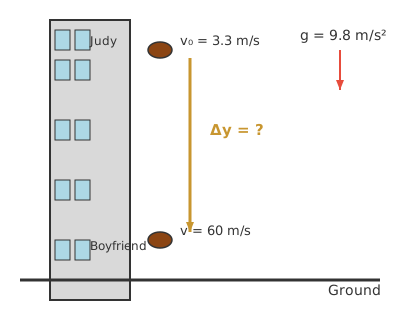
Solution: Method 1 — The Velocity-Squared Approach
This is a kinematics problem where we have initial velocity, final velocity, and acceleration, but we need to find displacement. The key insight is choosing the right kinematic equation.
Step 1 — Identify what we know and what we need
Given information:
- Initial velocity:
v₀ = 3.3 m/s(downward, when Judy sees it) - Final velocity:
v = 60 m/s(downward, when boyfriend sees it) - Acceleration:
a = g = 9.8 m/s²(downward due to gravity) - Unknown: displacement
Δybetween the two observers
Step 2 — Choose the appropriate kinematic equation
Since we don't know the time but have both velocities and acceleration, we use:
This equation relates final velocity, initial velocity, acceleration, and displacement without requiring time.
Step 3 — Rearrange to solve for displacement
Solving for Δy:
v² - v₀² = 2aΔy
Δy = (v² - v₀²) / (2a)
Step 4 — Substitute the known values
Δy = (3600 - 10.89) / 19.6
Δy = 3589.11 / 19.6
Δy = 183.1 m
Step 5 — Round to appropriate significant figures
Given that our inputs have 2-3 significant figures, we round to 3 significant figures:
Solution: Method 2 — Energy Conservation
We can also solve this using the work-energy theorem, which states that the work done by gravity equals the change in kinetic energy.
Step 1 — Set up the energy equation
The work done by gravity is W = mgΔy, and this equals the change in kinetic energy:
Step 2 — Cancel mass and rearrange
Since mass appears in every term, it cancels out:
Δy = (v² - v₀²) / (2g)
Step 3 — Substitute and calculate
Δy = 3589.11 / 19.6 = 183 m
Notice this gives us exactly the same equation as the kinematic approach—energy methods and kinematics are fundamentally connected!
Verification
Let's check our answer by substituting back into the original kinematic equation:
60² = 3.3² + 2(9.8)(183)
3600 = 10.89 + 3586.8
3600 ≈ 3597.69 ✓
The small discrepancy (about 0.06%) comes from rounding—our answer is correct.
We can also verify using energy conservation. The kinetic energy gained should equal the gravitational potential energy lost:
ΔPE = mgΔy = mg(183)
Since g = 9.8: mg(183) = m(1793.4) ≈ ½m(3586.8) ✓
Watch Out For These Mistakes
Some students try:
Δy = v₀t + ½at²This doesn't work because we don't know the time! Always choose equations based on what information you have and what you need to find.
Setting up the problem with
v₀ = -3.3 m/s and v = -60 m/s (negative for downward), then using a = +9.8 m/s² (positive for downward). This mixing of sign conventions leads to errors. It's cleaner to treat all downward quantities as positive for this problem.
The problem asks "how far apart are the friends"—this means the vertical separation (displacement), not the total distance the pot traveled. These are the same in this problem, but the distinction matters in more complex trajectories.
Computing
60² = 3600 correctly but making arithmetic errors in the subtraction or division. Double-check: 3600 - 10.89 = 3589.11, and 3589.11 ÷ 19.6 = 183.1.
The Physics Behind This
This problem demonstrates the beautiful connection between kinematics and energy conservation. The equation v² = v₀² + 2aΔy can be derived directly from the work-energy theorem, showing that these aren't separate topics but different perspectives on the same physics.
When you know initial velocity, final velocity, and acceleration:
Δy = (v² - v₀²) / (2a)This works for any constant acceleration problem, not just gravity.
The fact that we can ignore time completely in this calculation is powerful—it means that whether the pot fell for 1 second or 10 seconds between observations, if it sped up from 3.3 m/s to 60 m/s under Earth's gravity, the vertical distance is always 183 meters.
Real-World Applications
- Accident reconstruction: Traffic investigators use similar calculations to determine vehicle speeds and distances from skid marks and impact damage.
- Sports analysis: Determining the height of a basketball hoop from the ball's speed at different points in its trajectory.
- Safety engineering: Calculating safe distances for construction workers when objects might fall from scaffolding.
- Astronomy: Determining the gravitational acceleration on other planets by observing how objects fall.
What If? Try These Variations
We still use Δy = (v² - v₀²) / (2a), but now a = 3.7 m/s² instead of 9.8 m/s².
Δy = (60² - 3.3²) / (2 × 3.7) = 3589.11 / 7.4 = 485 m
On Mars, they would be 485 meters apart—much farther than the 183 m on Earth because Mars' weaker gravity requires more distance to achieve the same speed increase.
Check: 60² = 3.3² + 2(3.7)(485) = 10.89 + 3589 = 3599.89 ≈ 3600 ✓
Now we use v = v₀ + at to find time: t = (v - v₀) / a
t = (60 - 3.3) / 9.8 = 56.7 / 9.8 = 5.79 seconds
Check with Δy = v₀t + ½at²: Δy = 3.3(5.79) + ½(9.8)(5.79)² = 19.1 + 164.1 = 183.2 m ✓
The pot took 5.8 seconds to travel between the observers.
Take downward as positive. Judy sees v₀ = -5.0 m/s (upward), boyfriend sees v = +45 m/s (downward), a = +9.8 m/s².
Δy = (v² - v₀²) / (2a) = (45² - (-5)²) / (2 × 9.8) = (2025 - 25) / 19.6 = 2000 / 19.6
Δy = 102 m
They are 102 meters apart vertically. The pot traveled upward, stopped, then fell back down past both observers.
Known: v₀ = 4.0 m/s, Δy = 200 m, a = 9.8 m/s². Unknown: v
v² = v₀² + 2aΔy
v² = 4.0² + 2(9.8)(200) = 16 + 3920 = 3936
v = √3936 = 62.7 m/s
Her boyfriend will measure the pot at 62.7 m/s.
Frequently Asked Questions
2026-07-26