




Solve Farm Animal Problems with Systems of Equations
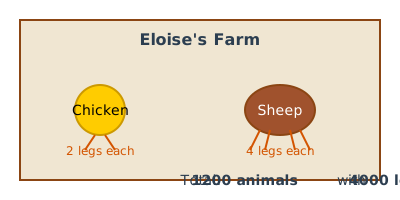
What This Problem Teaches
- Setting up systems of equations from word problems with multiple constraints
- Translating "legs per animal" information into algebraic expressions
- Solving two-variable systems using substitution method
- Recognizing the classic "counting with different attributes" problem structure
- Verifying solutions by checking both original constraints
Solution: Method 1 — The Substitution Approach
This is a classic system of equations problem where we have two unknowns and two pieces of information. Let's organize what we know and set up our variables systematically.
Step 1 — Define the variables
Let c = number of chickens and s = number of sheep on the farm.
Step 2 — Set up the first equation (total animals)
We know there are 1200 animals total, so:
Step 3 — Set up the second equation (total legs)
Chickens have 2 legs each, sheep have 4 legs each, and there are 4000 legs total:
Step 4 — Solve using substitution
From the first equation, we can express c in terms of s:
Substitute this into the second equation:
Step 5 — Simplify and solve for s
Expand the left side:
Combine like terms:
Subtract 2400 from both sides:
Divide by 2:
Step 6 — Find the number of chickens
Substitute back into our first equation:
Solution: Method 2 — The "All Chickens" Thought Experiment
Sometimes it's easier to imagine an extreme case and then adjust. This method uses logical reasoning instead of formal algebra.
Step 1 — Imagine all animals are chickens
If all 1200 animals were chickens, they would have:
Step 2 — Find the "extra" legs
But we actually have 4000 legs, so we need:
Step 3 — Convert chickens to sheep
Each time we replace a chicken with a sheep, we gain 2 legs (from 2 to 4). So the number of sheep needed is:
Step 4 — Find the remaining chickens
If 800 animals are sheep, then the remaining animals are chickens:
This method often feels more intuitive because it mirrors how we might think about the problem in real life.
Verification
Let's check our answer against both original constraints:
Check total animals:
Check total legs:
Both checks work perfectly, confirming our solution is correct.
Common Pitfalls
✗Mixing up which animal has how many legs
Some students write 4c + 2s = 4000, giving chickens 4 legs and sheep 2 legs. Always double-check: chickens are birds (2 legs), sheep are mammals (4 legs). A quick mental check helps: more legs per animal means fewer of that animal type needed.
✗Forgetting to substitute back
After finding s = 800, some students stop there and forget to find the number of chickens. Always solve for both variables - the problem asks for "how many of each type."
✗Setting up only one equation
Writing just c + s = 1200 and trying to solve. You need both pieces of information (total animals AND total legs) to create two equations for two unknowns.
The Pattern Behind This
This problem belongs to the family of "counting with attributes" problems. The general structure is:
(Attribute per A) × A + (Attribute per B) × B = Total Attribute
You'll see this pattern in:
- Coin problems: pennies + nickels = total coins; 1×pennies + 5×nickels = total value
- Ticket problems: adult + child = total tickets; price×adult + price×child = total revenue
- Vehicle problems: cars + trucks = total vehicles; 4×cars + 18×trucks = total wheels
The key insight is that you need two different ways of counting the same collection - once by quantity, once by some attribute.
Why This Problem Matters
Farm animal problems aren't just academic exercises - they teach the same mathematical thinking used in:
Manufacturing: A factory produces small bolts (using 2 minutes each) and large bolts (using 5 minutes each). With 1000 total bolts produced in 3200 minutes, how many of each size were made?
Nutrition planning: A meal plan combines foods with different protein contents per serving to reach specific totals for both servings and protein grams.
Resource allocation: Project managers assign junior staff (20 hours per task) and senior staff (35 hours per task) to complete a fixed number of tasks within a total hour budget.
The mathematical structure is identical - you're always balancing two constraints simultaneously.
What If?
Test your understanding with these variations. Each problem uses the same core method but adds a twist.
Let c = chickens and s = sheep. We have: c + s = 150 and 2c + 4s = 520
From the first equation: c = 150 - s
2(150 - s) + 4s = 520 → 300 - 2s + 4s = 520 → 300 + 2s = 520
2s = 220 → s = 110
c = 150 - 110 = 40
Check: 40 + 110 = 150 ✓ and 40×2 + 110×4 = 80 + 440 = 520 ✓
Answer: 40 chickens and 110 sheep
Let c = chickens = sheep and w = cows (since chickens equal sheep)
Animals: c + c + w = 200 → 2c + w = 200
Legs: 2c + 4c + 4w = 720 → 6c + 4w = 720
From first equation: w = 200 - 2c
Substitute: 6c + 4(200 - 2c) = 720
6c + 800 - 8c = 720 → -2c = -80 → c = 40
w = 200 - 2(40) = 120
Animals: 40 + 40 + 120 = 200 ✓
Legs: 40×2 + 40×4 + 120×4 = 80 + 160 + 480 = 720 ✓
Answer: 40 chickens, 40 sheep, 120 cows
If the ratio is 2:3, then chickens = 2x and sheep = 3x for some value x
2x + 3x = 300 → 5x = 300 → x = 60
Chickens = 2×60 = 120
Sheep = 3×60 = 180
Chicken legs: 120 × 2 = 240
Sheep legs: 180 × 4 = 720
Total legs: 240 + 720 = 960
Check ratio: 120:180 = 2:3 ✓
Check total: 120 + 180 = 300 ✓
Answer: 960 legs total
Let c = current chickens and s = current sheep
We know: c + s = 1500 and 2c + 4s = 5600
From first equation: c = 1500 - s
Substitute: 2(1500 - s) + 4s = 5600
3000 - 2s + 4s = 5600 → 3000 + 2s = 5600 → 2s = 2600 → s = 1300
c = 1500 - 1300 = 200
Check: 200 + 1300 = 1500 ✓ and 200×2 + 1300×4 = 400 + 5200 = 5600 ✓
Originally 600 chickens, now 200 chickens → 400 chickens were replaced by sheep
Answer: 200 chickens remain
Frequently Asked Questions
2026-08-08