




Multi-Person Age Problem: Five Siblings
What This Problem Teaches
- Managing multiple variables connected by linear relationships
- Converting word relationships into algebraic expressions
- Using averages as equation constraints in multi-variable problems
- Systematic substitution to reduce complex systems to single equations
- Verification strategies for problems with multiple interconnected answers
Solution: Method 1 — The Chain Substitution Approach
With five people and multiple relationships, the key insight is to express everyone's age in terms of one person's age, then use the average constraint to solve.
Step 1 — Choose the base variable
Let E = Ethan's age. We choose Ethan because many relationships reference him directly.
Step 2 — Express all ages in terms of Ethan's age
Using the given relationships:
Grace = E + 4 (Grace is 4 years older than Ethan)
Max = E + 3 (Max is 3 years older than Ethan)
Lena = Max - 2 = (E + 3) - 2 = E + 1 (Lena is 2 years younger than Max)
Olivia = 2 × Grace = 2(E + 4) = 2E + 8 (Olivia is twice as old as Grace)
Step 3 — Use the average constraint
The average age of Ethan and Grace is 10, which means their ages sum to 20:
Ethan + Grace = 20
E + (E + 4) = 20
2E + 4 = 20
Step 4 — Solve for Ethan's age
2E = 16
E = 8
Step 5 — Calculate everyone's age
Now that we know Ethan is 8, we can find all other ages:
Grace = 8 + 4 = 12
Max = 8 + 3 = 11
Lena = 8 + 1 = 9
Olivia = 2(12) = 24
Solution: Method 2 — Age Line Visualization
Sometimes a visual approach helps organize the relationships before diving into algebra.
Step 1 — Start with the average constraint
If Ethan and Grace average 10, their ages sum to 20. Since Grace is 4 years older than Ethan, we can find their individual ages by solving: E + (E + 4) = 20, giving us E = 8 and Grace = 12.
Step 2 — Create an age timeline
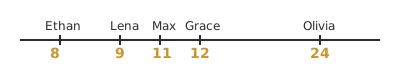
Once we know Ethan = 8 and Grace = 12, we can position everyone on an age line:
Step 3 — Apply each relationship
Working from our anchor ages:
Lena = Max - 2 = 11 - 2 = 9 ✓
Olivia = 2 × Grace = 2 × 12 = 24 ✓
The visual shows the age gaps clearly: a tight cluster of four siblings between ages 8-12, with Olivia significantly older at 24.
Verification
Let's confirm each relationship holds with our calculated ages:
✓ Grace is 4 years older than Ethan: 12 = 8 + 4
✓ Lena is 2 years younger than Max: 9 = 11 - 2
✓ Olivia is twice as old as Grace: 24 = 2 × 12
✓ Average age of Ethan and Grace: (8 + 12) ÷ 2 = 20 ÷ 2 = 10
All relationships check out perfectly. The constraint that tied everything together was the average—without it, we'd have had infinitely many solutions.
Common Pitfalls
Students often write "Lena is 2 years younger than Max" as Lena = Max + 2 instead of Lena = Max - 2. The word "younger" means subtract, not add. A helpful check: if Max is 11 and Lena is younger, then Lena must be less than 11.
Some students try to set each individual age equal to the average: "Ethan = 10 and Grace = 10." But average doesn't mean equal—it means their sum divided by 2 equals 10, so their sum is 20. The individual ages can be different as long as they average to 10.
With multiple relationships, students sometimes substitute incorrectly. For instance, writing Lena = E + 3 - 2 = E + 1 but forgetting that Max = E + 3, so the correct substitution is Lena = (E + 3) - 2 = E + 1. Always substitute the full expression, not just the variable.
Recognizing This Problem in the Wild
Age problems with multiple people often signal themselves with these patterns:
- "A is X years older/younger than B"
- "C is twice as old as D" (or other multiplicative relationships)
- "The average age of..." or "The sum of their ages is..."
- Three or more people with interconnected age relationships
The telltale sign you need the chain substitution method: when most ages are defined relative to other ages, rather than as absolute values. Look for the person mentioned most often in the relationships—they make the best choice for your base variable.
The Pattern Behind This
This problem demonstrates the general structure of constraint satisfaction with linear relationships. The mathematical pattern is:
2. Use constraints (averages, sums, products) to create equations
3. Solve for the base variable
4. Substitute back to find all unknowns
This exact approach works for any problem where you have N unknowns connected by N-1 linear relationships, plus one constraint equation. The constraint equation is what makes the system solvable—without the average condition, we'd have infinitely many solutions since we could pick any age for Ethan and calculate the rest.
You'll see this pattern in economics (supply chains), physics (connected systems), and computer science (dependency graphs).
What If?
Let E = Ethan's age. Express all ages in terms of E: Grace = E + 4, Max = E + 3, Lena = E + 1, Olivia = 2(E + 4) = 2E + 8.
Average of Ethan and Grace is 12, so: (E + E + 4) ÷ 2 = 12, which gives us 2E + 4 = 24.
2E + 4 = 24 → 2E = 20 → E = 10
Ethan = 10, Grace = 14, Max = 13, Lena = 11, Olivia = 28
Check: (10 + 14) ÷ 2 = 12 ✓. All other relationships hold with the new ages.
Let E = Ethan's age. Then Grace = E + 4, Max = E + 3, Lena = E + 1, Olivia = 2(E + 4) = 2E + 8.
Sum of all ages = 70: E + (E + 4) + (E + 3) + (E + 1) + (2E + 8) = 70
E + E + 4 + E + 3 + E + 1 + 2E + 8 = 70 → 6E + 16 = 70 → 6E = 54 → E = 9
Ethan = 9, Grace = 13, Max = 12, Lena = 10, Olivia = 26
Sum check: 9 + 13 + 12 + 10 + 26 = 70 ✓
From the constraint that Ethan and Grace average 10, we get the same result as before: Ethan = 8, Grace = 12, Max = 11, Lena = 9, Olivia = 24.
Noah is 5 years younger than Olivia: Noah = 24 - 5 = 19
Sum of all six ages: 8 + 12 + 11 + 9 + 24 + 19 = 83
Average: 83 ÷ 6 = 13.83... ≠ 12
The problem is over-constrained. We can't satisfy both "Ethan and Grace average 10" AND "all six average 12" with these relationships. One constraint must be relaxed.
Check: Max = 15, Ethan = 12, so Max is 15 - 12 = 3 years older than Ethan ✓
Grace = 16, Ethan = 12, so Grace is 16 - 12 = 4 years older than Ethan ✓
Lena = 13, Max = 15, so Lena is 15 - 13 = 2 years younger than Max ✓
Olivia = 32, Grace = 16
Ratio: 32 ÷ 16 = 2
Olivia is 2 times Grace's age.
Check: 2 × 16 = 32 = Olivia's age ✓
Frequently Asked Questions
2026-11-01