




Extend the Fibonacci Sequence: Field Daisy Petals
What You Will Learn
- How to identify and extend a Fibonacci sequence pattern
- The recursive relationship where each term equals the sum of the two preceding terms
- Pattern recognition techniques for sequence problems
- How mathematical sequences appear naturally in biological systems
- Verification methods to check sequence calculations
Visualizing the Pattern
Let's look at what we know and what we're trying to find:
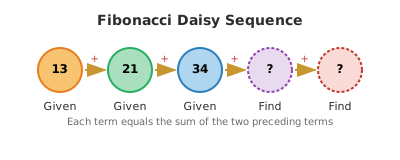
The key insight is recognizing that this follows the Fibonacci pattern: each new term is created by adding the two terms that come immediately before it.
Solution: Method 1 — Direct Application of Fibonacci Rule
The Fibonacci sequence has a simple rule: each term equals the sum of the two terms immediately before it. Let's apply this step by step.
Step 1 — Identify the pattern and known terms
We have three consecutive terms in a Fibonacci sequence: 13, 21, 34. We need to verify this follows the pattern and then extend it.
Check: 13 + 21 = 34 ✓
This confirms we have a valid Fibonacci sequence.
Step 2 — Find the fourth term
Using the Fibonacci rule, the fourth term equals the sum of the second and third terms:
Step 3 — Find the fifth term
Similarly, the fifth term equals the sum of the third and fourth terms:
Step 4 — State the complete extended sequence
Our extended sequence is: 13, 21, 34, 55, 89
Solution: Method 2 — Tabular Progression
Sometimes it helps to organize the work in a table format, especially when extending longer sequences or when you want to see the pattern clearly.
Step 1 — Set up a table with the known terms
| Position | Petals | Calculation |
|---|---|---|
| Term 1 | 13 | Given |
| Term 2 | 21 | Given |
| Term 3 | 34 | 13 + 21 = 34 (verify) |
Step 2 — Extend the table using the Fibonacci rule
| Position | Petals | Calculation |
|---|---|---|
| Term 1 | 13 | Given |
| Term 2 | 21 | Given |
| Term 3 | 34 | 13 + 21 = 34 |
| Term 4 | 55 | 21 + 34 = 55 |
| Term 5 | 89 | 34 + 55 = 89 |
The table format makes it easy to see the progression and ensures we don't make arithmetic errors when working with larger numbers.
Verification
Let's verify our answer by checking that our extended sequence maintains the Fibonacci property throughout:
Term 2 + Term 3 = 21 + 34 = 55 ✓ (matches our Term 4)
Term 3 + Term 4 = 34 + 55 = 89 ✓ (matches our Term 5)
We can also verify by checking one more term ahead: 55 + 89 = 144, which would be the sixth term. Since all our additions work out correctly, we can be confident in our answer.
Common Pitfalls
Here are the mistakes students often make with Fibonacci sequence problems:
Incorrect:
13 + 21 + 34 = 68This treats the problem as if you're finding a total, but Fibonacci sequences work by adding consecutive pairs, not all terms together.
Incorrect:
13 + 34 = 47 (skipping the middle term)The Fibonacci rule specifically requires adding the two immediately preceding terms. You can't skip terms in between.
Incorrect: Starting with
21, 34 and finding 21 + 34 = 55, then 21 + 55 = 76Once you find a new term (55), you must use it along with the previous term (34) to find the next one, not keep using the older terms.
The Math Beneath the Surface
The Fibonacci sequence follows a recursive relationship that can be expressed mathematically:
Where F(n) represents the nth term in the sequence. This formula tells us that any term equals the sum of the two terms that come immediately before it.
For our daisy problem:
F(1) = 13(first given term)F(2) = 21(second given term)F(3) = 34(third given term)F(4) = F(3) + F(2) = 34 + 21 = 55F(5) = F(4) + F(3) = 55 + 34 = 89
This recursive nature means that once you know any two consecutive terms in a Fibonacci sequence, you can generate all subsequent terms indefinitely.
This Pattern in the Natural World
The appearance of Fibonacci numbers in daisy petals isn't just a mathematical curiosity—it reflects deep patterns in biological growth:
- Sunflower seed spirals: The number of clockwise and counterclockwise spirals are consecutive Fibonacci numbers
- Pinecone scales: Arranged in Fibonacci spirals for optimal packing
- Flower petals: Many flowers have 3, 5, 8, 13, 21, or 34 petals—all Fibonacci numbers
- Tree branches: The branching patterns often follow Fibonacci ratios
These patterns emerge because Fibonacci arrangements provide optimal space utilization and structural efficiency in biological systems.
What If?
Test your understanding with these variations:
Check: 8 + 13 = 21 ✓. This confirms a valid Fibonacci sequence.
Fourth term = 13 + 21 = 34
Fifth term = 21 + 34 = 55
Check: 13 + 21 = 34 and 21 + 34 = 55 ✓
Answer: 34 and 55 petals
If the sequence is ..., ?, 55, 89, then we need to work backwards.
Since previous term + 55 = 89, we have: previous term = 89 - 55 = 34
Since term before 34 + 34 = 55, we have: term before 34 = 55 - 34 = 21
Check: 21 + 34 = 55 and 34 + 55 = 89 ✓
Answer: 21 and 34 petals
Check: 7 + 11 = 18 ✓. Same rule, different starting numbers.
Fourth term = 11 + 18 = 29
Fifth term = 18 + 29 = 47
Sixth term = 29 + 47 = 76
Check all: 11 + 18 = 29, 18 + 29 = 47, 29 + 47 = 76 ✓
Answer: 29, 47, and 76 petals
If the sequence is 21, ?, 55, 89, then ? + 55 = 89 and 21 + ? = 55.
From 21 + ? = 55: ? = 55 - 21 = 34
From ? + 55 = 89: ? = 89 - 55 = 34
Both equations give the same answer, confirming there's exactly one solution.
Verify: 21 + 34 = 55 and 34 + 55 = 89 ✓
Answer: The missing count is 34 petals, and this is the unique solution.
Frequently Asked Questions
2026-08-11