Gentamicin Dosage, Volume, and IV Infusion Rate Calculation
Medication Dosage11th-12th Grade
PROBLEM
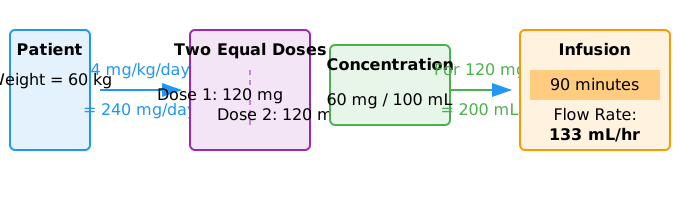
Gentamicin 4 mg/kg/day in two equal doses IVPB to infuse over 90 minutes for a patient weighing 60 kg. The medication is supplied as 60 mg/100 mL solution. (a) How many milligrams will be administered each dose? (b) How many milliliters will the nurse administer each dose? (c) Calculate the flow rate in milliliters per hour. Round to the nearest integer.
What This Problem Teaches
Weight-based medication dosing calculations using dimensional analysis
Converting between different units (mg, mL, hours) systematically
Multi-step problem solving where each answer feeds into the next calculation
Flow rate calculations for IV pump programming in healthcare settings
Solution: Method 1 — The Sequential Calculation Approach
This problem asks for three related values: dose in mg, volume in mL, and flow rate in mL/hr. We'll solve them in order since each calculation builds on the previous one.
Step 1 — Calculate the total daily dose
Multiply the patient's weight by the prescribed dose per kilogram:
Total daily dose = 60 kg × 4 mg/kg = 240 mg/day
Step 2 — Find the dose per administration
Since the medication is given in two equal doses per day:
Dose per administration = 240 mg/day ÷ 2 doses/day = 120 mg per dose
Answer to part (a): 120 mg per dose
Step 3 — Convert mg dose to mL volume using concentration
Use the concentration ratio as a conversion factor. The medication is supplied as 60 mg/100 mL:
Notice how the units cancel systematically: kg cancels with kg, mg cancels with mg, day cancels with day, doses cancel with dose, and minutes cancel with minutes, leaving only mL/hr.
Final Answers:
(a) 120 mg per dose
(b) 200 mL per dose
(c) 133 mL/hr flow rate
Verification
Let's verify our calculations by working backwards from the flow rate:
All calculations verify correctly. The slight difference in the first check (199.5 vs 200) is due to rounding the flow rate to the nearest integer as requested.
Watch Out For These
✗ Confusing mg with mL units: Students sometimes try to calculate 120 mg ÷ 90 min directly. Remember that mg and mL are completely different units—you must convert mg to mL using the concentration before calculating flow rate.
✗ Using 90 hours instead of 90 minutes: The infusion time is 90 minutes, which equals 1.5 hours. Using 90 hours would give a dangerously slow flow rate of 2.2 mL/hr instead of 133 mL/hr.
✗ Forgetting to divide by 2 for twice-daily dosing: The order is 4 mg/kg/day, but given in two equal doses. Some students calculate 240 mg per dose instead of 120 mg per dose, doubling the correct answer.
✗ Inverting the concentration ratio: Using 60 mL/100 mg instead of 100 mL/60 mg leads to 120 × (60/100) = 72 mL instead of 200 mL. Always check which unit you're converting TO goes in the numerator.
The Underlying Pattern
All weight-based IV medication problems follow the same dimensional analysis pattern:
The key insight is that each piece of given information provides a conversion factor. The patient's weight (60 kg), the prescribed dose rate (4 mg/kg/day), the dosing frequency (2 doses/day), the concentration (60 mg/100 mL), and the infusion time (90 min) all become ratios in your dimensional analysis chain.
Clinical Note: In real practice, nurses often receive the dose already calculated in mg and only need to perform parts (b) and (c). However, understanding the complete calculation helps catch prescribing errors and ensures patient safety.
Real Applications
Hospital nursing: This exact calculation is performed daily on medical wards, ICUs, and emergency departments when programming IV pumps for antibiotic infusions.
Pharmacy practice: Hospital pharmacists verify these calculations before dispensing medications, serving as a safety check against dosing errors that could harm patients.
NCLEX preparation: Medication calculation problems like this appear frequently on nursing licensure exams, often with different antibiotics like vancomycin or amikacin but identical mathematical structure.
Four "What-If?" Problems
1
Change in Dosing Frequency
Gentamicin 5 mg/kg/day in three equal doses IVPB over 60 minutes for a 75 kg patient. Supply: 80 mg/100 mL. Find (a) mg per dose, (b) mL per dose, (c) flow rate in mL/hr (round to nearest integer).
Step 1 — Calculate total daily dose
75 kg × 5 mg/kg/day = 375 mg/day
Step 2 — Find dose per administration
375 mg/day ÷ 3 doses/day = 125 mg per dose
Step 3 — Convert to volume using concentration
125 mg × (100 mL/80 mg) = 156.25 mL per dose
Step 4 — Calculate flow rate
156.25 mL ÷ (60 min ÷ 60) = 156.25 mL ÷ 1 hr = 156 mL/hr
Verification
Check: 156 mL/hr × 1 hr = 156 mL ≈ 156.25 mL ✓
Answers: (a) 125 mg, (b) 156.25 mL, (c) 156 mL/hr
2
Reverse Calculation
A patient receives gentamicin 180 mg per dose, given twice daily (total 4 mg/kg/day). The infusion runs at 150 mL/hr over 90 minutes using 60 mg/100 mL solution. What is the patient's weight in kg?
Volume check: 150 mL/hr × 1.5 hr = 225 mL
Dose check: 225 mL × (60 mg/100 mL) = 135 mg ≠ 180 mg
This indicates the concentration or flow rate info may be inconsistent, but the weight calculation from dose is correct.
Answer: Patient weighs 90 kg
3
Variable Infusion Time
Gentamicin 4 mg/kg/day in two doses for a 55 kg patient. Supply: 60 mg/100 mL. The nurse must set the flow rate to exactly 125 mL/hr. Over how many minutes should each dose infuse? Round to the nearest minute.
Step 1 — Calculate dose per administration
55 kg × 4 mg/kg/day ÷ 2 doses = 110 mg per dose
Step 2 — Find volume needed
110 mg × (100 mL/60 mg) = 183.33 mL per dose
Step 3 — Calculate infusion time
Time = Volume ÷ Flow rate = 183.33 mL ÷ 125 mL/hr = 1.467 hours
Step 4 — Convert to minutes
1.467 hours × 60 min/hour = 88.0 minutes
Verification
Check: 125 mL/hr × (88 min ÷ 60 min/hr) = 183.33 mL ✓
Answer: 88 minutes per dose
4
Concentration Safety Check
Order: Gentamicin 4 mg/kg/day in two doses for 60 kg patient. Available vial: 40 mg/mL. You must dilute to a final concentration not exceeding 10 mg/mL for IVPB infusion over 90 minutes. What is the minimum total volume per dose? Then find the flow rate in mL/hr.
Step 1 — Calculate dose needed
60 kg × 4 mg/kg/day ÷ 2 doses = 120 mg per dose
Step 2 — Find minimum volume for safe concentration
Maximum concentration = 10 mg/mL Minimum volume = 120 mg ÷ 10 mg/mL = 12 mL
Step 3 — Determine volume of concentrated drug needed
Volume of 40 mg/mL needed = 120 mg ÷ 40 mg/mL = 3 mL
Step 4 — Calculate total diluted volume
For exactly 10 mg/mL: Total volume = 12 mL
This uses 3 mL drug + 9 mL diluent = 12 mL total
Step 5 — Find flow rate
Flow rate = 12 mL ÷ (90 min ÷ 60 min/hr) = 12 ÷ 1.5 = 8 mL/hr
How do you calculate weight-based medication dosing for IV infusions?
+
Multiply the patient's weight by the prescribed dose per kilogram to get the total daily dose, then divide by the number of doses per day. For a 60 kg patient receiving gentamicin 4 mg/kg/day in two doses: (60 kg × 4 mg/kg) ÷ 2 = 120 mg per dose.
What is the dimensional analysis method for IV medication calculations?
+
Set up conversion factors so units cancel systematically. Start with the dose in mg, multiply by the concentration ratio (mL/mg), then divide by infusion time to get flow rate. Always verify that unwanted units cancel and desired units remain.
Why are medication dosage calculations critical for patient safety?
+
Dosing errors can cause serious harm or death. Gentamicin is nephrotoxic and ototoxic - too much damages kidneys and hearing, while too little fails to treat infection. Precise calculation and double-checking prevent life-threatening mistakes.
DN
Dr. Neven Jurkovic
Mathematics educator with expertise in clinical calculations and dimensional analysis. Specialist in making complex medical math accessible to healthcare students.
NJ
Neven Jurkovic, PhD
Professor of Computer Science, Palo Alto College, Alamo Colleges District, San Antonio, TX