




Geometric Sequence: Modeling Soda Consumption Reduction
Skills This Problem Builds
- Pattern Recognition: Identifying geometric sequences from decimal data points
- Recursive Thinking: Writing formulas that define each term using the previous term
- Ratio Analysis: Computing and verifying common ratios in geometric sequences
- Iterative Calculation: Applying recursive formulas repeatedly to reach distant terms
- Real-World Modeling: Connecting mathematical sequences to exponential decay scenarios
Visualizing the Decay Pattern
Let's organize the given data and see the decreasing trend:
| Month (n) | Sodas f(n) | Ratio f(n)/f(n-1) |
|---|---|---|
| 1 | 150 | — |
| 2 | 135 | 135 ÷ 150 = 0.9 |
| 3 | 121.5 | 121.5 ÷ 135 = 0.9 |
| 4 | 109.35 | 109.35 ÷ 121.5 = 0.9 |
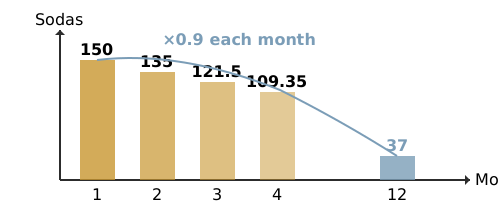
The constant ratio of 0.9 confirms this is a geometric sequence where Robert reduces his consumption by 10% each month.
Solution: Method 1 — The Recursive Decay Formula
Step 1 — Identify the sequence type
Looking at the data, we need to check if this is arithmetic (constant difference) or geometric (constant ratio). Let's calculate the ratios between consecutive terms:
121.5 ÷ 135 = 0.9
109.35 ÷ 121.5 = 0.9
Since the ratio is constant at 0.9, this is a geometric sequence where each month's consumption is 90% of the previous month.
Step 2 — Write the recursive formula
For a recursive formula, we need the first term and the rule for finding subsequent terms:
f(n) = 0.9 × f(n-1) for n ≥ 2
Step 3 — Apply the formula to find f(12)
We'll calculate each month step by step:
f(2) = 0.9 × 150 = 135
f(3) = 0.9 × 135 = 121.5
f(4) = 0.9 × 121.5 = 109.35
f(5) = 0.9 × 109.35 = 98.415
f(6) = 0.9 × 98.415 = 88.5735
f(7) = 0.9 × 88.5735 = 79.71615
f(8) = 0.9 × 79.71615 = 71.744535
f(9) = 0.9 × 71.744535 = 64.5700815
f(10) = 0.9 × 64.5700815 = 58.11307335
f(11) = 0.9 × 58.11307335 = 52.301766015
f(12) = 0.9 × 52.301766015 = 47.0715894135
Step 4 — Round to the nearest can
Since Robert can't drink a fraction of a can, we round 47.07 to the nearest whole number:
Solution: Method 2 — The Explicit Formula Approach
Step 1 — Derive the explicit formula
For a geometric sequence with first term a and common ratio r, the explicit formula is:
In our case, a = 150 and r = 0.9, so:
Step 2 — Calculate f(12) directly
Instead of calculating each month sequentially, we can jump directly to month 12:
f(12) = 150 × (0.9)^11
f(12) = 150 × 0.31384283767
f(12) = 47.076425651
Step 3 — Round to the nearest can
Rounding 47.076 to the nearest whole number gives us 47 sodas.
Verification
Let's verify our answer using both approaches and check that our recursive formula produces the given data points:
f(1) = 150 ✓
f(2) = 0.9 × 150 = 135 ✓
f(3) = 0.9 × 135 = 121.5 ✓
f(4) = 0.9 × 121.5 = 109.35 ✓
Check f(12) with explicit formula:
f(12) = 150 × (0.9)^11 = 47.076... ≈ 47 ✓
We can also verify that 47 is reasonable: after 11 months of 10% decreases, Robert's consumption should be much less than his starting 150 sodas, but not close to zero yet. 47 sodas (about 31% of the original amount) fits this expectation perfectly.
Watch Out For These Mistakes
The Pattern Behind This
This problem demonstrates exponential decay, one of the most important patterns in mathematics and science. The general structure is:
Explicit: f(n) = initial_value × (decay_factor)^(n-1)
Key insights:
- Constant percentage change always produces geometric sequences
- Decay factor = 1 - percentage_lost (10% loss → factor of 0.9)
- Half-life problems are special cases where the decay factor is 0.5
- The math doesn't care about context — radioactive decay, population decline, and soda reduction follow identical formulas
Real Applications
This exact mathematical structure appears throughout science and finance:
- Radioactive decay: Carbon-14 decreases by 50% every 5,730 years, following f(t) = initial × (0.5)^(t/5730)
- Medication clearance: Many drugs are eliminated from the body at a constant percentage per hour
- Population decline: Endangered species populations often follow exponential decay models
- Depreciation: Car values typically decrease by 10-20% per year in early years
- Economic recession: GDP or employment can decline at constant percentage rates during downturns
What If?
Same pattern, different starting value: f(1) = 200 and f(n) = 0.9 × f(n-1) for n ≥ 2.
f(1) = 200f(2) = 0.9 × 200 = 180f(3) = 0.9 × 180 = 162f(4) = 0.9 × 162 = 145.8f(5) = 0.9 × 145.8 = 131.22f(6) = 0.9 × 131.22 = 118.098f(7) = 0.9 × 118.098 = 106.2882f(8) = 0.9 × 106.2882 = 95.65938
Sarah will have 96 sodas in month 8.
Using explicit formula: f(8) = 200 × (0.9)^7 = 200 × 0.4782969 = 95.659 ✓
We need 150 × (0.9)^(n-1) ≤ 25
(0.9)^(n-1) ≤ 25/150 = 1/6 ≈ 0.1667
Taking natural log: (n-1) × ln(0.9) ≤ ln(0.1667)(n-1) × (-0.1054) ≤ -1.7918n-1 ≥ 17.0 (inequality flips when dividing by negative)n ≥ 18
f(17) = 150 × (0.9)^16 = 150 × 0.1853 = 27.80 (still above 25)f(18) = 150 × (0.9)^17 = 150 × 0.1668 = 25.02 (still above 25)f(19) = 150 × (0.9)^18 = 150 × 0.1501 = 22.52 (below 25)
Month 19 is when Robert's consumption first drops to 25 or fewer sodas.
15% reduction means keeping 85% each month, so the decay factor is 0.85.
Recursive:f(1) = 180 and f(n) = 0.85 × f(n-1) for n ≥ 2
Explicit:f(n) = 180 × (0.85)^(n-1)
f(6) = 180 × (0.85)^5f(6) = 180 × 0.4437f(6) = 79.87
Michael will have 80 sodas in month 6.
f(1) = 180, f(2) = 153, f(3) = 130.05, f(4) = 110.54, f(5) = 93.96, f(6) = 79.87 ✓
Using the explicit formula: f(5) = initial × (0.8)^(5-1) = initial × (0.8)^4
We know f(5) = 64, so: 64 = initial × (0.8)^4
(0.8)^4 = 0.8 × 0.8 × 0.8 × 0.8 = 0.4096
64 = initial × 0.4096initial = 64 ÷ 0.4096 = 156.25
Lisa started with 156 sodas.
Check: 156 × (0.8)^4 = 156 × 0.4096 = 63.9 ≈ 64 ✓
Frequently Asked Questions
2026-10-23