




Half-Life & Exponential Decay: Radioactive Substance
What You Will Learn
- How to apply the half-life concept to calculate remaining quantities over time
- Understanding exponential decay as repeated multiplication by 1/2
- Converting time periods into half-life intervals for easier calculation
- Using the exponential decay formula A = A₀(1/2)^(t/T)
- Recognizing when to use sequential halving versus the general formula
Visualizing the Problem
Let's map out what happens to our radioactive tin over the 50-day period:
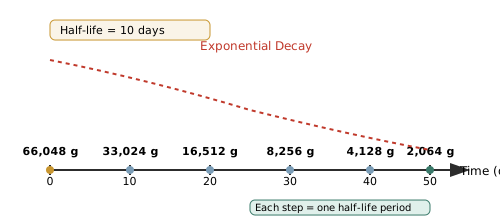
Notice how the amount halves every 10 days. After 50 days (which is 5 half-life periods), we need to find how much remains.
Solution: Method 1 — Sequential Halving
The most intuitive approach is to apply the half-life definition directly. Every 10 days, exactly half of the remaining tin decays.
Step 1 — Count the half-life periods
We need to find how many 10-day periods fit into 50 days:
Step 2 — Apply the halving repeatedly
Starting with 66,048 grams, we halve the amount 5 times:
After 2 half-lives (20 days): 33,024 ÷ 2 = 16,512 grams
After 3 half-lives (30 days): 16,512 ÷ 2 = 8,256 grams
After 4 half-lives (40 days): 8,256 ÷ 2 = 4,128 grams
After 5 half-lives (50 days): 4,128 ÷ 2 = 2,064 grams
Step 3 — Express as a single calculation
Since we're dividing by 2 five times, this is equivalent to:
Solution: Method 2 — Exponential Decay Formula
The general exponential decay formula gives us a direct path to the answer without sequential calculations.
Step 1 — Set up the decay formula
For radioactive decay with half-life T, the amount remaining after time t is:
Where A₀ = initial amount, t = elapsed time, T = half-life
Step 2 — Substitute our values
We have A₀ = 66,048 grams, t = 50 days, T = 10 days:
A = 66,048 × (1/2)^5
Step 3 — Calculate the exponential term
First, find (1/2)^5:
Step 4 — Complete the calculation
Verification
Let's check our answer by working backwards from the result:
Forward verification: If we start with 2,064 grams and let it grow by doubling 5 times (reverse of decay), we should get back to our starting amount:
Alternative calculation: We can also verify using the fraction of the original amount that remains:
2,064 ÷ 66,048 = 1/32 = 0.03125 ✓
Both checks confirm our answer is correct.
Does This Seem Reasonable?
Let's put our answer in context to see if it makes intuitive sense.
Magnitude check: We started with 66,048 grams and ended with 2,064 grams. That's about 3% of the original amount remaining after 50 days, which seems reasonable for 5 half-life periods.
Comparison with linear decay: If the tin decayed linearly (losing the same amount each day), we'd lose 66,048 ÷ 50 = 1,321 grams per day, leaving us with zero after 50 days. Exponential decay is much slower initially but never reaches zero.
Pattern recognition: Notice that 2,064 = 66,048 ÷ 32, and 32 = 2^5. This confirms we've correctly applied five halvings.
What Trips People Up
Wrong calculation: 66,048 - (66,048 ÷ 2) = 66,048 - 33,024 = 33,024 after the first half-life. This is backwards thinking—we keep the half that doesn't decay, we don't subtract the half that does decay. The remaining amount IS the half that's left.
Wrong calculation: 66,048 ÷ 5 = 13,210 grams remaining. This treats decay as linear rather than exponential. You don't divide by the number of half-lives; you divide by 2 raised to the power of the number of half-lives.
Some students think "half-life" means half the substance is gone per period, so they multiply by 0.5 instead of dividing by 2. Both give the same result, but the conceptual error can lead to mistakes with other decay rates (like losing 30% per period, where you multiply by 0.7, not 0.3).
The General Formula
The exponential decay formula we used is part of a broader family of growth and decay models:
A = A₀ × e^(-kt) [Continuous decay formula]
A = A₀ × (1-r)^t [Discrete decay formula]
Where:
- Half-life formula: Best when the decay rate is given as a half-life period
- Continuous formula: Used in calculus and when decay happens continuously
- Discrete formula: Used when you know the percentage lost per period
Key insight: The exponent t/T tells you how many half-life periods have passed. This makes the calculation much more intuitive than working with decimal rates or natural logarithms.
Real Applications
Half-life calculations show up frequently outside of textbook problems:
Medical imaging: Radiologists use half-life formulas to calculate how long radioactive tracers remain active in patients. The same math determines safe waiting periods before repeat scans.
Nuclear power and waste: Engineers use these calculations to predict how long nuclear waste remains dangerous. Cesium-137, a common fission product, has a 30-year half-life—the same formula tells us how much will remain after decades of storage.
Carbon dating: Archaeologists use the 5,730-year half-life of carbon-14 to date organic artifacts. The exponential decay formula converts the remaining carbon-14 levels into the artifact's age.
What Comes After This
Once you're comfortable with half-life problems, the natural progressions include:
Inverse problems: Given the starting and ending amounts, find either the half-life or the elapsed time. These require logarithms to solve, since you're finding the exponent rather than calculating the result.
Continuous decay models: In calculus, you'll see the same decay pattern expressed as differential equations: dA/dt = -kA. The exponential solutions connect directly to what we've done here.
Multi-component systems: More advanced problems might involve multiple radioactive substances decaying simultaneously, each with different half-lives. You'd calculate each component separately and add the results.
Four "What-If?" Problems
Number of half-lives = 70 ÷ 10 = 7 periods
A = 66,048 × (1/2)^7
(1/2)^7 = 1/128 = 0.0078125
A = 66,048 × (1/128) = 66,048 ÷ 128 = 516 grams
Check: 516 × 128 = 66,048 ✓
Answer: 516 grams remain after 70 days.
We know: 258 = A₀ × (1/2)^(60/10)
(1/2)^6 = 1/64 = 0.015625
258 = A₀ × (1/64), so A₀ = 258 × 64 = 16,512 grams
Check: 16,512 × (1/2)^6 = 16,512 ÷ 64 = 258 ✓
Answer: The initial mass was 16,512 grams.
Remaining fraction = 4,096 ÷ 32,768 = 1/8
1/8 = (1/2)³, so 3 half-lives occurred
If 3 half-lives = 45 days, then 1 half-life = 45 ÷ 3 = 15 days
Check: 32,768 × (1/2)^(45/15) = 32,768 × (1/2)³ = 32,768 ÷ 8 = 4,096 ✓
Answer: The half-life is 15 days.
After 6 half-lives (60 days): 66,048 ÷ 64 = 1,032 grams
After 7 half-lives (70 days): 66,048 ÷ 128 = 516 grams
At 60 days: 1,032 grams (still above 1,000)
At 70 days: 516 grams (below 1,000)
Set up: 1,000 = 66,048 × (1/2)^(t/10)
This gives: (1/2)^(t/10) = 1,000/66,048 ≈ 0.01514
Since 1,000 grams occurs between 60 and 70 days, and closer to 60 days, the answer is approximately 61-62 days.
Answer: Less than 1,000 grams will remain after about 62 days.
Frequently Asked Questions
2026-05-21