




Impulse and Force: Seat Belt vs Dashboard Impact
Visualizing the Problem
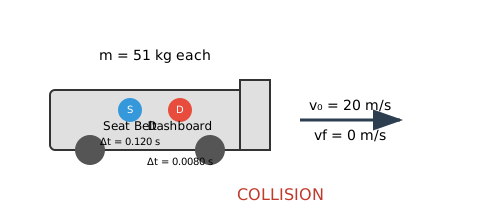
By the End of This Page
- Master the impulse-momentum theorem and its relationship to force
- Understand why stopping time dramatically affects collision forces
- Calculate impulse from momentum changes in real-world scenarios
- Connect physics equations to life-saving safety engineering
- Analyze multi-part problems involving both impulse and force calculations
Solution: Method 1 — The Impulse-Momentum Approach
Step 1 — Apply the impulse-momentum theorem
Impulse equals change in momentum: J = Δp = m(vf - vi). Since both girls have identical mass and undergo the same velocity change, they experience identical impulse. Force is then found using F = J/Δt.
F = J/Δt
Step 2 — Calculate the impulse for both girls
Both girls start at vi = 20 m/s and end at vf = 0 m/s, with mass m = 51 kg.
J = 51 kg × (0 - 20) m/s
J = 51 kg × (-20 m/s)
J = -1020 kg⋅m/s
The negative sign indicates the impulse opposes the initial motion direction. The magnitude is 1020 kg⋅m/s for both girls.
Step 3 — Find force on the seat-belted girl
The seat belt extends the stopping time to Δt = 0.120 s.
F = (-1020 kg⋅m/s)/(0.120 s)
F = -8500 N
The magnitude is 8500 N.
Step 4 — Find force on the unbelted girl
The dashboard impact has a much shorter stopping time of Δt = 0.0080 s.
F = (-1020 kg⋅m/s)/(0.0080 s)
F = -127,500 N
The magnitude is 127,500 N — fifteen times larger than the seat belt force.
Solution: Method 2 — Kinematics with Newton's Second Law
Step 1 — Find the deceleration for each girl
Using kinematics: vf = vi + aΔt, so a = (vf - vi)/Δt.
For the seat-belted girl:
For the unbelted girl:
Step 2 — Apply Newton's second law to find forces
Using F = ma:
Seat-belted girl:
Unbelted girl:
Step 3 — Calculate impulse from force
Using J = F × Δt:
J₂ = (-127,500 N) × (0.0080 s) = -1020 kg⋅m/s
Both methods confirm identical impulse values, as expected from physics principles.
a. Impulse: 1020 kg⋅m/s for both girls (magnitude)
b. Forces: Seat-belted girl: 8,500 N; Unbelted girl: 127,500 N
Verification
Let's verify our impulse calculation using the definition J = F⋅Δt:
Seat-belted girl: J = 8500 N × 0.120 s = 1020 kg⋅m/s ✓
Unbelted girl: J = 127,500 N × 0.0080 s = 1020 kg⋅m/s ✓
We can also verify using momentum change directly:
Final momentum: pf = mv_f = 51 kg × 0 m/s = 0 kg⋅m/s
Change: Δp = 0 - 1020 = -1020 kg⋅m/s ✓
The magnitude matches our calculated impulse, confirming our solution.
The Life-Saving Physics
This problem reveals the fundamental physics behind automotive safety design. Both passengers experience identical impulse because they undergo the same momentum change. However, the force—which determines injury severity—depends entirely on the time over which this change occurs.
The seat belt increases stopping time by a factor of 15 (from 0.008 s to 0.120 s), which decreases the force by the same factor. This transforms a potentially fatal impact force of 127,500 N into a survivable 8,500 N.
Watch Out for These Mistakes
Wrong: "The seat-belted girl has larger impulse because she stops more slowly."
Right: Impulse depends only on momentum change. Both girls have identical impulse because they have the same mass and velocity change, regardless of stopping time.
Wrong: Reporting force as "8500 kg⋅m/s" or impulse as "1020 N"
Right: Force has units of Newtons (N), while impulse has units of kg⋅m/s. These are equivalent to N⋅s, but the distinction matters for understanding.
Wrong: Mixing up the direction conventions halfway through the problem
Right: Choose a positive direction at the start (e.g., forward motion = positive) and stick with it throughout. The negative impulse and force indicate they oppose the initial motion.
The Impulse-Momentum Connection
This problem demonstrates one of physics' most important relationships. The impulse-momentum theorem states that:
This seemingly simple equation connects three fundamental quantities:
- Impulse (J): The "kick" delivered to change motion
- Momentum change (Δp): How much the motion actually changes
- Force and time (F⋅Δt): How that change is delivered
In collisions, the momentum change is fixed by the initial and final velocities. The key insight is that this fixed impulse can be delivered as a large force over short time, or a smaller force over longer time. Safety engineering always chooses the latter.
Real-World Applications
Automotive Safety: This exact calculation is used to design seat belts, airbags, and crumple zones. Engineers minimize peak forces while managing the space constraints of a vehicle interior.
Sports Equipment: Boxing gloves, football helmets, and gymnastics mats all work by increasing impact time to reduce forces on athletes.
Packaging Design: Bubble wrap, foam padding, and air cushions protect fragile items by extending the time over which shipping impacts occur.
What If?
Both girls: J = m(vf - vi) = 51 kg × (0 - 35) = -1785 kg⋅m/s
F₁ = J/Δt = -1785/(0.120) = -14,875 N
F₂ = J/Δt = -1785/(0.0080) = -223,125 N
Answer: Impulse: 1785 kg⋅m/s each. Forces: 14,875 N (seat belt), 223,125 N (dashboard). The higher speed increases all values by the factor 35/20 = 1.75.
J = m(vf - vi) = 51 kg × (0 - 20) = -1020 kg⋅m/s
F = J/Δt, so Δt = J/F = 1020/50,000 = 0.0204 s
The dashboard impact time was 0.0080 s, which is less than the 0.0204 s survival threshold.
Answer: Minimum stopping time: 0.0204 s. The original dashboard impact (0.0080 s) would likely be fatal, while the seat belt time (0.120 s) provides a large safety margin.
J = -1020 kg⋅m/s (unchanged from original problem)
F = J/Δt = -1020/(0.040) = -25,500 N
Dashboard: 127,500 N
Airbag: 25,500 N
Seat belt: 8,500 N
Answer: Airbag force: 25,500 N. This is 5× smaller than the dashboard but 3× larger than the seat belt. The airbag saves lives but the seat belt remains superior.
J₁ = m₁(vf - vi) = 60 kg × (0 - 20) = -1200 kg⋅m/s
J₂ = m₂(vf - vi) = 45 kg × (0 - 20) = -900 kg⋅m/s
Seat belt (60 kg): F₁ = -1200/0.120 = -10,000 N
Dashboard (45 kg): F₂ = -900/0.0080 = -112,500 N
Answer: Impulses: 1200 kg⋅m/s (60 kg girl), 900 kg⋅m/s (45 kg girl). Forces: 10,000 N (seat belt), 112,500 N (dashboard). The lighter girl experiences less impulse but still faces a potentially fatal dashboard force.
Frequently Asked Questions
2026-08-27