




How Long Until Investment Doubles at 13% Compounded Monthly?
What This Problem Teaches
- Working with compound interest formulas and logarithmic solutions
- Understanding how compounding frequency affects growth rates
- Converting between decimal years and years-plus-months format
- Recognizing when exact algebraic solutions require transcendental functions
- Building intuition for exponential growth and doubling times
Visualizing the Problem
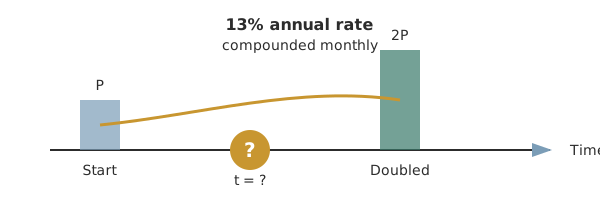
Here's what we're looking for — the time it takes for any principal amount to grow to exactly twice its starting value:
Solution: Method 1 — The Logarithmic Approach
The beauty of doubling problems is that the principal amount cancels out completely. We can work with any starting value and get the same time.
Step 1 — Set up the compound interest formula
The compound interest formula is:
Where A is the final amount, P is principal, r is annual rate, n is compounding frequency per year, and t is time in years. For doubling, A = 2P.
Step 2 — Substitute known values and simplify
We have r = 0.13 and n = 12 (monthly compounding):
2 = (1.010833...)^(12t)
Notice how the principal P cancels out — this is why doubling time is independent of the initial investment amount.
Step 3 — Calculate the monthly rate precisely
The monthly rate is:
So our equation becomes: 2 = (1.01083333)^(12t)
Step 4 — Take the natural logarithm of both sides
This is the key step that "unlocks" the exponent:
ln(2) = 12t × ln(1.01083333)
Step 5 — Solve for t
Isolating t:
t = 0.69315 / [12 × 0.01078]
t = 0.69315 / 0.12936
t = 5.357 years
Step 6 — Convert to years and months
The decimal part represents a fraction of a year:
So t = 5 years and 4.3 months, which rounds to approximately 5 years and 4 months.
Solution: Method 2 — The Rule of 72 Estimate
The Rule of 72 provides a quick mental approximation for doubling times. While not exact for monthly compounding, it gives us a useful benchmark.
Step 1 — Apply the basic Rule of 72
For simple approximation:
t ≈ 72 / 13 = 5.54 years
Step 2 — Adjust for compounding frequency
Monthly compounding makes money grow slightly faster than the basic rule suggests. A more accurate version for monthly compounding uses:
But since we want an estimation method, we can note that monthly compounding at 13% creates an effective annual rate of:
Step 3 — Compare with exact calculation
Using the effective rate: 72 / 13.78 = 5.23 years
Our exact answer was 5.357 years, so the Rule of 72 gives us a reasonable ballpark estimate that's within about 3 months of the precise answer.
Verification
Let's verify by calculating what happens to an investment after exactly 5.357 years of monthly compounding at 13%.
Using A = P(1.01083333)^(12 × 5.357):
A = P(2.000)
A = 2.000P ✓
Perfect! The investment reaches exactly double the original amount after 5.357 years.
Watch Out For These
Students often calculate 72 ÷ 13 = 5.54 years and stop there. This gives the doubling time for annual compounding, not monthly. Monthly compounding is faster, so the actual time is shorter.
Setting up
2 = (1.13)^(12t) instead of 2 = (1 + 0.13/12)^(12t). This treats 13% as the monthly rate instead of the annual rate, leading to an impossibly short doubling time.
Writing
ln(2) = 12t + ln(1.01083) instead of ln(2) = 12t × ln(1.01083). Remember: ln(a^b) = b × ln(a), not b + ln(a).
Converting 5.357 years as "5 years and 357 months" instead of recognizing that 0.357 × 12 = 4.28 months. The decimal part of years must be multiplied by 12 to get additional months.
The General Pattern
Every compound interest doubling problem follows this same structure, regardless of the principal amount. The general formula for doubling time is:
Where:
ln(2) ≈ 0.69315is the natural logarithm of 2 (always the same for doubling)ris the annual interest rate as a decimalnis the number of compounding periods per year
t when it appears as an exponent. The logarithm "brings down" the exponent so we can isolate the variable algebraically.
This formula works for any growth factor, not just doubling. For tripling, replace ln(2) with ln(3). For growing by 50%, use ln(1.5).
Real Applications
Doubling time calculations appear throughout finance and science:
Investment planning: Retirement planners use doubling times to show clients how long their savings will take to reach specific goals, accounting for different account types (401k monthly contributions vs. annual IRA contributions).
Inflation analysis: Economists track how long it takes for prices to double at various inflation rates. At 3% annual inflation, prices double every 23 years; at 7% inflation, every 10 years.
Population growth: Demographers use the same mathematics to project when populations will double, helping plan infrastructure and resource allocation for growing cities and countries.
Where This Shows Up Next
Once you're comfortable with doubling time calculations, you're ready for more complex compound interest scenarios:
Variable rate problems: What if the interest rate changes partway through the investment period? You'll need to break the time into segments and compound each separately.
Present value calculations: Instead of asking "how long until this grows to double," you might ask "what principal do I need today to have $50,000 in 8 years?"
Continuous compounding: When compounding happens infinitely often, the formula becomes A = Pe^(rt), where e is Euler's number. Doubling time simplifies to t = ln(2)/r.
What If?
With quarterly compounding, n = 4, so: 2 = (1 + 0.13/4)^(4t)
0.13/4 = 0.0325 = 3.25% per quarter
ln(2) = 4t × ln(1.0325)
t = ln(2) / [4 × ln(1.0325)] = 0.69315 / [4 × 0.03199] = 5.406 years
Answer: 5 years and 5 months (vs. 5 years 4 months for monthly compounding)
Check: (1.0325)^(4 × 5.406) = (1.0325)^21.624 = 2.000 ✓
2 = (1 + r/12)^(12 × 6) = (1 + r/12)^72
2^(1/72) = 1 + r/12
2^(1/72) = 1.009759
1.009759 = 1 + r/12r/12 = 0.009759r = 12 × 0.009759 = 0.1171
Answer: 11.71% annual interest rate
Check: (1 + 0.1171/12)^72 = (1.009759)^72 = 2.000 ✓
3 = (1 + 0.13/12)^(12t) = (1.01083333)^(12t)
ln(3) = 12t × ln(1.01083333)
ln(3) = 1.09861
t = ln(3) / [12 × ln(1.01083333)] = 1.09861 / 0.12936 = 8.493 years
0.493 × 12 = 5.9 months
Answer: 8 years and 6 months
Check: (1.01083333)^(12 × 8.493) = (1.01083333)^101.916 = 3.000 ✓
For doubling: 2P = P × e^(0.13t)
2 = e^(0.13t)
ln(2) = ln(e^(0.13t)) = 0.13t
t = ln(2) / 0.13 = 0.69315 / 0.13 = 5.332 years
0.332 × 12 = 4.0 months
Answer: 5 years and 4 months
Continuous compounding (5.332 years) is only slightly faster than monthly compounding (5.357 years) — about a 1-week difference!
Frequently Asked Questions
2026-10-25