




How to Solve Combined Direct and Inverse Variation Problems
What This Problem Teaches
- Setting up equations for combined direct and inverse variation
- Finding the constant of variation using known values
- Solving equations with variables in both numerator and denominator
- Interpreting real-world relationships through mathematical modeling
- Verifying solutions by substitution in variation problems
Visualizing the Relationship
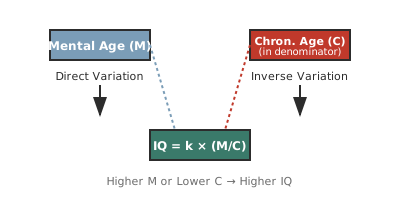
This diagram shows how IQ depends on two factors working in opposite directions: mental age increases IQ (direct variation) while chronological age decreases it (inverse variation).
Solution: Method 1 — The Variation Formula Approach
Step 1 — Set up the variation equation
Since IQ varies directly with mental age and inversely with chronological age, we can write:
Or more compactly: IQ = k(M/C), where k is the constant of variation.
Step 2 — Find the constant k using the given information
We know that when Mental Age = 22 and Chronological Age = 30, the IQ = 110:
110 = k × (11/15)
k = 110 × (15/11)
k = 150
Step 3 — Write the complete equation
Now we know the relationship is:
Step 4 — Solve for the unknown chronological age
We need to find the chronological age when Mental Age = 40 and IQ = 120:
120 = (150 × 40)/C
120 = 6000/C
120C = 6000
C = 6000/120
C = 50
Solution: Method 2 — The Ratio Consistency Approach
Step 1 — Recognize that the product IQ × C / M is constant
From the variation formula IQ = k(M/C), we can rearrange to see that IQ × C / M = k for any person.
Step 2 — Calculate the constant using the first person
For the person with mental age 22, chronological age 30, and IQ 110:
Step 3 — Apply this constant to the second person
For the person with mental age 40 and IQ 120, the same constant must hold:
120C / 40 = 150
3C = 150
C = 50
Verification
Let's check our answer by substituting back into the original relationship:
IQ = 150 × (40)/(50)
IQ = 150 × 0.8
IQ = 120 ✓
Perfect! This matches the given IQ of 120, confirming our answer is correct.
Common Pitfalls
Writing
IQ = k(C/M) instead of IQ = k(M/C). Remember: direct variation means the variable goes in the numerator, inverse variation means it goes in the denominator.
Trying to solve
120 = k(40/C) without knowing what k equals. You must always use the given information to find k before proceeding.
Confusing mental age with chronological age in the setup. Mental age is what you're capable of; chronological age is how old you actually are.
The Underlying Pattern
All combined variation problems follow this structure:
The key steps are always the same:
- Identify what varies directly (numerator) and inversely (denominator)
- Use given data to find the constant k
- Apply the complete formula to find the unknown
This pattern appears in physics (gas laws), economics (supply and demand), and many other real-world situations where multiple factors influence an outcome in opposite ways.
Real Applications
Educational Assessment: IQ tests and other standardized measures often use developmental ratios like this to assess cognitive development relative to age.
Physics: Boyle's Law states that gas pressure varies inversely with volume and directly with temperature - the same mathematical structure.
Economics: Market prices often vary directly with demand and inversely with supply, creating similar combined variation relationships.
What If?
We know IQ = 150 × (M/C) where M is mental age and C is chronological age.
With IQ = 135 and C = 25: 135 = 150 × (M/25)
135 = 150M/25135 = 6MM = 135/6 = 22.5
IQ = 150 × (22.5/25) = 150 × 0.9 = 135 ✓
Answer: Mental age is 22.5 years
Let's say original chronological age is C₁. Then IQ₁ = 150 × (30/C₁)
We want IQ₂ = 2 × IQ₁ with new chronological age C₂: 2 × IQ₁ = 150 × (30/C₂)
2 × 150 × (30/C₁) = 150 × (30/C₂)2 × (30/C₁) = 30/C₂C₂ = C₁/2
The chronological age must be halved to double the IQ.
Answer: Chronological age must be reduced by a factor of 2 (halved)
With k = 200: IQ = 200 × (Mental Age/Chronological Age)
IQ = 160, Chronological Age = 20: 160 = 200 × (M/20)
160 = 200M/20160 = 10MM = 16
IQ = 200 × (16/20) = 200 × 0.8 = 160 ✓
Answer: Mental age is 16 years
Original: IQ₁ = 150 × (M/C)
New mental age: M₂ = 1.20M
New chronological age: C₂ = 1.25C
IQ₂ = 150 × (1.20M/1.25C) = 150 × (1.20/1.25) × (M/C) = 150 × 0.96 × (M/C)
IQ₂ = 0.96 × IQ₁
This represents a 4% decrease: (0.96 - 1) × 100% = -4%
Answer: IQ decreases by 4%
Frequently Asked Questions
2026-10-27