




How Many Tablets Per Dose? Medication Dosage Math
What This Problem Teaches
- Unit conversion mastery — Converting between dosage units and tablet counts using division
- Clinical calculation accuracy — Understanding that medication errors have serious consequences
- Dimensional analysis fundamentals — Setting up ratios where units cancel correctly
- Healthcare math confidence — Building the systematic approach nurses and pharmacists use daily
- Real-world problem solving — Extracting key information from medical orders and pharmacy labels
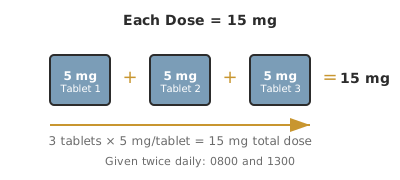
Solution: Method 1 — Direct Division
This is the standard approach used in clinical practice. We divide the ordered dose by the strength per tablet.
Step 1 — Extract the key information
From the medication order:
- Ordered dose:
15 mgper dose - Frequency: twice daily (0800 and 1300)
- Available strength:
5 mg per tablet - Question: How many tablets per dose?
Step 2 — Set up the calculation
We need to find how many 5 mg tablets make 15 mg:
Number of tablets = 15 mg ÷ 5 mg per tablet
Step 3 — Perform the division
The units cancel out, leaving us with pure tablets:
Step 4 — Interpret the result
The patient receives 3 tablets at each dose time (0800 and 1300). This gives them exactly 15 mg per dose as ordered.
Solution: Method 2 — Ratio and Proportion
This method sets up equivalent ratios, which some nursing students find more intuitive for complex dosage problems.
Step 1 — Set up the known ratio
We know that 1 tablet contains 5 mg:
Step 2 — Cross multiply
Using the cross multiplication property of proportions:
15 = 5x
Step 3 — Solve for x
Divide both sides by 5:
Step 4 — Verify the proportion
Check: 1 tablet : 5 mg = 3 tablets : 15 mg
Cross check: 1 × 15 = 15 and 3 × 5 = 15 ✓
Verification
Let's double-check by calculating the total milligrams from our answer:
This matches the ordered dose of 15 mg exactly. ✓
Additional check: Since the dose is given twice daily, the patient receives:
Daily mg total = 6 tablets × 5 mg/tablet = 30 mg per day
This matches 15 mg × 2 doses = 30 mg daily. ✓
Watch Out For These Pitfalls
✗ Confusing dose frequency with tablets per dose
Wrong thinking: "It says twice a day, so maybe 2 tablets?"
Why this fails: The frequency (twice daily) tells you when to give the medication, not how much. You still need to calculate the tablets needed to achieve 15 mg per dose.
✗ Using addition instead of division
Wrong calculation: 15 mg + 5 mg = 20 tablets
Why this fails: Addition doesn't tell you how many 5 mg pieces fit into 15 mg. Division is the correct operation for "how many groups" problems.
✗ Mixing up tablet strength and dose times
Wrong setup: 15 mg ÷ 2 doses = 7.5 mg (then getting confused about fractional mg)
Why this fails: This calculates mg per dose, which we already know. The question asks for tablets per dose, so you need to divide by tablet strength (5 mg), not frequency (2 times daily).
How to Spot This Problem Type
Look for these key phrases that signal a basic tablet calculation:
- "Supplied as [X] mg per tablet" — This gives you the denominator for your division
- "How many tablets" — The question directly asks for tablet count, not milligrams
- "Each dose" or "per dose" — You're calculating for one administration, not daily total
- Time specifications like "0800 and 1300" — These give frequency but don't affect the tablets-per-dose calculation
In nursing school and on the NCLEX exam, you'll see variations like "capsules per dose," "mL per dose," or "units per dose" — but the calculation structure stays the same: ordered amount ÷ concentration per unit.
The General Formula
All basic medication dosage problems follow this pattern:
This works regardless of the specific drug, dose, or tablet strength. The key is identifying:
- Dose ordered: What the provider prescribed per dose (15 mg in this problem)
- Dose per tablet: What's printed on the medication label (5 mg per tablet here)
Important note: This formula assumes the ordered dose is achievable with whole tablets. In real practice, if your calculation gives 2.3 tablets, you need to consult with the pharmacy or provider about available strengths — patients cannot take partial tablets in most cases.
This Calculation in Healthcare
This exact type of problem appears constantly in clinical practice:
- Hospital nursing: Every medication administration requires dosage calculation and verification
- Pharmacy practice: Pharmacists calculate quantities for prescription filling and insurance coverage
- Nursing school exams: NCLEX and nursing program exams test this skill repeatedly with different medications
The stakes are high — medication errors are a leading cause of preventable harm in hospitals. That's why nurses often use a "second nurse check" for complex calculations, and many hospitals require electronic verification systems for high-risk medications.
What If?
Ordered dose: 20 mg per dose
Available strength: 5 mg per tablet
Tablets needed = 20 mg ÷ 5 mg per tablet = 4 tablets
4 tablets × 5 mg per tablet = 20 mg ✓
4 tablets per dose
3 tablets × 5 mg per tablet = 15 mg per dose
15 mg per dose × 2 doses per day = 30 mg per day
3 tablets × 2 doses = 6 tablets daily6 tablets × 5 mg per tablet = 30 mg daily ✓
30 mg total daily dosage
Ordered dose: 15 mg
Available strength: 10 mg per tablet
Tablets needed = 15 mg ÷ 10 mg per tablet = 1.5 tablets
This requires giving 1.5 tablets (one and a half tablets). The tablet would need to be scored or capable of being split in half. Always verify with pharmacy that the tablet formulation allows splitting.
1.5 tablets × 10 mg per tablet = 15 mg ✓
15 mg ÷ 5 mg per tablet = 3 tablets per dose
3 tablets per dose × 2 doses per day = 6 tablets per day
6 tablets per day × 7 days = 42 tablets total
42 tablets × 5 mg per tablet = 210 mg total
Check: 15 mg × 2 × 7 days = 210 mg ✓
42 tablets for a 7-day supply
Frequently Asked Questions
2026-09-19