




Solve Mixture Problems: Combining Two Solutions
What This Problem Teaches
- Setting up equations based on the conservation of pure medication
- Converting percentages to decimals for calculations
- Understanding that mixing solutions requires balancing substance amounts, not just volumes
- Solving linear equations with practical constraints (volumes must be positive)
- Verifying solutions by checking final concentrations make physical sense
Visualizing the Problem
Let's create a clear picture of what we're mixing:
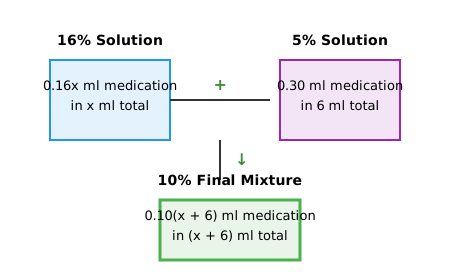
| Solution | Volume (ml) | Concentration | Pure Medication (ml) |
|---|---|---|---|
| Strong solution | x | 16% | 0.16x |
| Weak solution | 6 | 5% | 6 × 0.05 = 0.30 |
| Final mixture | x + 6 | 10% | 0.10(x + 6) |
Solution: Method 1 — Medication Mass Balance
The key insight is that pure medication is conserved when we mix solutions. The total amount of medication before mixing equals the total amount after mixing.
Step 1 — Define the variable
Let x = milliliters of 16% solution needed.
Step 2 — Calculate pure medication in each component
Pure medication is found by multiplying volume by concentration:
- From 16% solution:
x × 0.16 = 0.16xml of medication - From 5% solution:
6 × 0.05 = 0.30ml of medication - In final mixture:
(x + 6) × 0.10 = 0.10(x + 6)ml of medication
Step 3 — Set up the medication balance equation
The medication from both original solutions equals the medication in the final mixture:
0.16x + 0.30 = 0.10(x + 6)
Step 4 — Solve the equation
Expand the right side and collect like terms:
0.16x - 0.10x = 0.60 - 0.30
0.06x = 0.30
x = 0.30 ÷ 0.06 = 5
Step 5 — State the complete answer
The veterinarian needs 5 ml of the 16% solution.
Solution: Method 2 — The Concentration Difference Approach
This method uses the concept that we're moving the 5% solution "up" to 10%, while the 16% solution gets "diluted down" to 10%.
Step 1 — Calculate concentration differences
Find how far each solution is from the target concentration:
- 5% solution needs to increase by:
10% - 5% = 5% - 16% solution will decrease by:
16% - 10% = 6%
Step 2 — Set up the ratio
The volume ratio should be inversely related to the concentration differences:
x : 6 = 5 : 6
Step 3 — Solve the proportion
x = 6 × 5/6 = 5
This confirms our answer: 5 ml of the 16% solution.
Verification
Let's check our answer by calculating the final concentration:
Calculate total medication
- From 5 ml of 16% solution:
5 × 0.16 = 0.80 ml - From 6 ml of 5% solution:
6 × 0.05 = 0.30 ml - Total medication:
0.80 + 0.30 = 1.10 ml
Calculate total volume and final concentration
- Total volume:
5 + 6 = 11 ml - Final concentration:
1.10 ÷ 11 = 0.10 = 10%✓
Perfect! Our answer gives exactly the required 10% concentration.
Common Pitfalls
0.16x + 0.05(6) = 0.10(x)Why it's wrong: This ignores the volume contribution of the 5% solution to the final mixture. The final volume is
x + 6, not just x.
16x + 5(6) = 10(x + 6)Why it's wrong: You must convert percentages to decimals when calculating amounts. This equation inflates all values by a factor of 100.
(16% + 5%) ÷ 2 = 10.5%Why it's wrong: This assumes equal volumes, but we have 6 ml of one solution and an unknown amount of the other. Concentrations must be weighted by volume.
Does This Seem Reasonable?
Let's do a sanity check on our answer of 5 ml:
- Volume check: We're adding 5 ml of strong solution to 6 ml of weak solution. Since 5 < 6, we expect the final concentration to be closer to the weak solution, which it is (10% is closer to 5% than to 16%).
- Concentration logic: The 16% solution is 6 percentage points above our target, while the 5% solution is 5 points below. We need slightly less of the stronger solution, which matches our 5:6 ratio.
- Practical context: For treating a small bird, 11 ml total volume (5 + 6) is a reasonable amount for a veterinarian to work with.
The answer passes all reasonableness tests.
The Pattern Behind This
All mixture problems follow the same fundamental principle: the amount of pure substance is conserved.
C₁V₁ + C₂V₂ = C_final(V₁ + V₂)
Where:
• C₁, C₂ = concentrations of original solutions
• V₁, V₂ = volumes of original solutions
• C_final = desired final concentration
This same structure applies whether you're mixing:
- Medication solutions (like this problem)
- Salt water of different concentrations
- Alcohol solutions for chemistry
- Fertilizer mixtures for agriculture
The key is identifying what substance is being conserved (medication, salt, alcohol, etc.) and setting up the balance equation correctly.
Why This Matters
Mixture calculations appear throughout healthcare and science:
- Pharmacy: Compounding custom medication strengths for patients with specific needs
- Veterinary medicine: Adjusting medication concentrations for different animal sizes and species
- Laboratory work: Preparing reagent solutions with precise concentrations for experiments
- Food industry: Creating products with specific nutrient or additive concentrations
In clinical settings, these calculations are often double-checked by multiple professionals because concentration errors can have serious consequences for patient safety.
What If?
Let x = ml of 16% solution. The medication balance equation becomes: 0.16x + 0.05(6) = 0.12(x + 6)
0.16x + 0.30 = 0.12x + 0.72
0.16x - 0.12x = 0.72 - 0.300.04x = 0.42x = 10.5
Total medication: 10.5(0.16) + 6(0.05) = 1.68 + 0.30 = 1.98 ml
Total volume: 10.5 + 6 = 16.5 ml
Final concentration: 1.98 ÷ 16.5 = 0.12 = 12% ✓
Answer: 10.5 ml of the 16% solution
Let x = ml of 16% solution and y = ml of 5% solution.
We know: x + y = 15 (total volume constraint)
0.16x + 0.05y = 0.10(15) = 1.5
From volume equation: y = 15 - x
Substitute: 0.16x + 0.05(15 - x) = 1.50.16x + 0.75 - 0.05x = 1.50.11x = 0.75x = 6.82 ml
y = 15 - 6.82 = 8.18 ml
Answer: Mix 6.82 ml of 16% solution with 8.18 ml of 5% solution
Let y = ml of 5% solution needed
Medication from 16% + Medication from 5% = Medication in final mixture0.16(8) + 0.05y = 0.10(8 + y)
1.28 + 0.05y = 0.80 + 0.10y1.28 - 0.80 = 0.10y - 0.05y0.48 = 0.05yy = 9.6
Total medication: 1.28 + 0.05(9.6) = 1.28 + 0.48 = 1.76 ml
Total volume: 8 + 9.6 = 17.6 ml
Final concentration: 1.76 ÷ 17.6 = 0.10 = 10% ✓
Answer: 9.6 ml of the 5% solution
Let x = ml of 16% solution needed
Components: x ml of 16%, 4 ml of 5%, 3 ml of 0%
From 16%: 0.16x ml
From 5%: 4 × 0.05 = 0.20 ml
From water: 3 × 0 = 0 ml
Total medication = Final concentration × Total volume0.16x + 0.20 + 0 = 0.08(x + 4 + 3)0.16x + 0.20 = 0.08(x + 7)
0.16x + 0.20 = 0.08x + 0.560.16x - 0.08x = 0.56 - 0.200.08x = 0.36x = 4.5
Total medication: 4.5(0.16) + 0.20 = 0.72 + 0.20 = 0.92 ml
Total volume: 4.5 + 4 + 3 = 11.5 ml
Final concentration: 0.92 ÷ 11.5 = 0.08 = 8% ✓
Answer: 4.5 ml of the 16% solution
Frequently Asked Questions
2026-10-30