




Solve Multi-Part Income & Budget Problem
By the End of This Page
- Calculate savings rates by finding what percentage remains after all expenses
- Work backwards from annual savings to determine monthly income using percentage relationships
- Convert timeframes between different car price points using monthly savings amounts
- Analyze how expense changes affect savings capacity and purchase timelines
- Apply percentage calculations to real-world financial planning scenarios
Visualizing the Budget
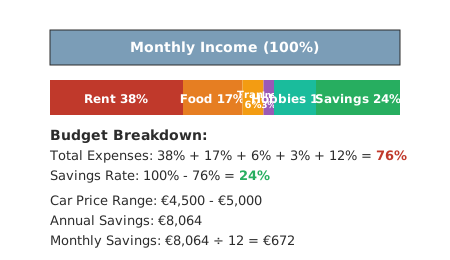
Let's see how Tuomas's monthly income breaks down across all categories:
Solution: Method 1 — The Savings Rate Approach
The key insight is that we can find Tuomas's savings rate first, then use the annual savings figure to work backwards to his income.
Step 1 — Calculate the total expense percentage
Add up all the given expense percentages:
Step 2 — Find the savings percentage
Since all income is either spent or saved:
Step 3 — Calculate monthly savings from annual figure
Convert the annual savings to monthly:
Step 4 — Find monthly income (Part b)
Use the relationship between monthly savings and savings percentage:
Monthly income = €672 ÷ 0.24 = €2,800
Step 5 — Determine car purchase timeline (Part a)
Calculate how many months for each price point:
For €5,000: €5,000 ÷ €672 = 7.4 months → 8 months
So Tuomas can buy the car after 7-8 months depending on which car he chooses.
Step 6 — Calculate food and transportation costs (Part c)
Transportation: €2,800 × 0.06 = €168 per month
Total: €476 + €168 = €644 per month
Step 7 — Analyze rent increase scenario (Part d)
First, calculate current and new rent:
New rent: €1,064 × 1.18 = €1,255.52 per month
Rent increase: €1,255.52 - €1,064 = €191.52 per month
This reduces monthly savings:
New timeline for car purchase:
For €5,000: €5,000 ÷ €480.48 = 10.4 months → 11 months
Solution: Method 2 — The Monthly Unit Approach
Alternatively, we can think of each month as producing a specific "unit" of savings, then determine what that unit is worth.
Step 1 — Determine the monthly savings unit
In 12 months, Tuomas saves €8,064, so each month he saves:
Step 2 — Find what percentage this represents
Calculate total spending percentage, then subtract from 100%:
Savings rate = 100% - 76% = 24%
Step 3 — Scale up to find full income
If €672 is 24% of his income, then 100% is:
Step 4 — Answer all parts using monthly savings
Part a: Months to buy car = Car price ÷ Monthly savings
€5,000 ÷ €672 ≈ 7.4 months → 8 months
Part b: Monthly salary = €2,800 (calculated above)
Part c: Food and transportation total:
Part d: With rent increase:
New monthly savings = €672 - €191.52 = €480.48
New timeline: 10-11 months
a. After 7-8 months (depending on car price)
b. Monthly salary: €2,800
c. Food and transportation total: €644 per month
d. With rent increase: 10-11 months
Verification
Let's verify our income calculation by checking if all the percentages add up correctly:
| Category | Percentage | Amount (€2,800) | Check |
|---|---|---|---|
| Rent | 38% | €1,064 | €1,064 ÷ €2,800 = 0.38 ✓ |
| Food | 17% | €476 | €476 ÷ €2,800 = 0.17 ✓ |
| Transportation | 6% | €168 | €168 ÷ €2,800 = 0.06 ✓ |
| Insurance | 3% | €84 | €84 ÷ €2,800 = 0.03 ✓ |
| Hobbies | 12% | €336 | €336 ÷ €2,800 = 0.12 ✓ |
| Savings | 24% | €672 | €672 × 12 = €8,064 ✓ |
| Total | 100% | €2,800 | All checks pass ✓ |
For the rent increase scenario:
Reduction in savings: €1,255.52 - €1,064 = €191.52
New monthly savings: €672 - €191.52 = €480.48
Time for €4,500: €4,500 ÷ €480.48 ≈ 9.4 months ✓
Watch Out For These
Students often see "€8,064" and use it directly for monthly calculations. Remember: this is the total saved in 12 months, so monthly savings = €8,064 ÷ 12 = €672.
You might try to work directly with the expense percentages, but you need the savings rate first: 100% - (sum of all expenses) = 100% - 76% = 24%.
When rent increases, it doesn't change the percentage structure—it reduces the absolute amount available for savings. The €191.52 increase comes directly out of the €672 monthly savings.
If you need 7.4 months to save for a car, you must save for 8 full months (you can't buy the car partway through month 7). Always round up for timeline questions unless the problem asks for fractional months.
The Pattern Behind This
This problem demonstrates the percentage-to-absolute conversion pattern that appears throughout personal finance:
You can find: The whole (total income)
Formula: Whole = Part ÷ Percentage
The general structure for budget problems like this:
- Find the "leftover" percentage: 100% minus all given percentages
- Convert annual to monthly: Divide by 12 for monthly figures
- Scale up: Use the leftover percentage to find the total income
- Answer questions: Multiply income by percentages for amounts, divide target amounts by savings for timelines
This same pattern works for any scenario where you know several percentage allocations and one absolute amount—whether it's household budgets, business expense breakdowns, or investment portfolios.
Why This Matters
This type of calculation appears constantly in personal finance planning:
- Salary negotiations: If you know you need €800 monthly savings and save 25% of income, you need €3,200 gross salary minimum
- Expense tracking apps: Many apps calculate your savings rate this way—by adding up expense percentages and subtracting from 100%
- Retirement planning: Financial advisors use this exact method to determine required income based on desired retirement contributions (often 10-20% of income)
- Debt reduction strategies: When creating payment plans, you work backwards from available monthly payment to required income level
The rent increase scenario models real inflation impacts—when housing costs rise but salary doesn't, it directly reduces your capacity to save for other goals. Understanding this mathematically helps in negotiating raises or deciding whether to move to lower-cost areas.
What If?
Car cost + Emergency fund = €3,600 + €600 = €4,200 total needed
From the original problem, monthly savings = €672
Months needed = €4,200 ÷ €672 = 6.25 months
Since he can only save full months, he needs 7 months
After 7 months: €672 × 7 = €4,704 saved
After purchase: €4,704 - €3,600 = €1,104 emergency fund ✓
Savings percentage = €720 ÷ €3,000 = 0.24 = 24%
Known expenses = 35% + 18% + 6% + 3% = 62%
All percentages must sum to 100%:
Known expenses + Hobbies + Savings = 100%
62% + Hobbies + 24% = 100%
Hobbies = 100% - 62% - 24% = 14%
Check: 14% of €3,000 = €420 monthly on hobbies
Total: €1,050 + €540 + €180 + €90 + €420 + €720 = €3,000 ✓
New income = €2,800 × 1.15 = €3,220
Savings rate remains 24%
New monthly savings = €3,220 × 0.24 = €772.80
Months needed = €5,000 ÷ €772.80 = 6.47 months
He needs 7 months to save for the car
After 7 months: €772.80 × 7 = €5,409.60 saved
This is more than €5,000, so he can afford the car ✓
Food reduction: 17% - 12% = 5 percentage points
Hobbies reduction: 12% - 6% = 6 percentage points
Total reduction = 5% + 6% = 11 percentage points
Original savings rate = 24%
New savings rate = 24% + 11% = 35%
Monthly income remains €2,800
New monthly savings = €2,800 × 0.35 = €980
Months = €4,500 ÷ €980 = 4.59 months
Rounded up: 5 months
New expense total: 38% + 12% + 6% + 3% + 6% = 65%
New savings: 100% - 65% = 35% ✓
After 5 months: €980 × 5 = €4,900 > €4,500 ✓
Frequently Asked Questions
2026-10-24