




Combined Work Rate: Two Drainage Pipes
Skills This Problem Builds
- Converting individual completion times to work rates
- Understanding that combined rates add when working toward the same goal
- Using dimensional analysis to track units throughout calculations
- Recognizing the relationship between rate, time, and total work
- Applying the work rate formula to real-world drainage scenarios
Picture This
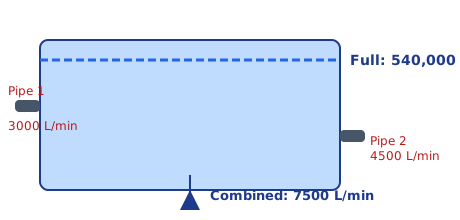
Solution: Method 1 — The Unit Rate Approach
The key insight is to convert each pipe's completion time into a drainage rate, then add those rates together.
Step 1 — Find each pipe's drainage rate
Rate equals work divided by time, so we divide the pool volume by each pipe's individual completion time.
Pipe 2 rate = 540,000 L ÷ 120 min = 4500 L/min
Step 2 — Add the rates to find combined drainage
When both pipes work together, their rates add because they're both removing water from the same pool.
Step 3 — Calculate time using the combined rate
Now we divide the total work by the combined rate to find the time needed.
Time = 540,000 L ÷ 7500 L/min = 72 minutes
Solution: Method 2 — The Reciprocal Formula
There's an elegant shortcut when you're given individual completion times and need the combined time.
Step 1 — Apply the harmonic mean formula
For two workers (or pipes) that complete a job in times a and b, the combined time is ab/(a + b).
Combined time = 21,600 ÷ 300
Combined time = 72 minutes
Step 2 — Understand why this works
This formula comes from adding the work fractions. Pipe 1 completes 1/180 of the job per minute, Pipe 2 completes 1/120 per minute. Together they complete (1/180 + 1/120) = 1/72 of the job per minute.
So the job takes 72 minutes to complete.
Verification
Let's verify by calculating how much work each pipe accomplishes in 72 minutes:
• Pipe 1 drains: 3000 L/min × 72 min = 216,000 L
• Pipe 2 drains: 4500 L/min × 72 min = 324,000 L
• Total drained: 216,000 + 324,000 = 540,000 L ✓
Check using work fractions:
In 72 minutes, Pipe 1 completes 72/180 = 2/5 of the job
In 72 minutes, Pipe 2 completes 72/120 = 3/5 of the job
Together: 2/5 + 3/5 = 5/5 = 1 complete job ✓
Watch Out For These
This treats the pipes as if they alternate working instead of working together. When rates add, times don't average—they get shorter than either individual time.
This adds the completion times instead of the work rates. Two pipes working together always finish faster than either one alone.
The harmonic mean formula for combined work is ab/(a+b), not ab/(a-b). The subtraction version would give a negative time when both pipes have the same speed.
Recognizing This Problem Type
Look for these telltale signs that signal a combined work rate problem:
- "Working together" or "both pipes draining" — multiple agents doing the same task
- Individual completion times given — "Pipe A alone takes X minutes, Pipe B alone takes Y minutes"
- Same type of work — filling, draining, building, or completing identical tasks
- Question asks for combined time — "How long together?" or "How long with both?"
This problem structure appears in manufacturing (two machines making widgets), construction (two crews building), data processing (two servers handling requests), and anywhere multiple agents work in parallel toward the same goal.
The General Formula
For any number of workers or pipes completing the same job:
Combined Time = Total Work ÷ Combined Rate
For exactly two workers with times a and b:
Combined Time = ab/(a + b)
The reciprocal formula only works cleanly for two workers. With three or more, it's usually faster to convert to rates, add them, then find the time. Also remember this formula assumes all workers start and stop together—it doesn't handle scenarios where one worker leaves early or joins late.
Real Applications
Network engineering: When two internet connections are bonded, their bandwidths add. A 50 Mbps line and a 30 Mbps line together provide 80 Mbps of total throughput.
Manufacturing: Two assembly machines producing identical parts work at combined rates. If Machine A produces 100 units/hour and Machine B produces 150 units/hour, together they produce 250 units/hour.
Medical infusion: Multiple IV drips delivering the same medication combine their flow rates. This calculation ensures patients receive the intended dosage rate when multiple access points are used.
What If?
Pipe 1 still drains at 3000 L/min and Pipe 2 at 4500 L/min, so combined rate is still 7500 L/min.
Time = 270,000 L ÷ 7500 L/min = 36 minutes
In 36 minutes: Pipe 1 drains 3000 × 36 = 108,000 L, Pipe 2 drains 4500 × 36 = 162,000 L. Total: 270,000 L ✓
Answer: 36 minutes
Pipe 3 rate = 540,000 L ÷ 90 min = 6000 L/min
Combined rate = 3000 + 4500 + 6000 = 13,500 L/min
Time = 540,000 L ÷ 13,500 L/min = 40 minutes
Total drained in 40 min: 3000×40 + 4500×40 + 6000×40 = 120,000 + 180,000 + 240,000 = 540,000 L ✓
Answer: 40 minutes
Normal rate: 3000 L/min
Clogged rate: 3000 × 0.60 = 1800 L/min
Pipe 2 rate: 4500 L/min (unchanged)
Combined rate = 1800 + 4500 = 6300 L/min
Time = 540,000 ÷ 6300 = 85.7 minutes ≈ 86 minutes
Answer: 86 minutes
Combined rate = 540,000 L ÷ 72 min = 7500 L/min
Pipe 1 rate = 540,000 L ÷ 180 min = 3000 L/min
Since rates add: Pipe 2 rate = 7500 - 3000 = 4500 L/min
Time = 540,000 L ÷ 4500 L/min = 120 minutes
Check with reciprocal formula: (180 × 120) ÷ (180 + 120) = 21,600 ÷ 300 = 72 minutes ✓
Answer: 120 minutes
Frequently Asked Questions
2026-11-09