




Plane Wind Speed: Solving for Headwind & Tailwind
What This Problem Teaches
- How wind affects effective travel speed in opposite directions
- Setting up equations when time is the constant factor between two different journeys
- Solving rational equations by cross multiplication
- Recognizing that equal times with different distances require different speeds
- Connecting the distance-rate-time relationship to real-world scenarios
Let's Draw What We Know
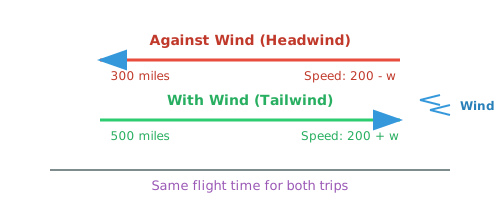
The diagram shows how wind affects the plane's effective speed. When flying with the wind, the plane's ground speed is faster than its cruising speed. When flying against the wind, it's slower. The key insight is that both trips take exactly the same amount of time, even though the distances and effective speeds are different.
Solution: Method 1 — The Time Equality Approach
Step 1 — Define the variable and effective speeds
Let w = wind speed in miles per hour.
When flying with the wind, the wind adds to the plane's speed:
When flying against the wind, the wind subtracts from the plane's speed:
Step 2 — Set up the time equations
Since Time = Distance ÷ Rate, we can write the time for each trip:
The problem states these times are equal, so:
Step 3 — Cross multiply to eliminate fractions
Cross multiplying gives us:
Step 4 — Expand both sides
Distribute on both sides:
Step 5 — Collect like terms and solve
Move all terms with w to one side and constants to the other:
Solution: Method 2 — Distance-Speed Proportion
Step 1 — Recognize the proportional relationship
Since both trips take the same time, the distances must be proportional to their respective speeds. If we call the common time t:
Step 2 — Set up the ratio
The ratio of distances equals the ratio of speeds:
Step 3 — Cross multiply and solve
Cross multiplying:
This confirms our answer: the wind speed is 50 mph.
Verification
Let's check our answer by calculating both flight times:
With wind (tailwind):
Speed = 200 + 50 = 250 mph
Time = 500 miles ÷ 250 mph = 2 hours
Against wind (headwind):
Speed = 200 - 50 = 150 mph
Time = 300 miles ÷ 150 mph = 2 hours
✓ Both times equal 2 hours, confirming our answer is correct.
Watch Out For These
Writing "with wind = 200 + w" and "against wind = 200 + w" ignores the fact that headwind opposes motion. Against the wind, the effective speed is 200 - w, not 200 + w.
Writing "500 = 300" makes no sense. The problem states the times are equal, not the distances. You must use the relationship time = distance/rate for each trip.
Calculating (500 + 300)/(200 + 200) assumes constant speed, but the wind changes the effective speeds. You cannot average distances and speeds when the underlying conditions are different.
When cross multiplying 500/(200 + w) = 300/(200 - w), be careful with signs. The correct expansion is 500(200 - w) = 300(200 + w), which becomes 100,000 - 500w = 60,000 + 300w.
Does This Seem Reasonable?
A 50 mph wind speed is quite strong—that's a severe storm level wind. But let's check if the math makes sense:
- With the wind: The plane effectively flies at 250 mph (200 + 50), covering 500 miles in exactly 2 hours.
- Against the wind: The plane effectively flies at 150 mph (200 - 50), covering 300 miles in exactly 2 hours.
Notice that the tailwind increases speed by 25% (250/200 = 1.25), while the headwind decreases speed by 25% (150/200 = 0.75). This symmetry makes sense—the same wind has equal but opposite effects.
The ratio of distances (500:300 = 5:3) equals the ratio of effective speeds (250:150 = 5:3), which confirms that time is indeed the same for both trips.
The General Pattern
Wind speed problems follow this structure:
This equation works because both trips take the same time. You can generalize further:
For our problem: Wind = (500 - 300) × 200 / (500 + 300) = 200 × 200 / 800 = 50 mph.
This formula only works when the plane speed and distances are such that a positive wind speed solution exists. If Distance₁ ≤ Distance₂, there's no wind speed that makes the faster trip (Distance₁) take the same time as the slower trip (Distance₂).
Real Applications
This problem structure appears frequently in real scenarios:
- Aviation: Commercial flights routinely adjust routes and departure times based on jet stream winds. A flight from New York to London might take 6.5 hours eastbound (with the jet stream) but 7.5 hours westbound (against it).
- Marine navigation: Ships must account for ocean currents when planning routes. The same distance can take very different times depending on current direction.
- Competitive cycling: Time trial courses are often out-and-back routes. Wind conditions can dramatically affect times, and cyclists must pace differently for each direction.
What If?
Let w = wind speed. Time equation: 420/(180 + w) = 300/(180 - w)
420(180 - w) = 300(180 + w)75,600 - 420w = 54,000 + 300w
75,600 - 54,000 = 300w + 420w21,600 = 720ww = 30
With wind: 420 ÷ 210 = 2 hours
Against wind: 300 ÷ 150 = 2 hours ✓
Answer: 30 mph wind speed
Let p = plane speed. Time equation: 450/(p + 30) = 270/(p - 30)
450(p - 30) = 270(p + 30)450p - 13,500 = 270p + 8,100
450p - 270p = 8,100 + 13,500180p = 21,600p = 120
With wind: 450 ÷ 150 = 3 hours
Against wind: 270 ÷ 90 = 3 hours ✓
Answer: 120 mph cruising speed
With wind speed = 200 + 40 = 240 mph
Time = 400 ÷ 240 = 5/3 hours
Against wind speed = 200 - 40 = 160 mph
Time = 400 ÷ 160 = 2.5 hours
Total = 5/3 + 2.5 = 5/3 + 5/2 = 10/6 + 15/6 = 25/6 ≈ 4.17 hours
No wind: 800 miles ÷ 200 mph = 4.0 hours
Wind adds 0.17 hours (about 10 minutes)
Answer: 4.17 hours with wind vs 4.0 hours without wind
Let w = wind speed, t = common time320 = t(200 + w)160 = t(200 - w)240 = t(200)
From 240 = t(200): t = 240/200 = 1.2 hours
320 = 1.2(200 + w)320 = 240 + 1.2w80 = 1.2ww = 80/1.2 = 66.67 mph
160 = 1.2(200 - 66.67) = 1.2(133.33) = 160 ✓
Answer: Wind speed = 66.67 mph, Common time = 1.2 hours
Frequently Asked Questions
2026-10-27