




Drawing Coins Without Replacement
What This Problem Teaches
- How "without replacement" changes probability calculations between draws
- The multiplication rule for sequential events (conditional probability)
- Why the total number of outcomes decreases after the first draw
- Setting up organized probability tables to track changing conditions
- Converting probability fractions to percentages for real-world interpretation
Let's Draw It
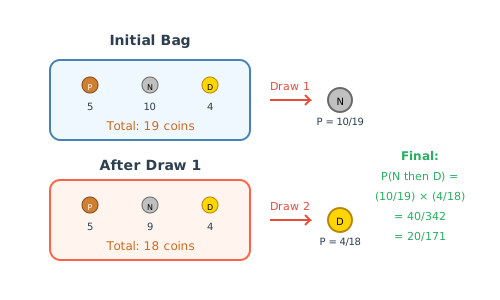
Solution: Method 1 — Sequential Probability
When drawing without replacement, we treat this as a sequence of events where each draw affects the next. We need a nickel first and a dime second, so we multiply their probabilities.
Step 1 — Count the total coins
First, let's see what we're working with:
Step 2 — Find the probability of drawing a nickel first
On the first draw, we have 10 nickels out of 19 total coins:
Step 3 — Adjust for the second draw
Here's the key insight: after removing one nickel, we have fewer coins total, but the number of dimes stays the same. The bag now contains:
Step 4 — Find the probability of drawing a dime second
On the second draw, we have 4 dimes out of the remaining 18 coins:
Step 5 — Multiply for the combined probability
Since we need both events to happen in sequence, we multiply:
Step 6 — Simplify the fraction
We can reduce this fraction by dividing both numerator and denominator by their greatest common factor of 2:
Solution: Method 2 — Organized Counting
Instead of thinking about conditional probability, we can count all possible ordered pairs and find what fraction are favorable.
Step 1 — Count all possible ordered pairs
For the first coin, we have 19 choices. For the second coin, we have 18 choices (since we don't replace the first). So there are:
Step 2 — Count favorable outcomes
A favorable outcome is picking any of the 10 nickels first, then any of the 4 dimes second:
Step 3 — Calculate the probability
Probability is favorable outcomes over total outcomes:
This gives us the same answer as Method 1, confirming our result.
Verification
Let's check our answer makes sense by testing the boundary conditions and using an alternative approach.
Reasonableness check: We're looking for a specific sequence out of many possibilities, so the probability should be fairly small. 11.7% seems reasonable.
Alternative calculation: We can verify by computing the probability as a decimal directly:
Fraction verification: Let's confirm our simplification is correct:
All checks confirm our answer of 20/171.
Watch Out For These
✗ Using 19 for both draws:
P = (10/19) × (4/19) = 40/361
Why it's wrong: This treats the draws as if you replace the first coin, but the problem says "without replacement." After drawing one coin, only 18 remain.
✗ Reducing the number of dimes:
P = (10/19) × (3/18)
Why it's wrong: Drawing a nickel doesn't change the number of dimes in the bag. Only the total count and the nickel count change.
✗ Adding instead of multiplying:
P = 10/19 + 4/18 = (180 + 76)/342 = 256/342
Why it's wrong: Addition is for "or" situations (either event). Since we need a nickel and then a dime, we multiply.
The Pattern Behind This
This problem demonstrates the fundamental rule for sequential events without replacement:
General Formula: For drawing items A then B without replacement:
The key insight is that the denominator decreases by 1 for the second draw, but only the count of the first item type decreases in the numerator.
This pattern extends to any number of draws. For three draws without replacement, you'd multiply three fractions with denominators of n, n-1, and n-2.
The distinction between "with replacement" and "without replacement" is crucial in probability. Without replacement makes each subsequent draw dependent on what happened before, while with replacement keeps each draw independent.
How to Spot This Problem Type
Look for these key phrases that signal a sequential probability without replacement problem:
- "Without replacement" or "don't put it back" — the classic signal
- "Draw two [items]" or "select two [items]" from a collection
- Questions asking for "A then B" or "first A, then B" (order matters)
- Problems involving cards from a deck, balls from an urn, or items from a bag
- Any scenario where taking one item changes the total for future draws
Be careful: Some problems will say "select two coins" without explicitly mentioning replacement. In most real-world scenarios, this means without replacement unless stated otherwise.
What If?
Total coins = 19. Dimes = 4. So P(dime first) = 4/19
After removing one dime, we have 18 coins total, with 10 nickels remaining. So P(nickel second | dime first) = 10/18 = 5/9
P(dime then nickel) = 4/19 × 10/18 = 40/342 = 20/171
Notice this equals the probability of nickel then dime! This makes sense: there are equally many ways to get each ordered pair.
Answer: 20/171 ≈ 11.7%
We want either: (nickel then dime) OR (dime then nickel)
P(nickel then dime) = 10/19 × 4/18 = 40/342
P(dime then nickel) = 4/19 × 10/18 = 40/342
For "OR" situations, we add: P = 40/342 + 40/342 = 80/342 = 40/171
Alternative: count favorable ordered pairs (10×4 + 4×10 = 80) out of total pairs (19×18 = 342). Gets 80/342 = 40/171 ✓
Answer: 40/171 ≈ 23.4%
With 19 total coins and 10 nickels: P(nickel first) = 10/19
Since we replace the coin, we still have 19 total coins and 4 dimes: P(dime second) = 4/19
P(nickel then dime) = 10/19 × 4/19 = 40/361
40/361 ≈ 0.1108 or about 11.1%. This is slightly less than the without replacement case (11.7%) because the denominator stays larger.
Answer: 40/361 ≈ 11.1%
Coin values: penny = 1¢, nickel = 5¢, dime = 10¢
Ways to make 15¢: nickel (5¢) + dime (10¢) = 15¢. That's the only way!
P(N then D) = 10/19 × 4/18 = 40/342
P(D then N) = 4/19 × 10/18 = 40/342
P(total = 15¢) = 40/342 + 40/342 = 80/342 = 40/171
Check: this is the same as "one nickel and one dime in any order" from Problem 2. ✓
Answer: 40/171 ≈ 23.4%
Frequently Asked Questions
2026-08-20