




Plane Speed and Wind Speed: Two-Condition Rate Problem
What This Problem Teaches
- Setting up systems of equations from real-world scenarios with relative motion
- Understanding how wind affects ground speed in opposite directions
- Using the elimination method when equations have symmetric structures
- Distinguishing between absolute speeds and relative speeds in physics contexts
- Recognizing that the same distance constraint creates two related equations
Visualizing the Problem
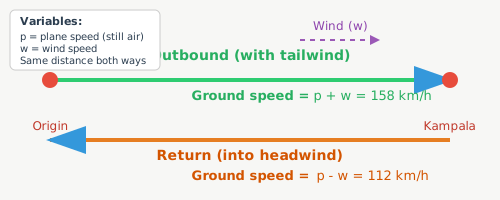
Solution: Method 1 — The Elimination Approach
Step 1 — Define the Variables
Let's call the plane's speed in still air p and the wind speed w (both in km/h).
Step 2 — Set Up the Speed Equations
When flying with a tailwind, the plane's ground speed is the sum of its air speed and wind speed. When flying against a headwind, we subtract the wind speed:
With tailwind: p + w = 158Against headwind: p - w = 112Step 3 — Add the Equations to Find Plane Speed
Adding both equations eliminates the wind variable:
(p + w) + (p - w) = 158 + 1122p = 270p = 135Step 4 — Find the Wind Speed
Substitute p = 135 into either original equation. Using the first:
135 + w = 158w = 23Solution: Method 2 — The Subtraction Method
Step 1 — Start with the Same System
We have the same two equations:
p + w = 158 ... (1)p - w = 112 ... (2)Step 2 — Subtract to Find Wind Speed First
Subtracting equation (2) from equation (1) eliminates the plane speed:
(p + w) - (p - w) = 158 - 112p + w - p + w = 462w = 46w = 23Step 3 — Find Plane Speed
Now substitute w = 23 into either equation:
p + 23 = 158p = 135Verification
Let's check our answer by substituting back into both original conditions:
With tailwind: 135 + 23 = 158 km/h ✓Against headwind: 135 - 23 = 112 km/h ✓Both conditions are satisfied, confirming our solution is correct.
Watch Out For These
✗ Averaging the Two Speeds
Some students think: "The average of 158 and 112 is 135, so that must be the still-air speed." While this happens to give the right answer here, it's coincidental and doesn't work in general. If the distances were different, this method would fail completely.
✗ Confusing Which Speed is Which
Writing p - w = 158 and p + w = 112. Remember: tailwind helps the plane go faster, so the higher ground speed (158) corresponds to p + w.
✗ Setting Up Distance Equations
Some students try to use distance = rate × time but realize they don't have time or distance information. The key insight is that both trips cover the same distance, so the speed relationships alone are sufficient.
The Pattern Behind This
This problem follows the classic sum-and-difference system pattern:
A + B = sumA - B = differenceThe solution is always:
A = (sum + difference) ÷ 2B = (sum - difference) ÷ 2In our case: A = (158 + 112) ÷ 2 = 135 and B = (158 - 112) ÷ 2 = 23.
Why This Matters
Wind-speed calculations appear throughout aviation and navigation:
- Flight planning: Pilots must account for wind when calculating fuel requirements and arrival times
- Weather forecasting: Meteorologists use aircraft reports to measure high-altitude wind speeds
- Shipping logistics: Similar calculations apply to boats dealing with currents
What If?
Let p = plane speed in still air, w = wind speed
p + w = 170 (with tailwind)
p - w = 100 (against headwind)
(p + w) + (p - w) = 170 + 100
2p = 270
p = 135
135 + w = 170
w = 35
Check: 135 + 35 = 170 ✓ and 135 - 35 = 100 ✓
Answer: Plane speed = 135 km/h, Wind speed = 35 km/h
Let w = wind speed, d = distance
With tailwind: d = (150 + w) × 3
Against wind: d = (150 - w) × 5
(150 + w) × 3 = (150 - w) × 5
450 + 3w = 750 - 5w
3w + 5w = 750 - 450
8w = 300
w = 37.5
d = (150 + 37.5) × 3 = 187.5 × 3 = 562.5
Answer: Wind speed = 37.5 km/h, Distance = 562.5 km
The middle flight gives us the plane's still-air speed directly: p = 150 km/h
For tailwind: 150 + w₁ = 180, so w₁ = 30 km/h
For headwind: 150 - w₂ = 120, so w₂ = 30 km/h
Since w₁ = w₂ = 30 km/h, the tailwind and headwind have the same magnitude.
Yes, both wind conditions are from the same 30 km/h wind system — the plane flew with it, then without it, then against it.
Plane 1: still-air speed = 160 km/h, ground speed = 185 km/h
Wind effect: 185 - 160 = +25 km/h (tailwind)
Plane 2: still-air speed = 140 km/h, ground speed = 165 km/h
Wind effect: 165 - 140 = +25 km/h (tailwind)
Both planes experience a +25 km/h wind effect, meaning both have tailwinds.
Both planes are flying with 25 km/h tailwinds in the same direction. Their different ground speeds result from their different still-air capabilities, not different wind conditions.
Frequently Asked Questions
2026-06-26