




Probability with Independent Events: Fruit Selection
What This Problem Teaches
- Breaking complex probability problems into mutually exclusive cases
- Distinguishing between independent events (selections from different baskets) and mutually exclusive events (different successful outcomes)
- Applying the multiplication rule for AND events and addition rule for OR events
- Converting word problems into precise mathematical probability statements
- Verifying probability answers using complementary counting
Let's Draw It
Before we calculate, let's visualize what we're working with. This tree diagram shows all possible outcomes when selecting one fruit from each basket.
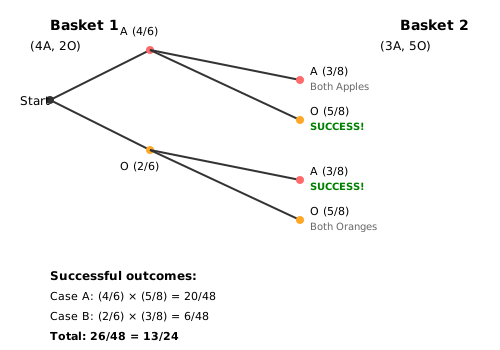
Solution: Method 1 — Case Analysis with Tree Diagram Thinking
The key insight is recognizing that "one apple and one orange" can happen in exactly two mutually exclusive ways. Let's work through each case systematically.
Step 1 — Identify the successful outcomes
We want one apple and one orange from our two selections. This can happen in two ways:
- Case A: Apple from Basket 1 and Orange from Basket 2
- Case B: Orange from Basket 1 and Apple from Basket 2
Step 2 — Calculate the probability for Case A
Basket 1 has 4 apples out of 6 total fruits, so P(Apple from Basket 1) = 4/6 = 2/3
Basket 2 has 5 oranges out of 8 total fruits, so P(Orange from Basket 2) = 5/8
P(Case A) = (4/6) × (5/8) = 20/48
Step 3 — Calculate the probability for Case B
Basket 1 has 2 oranges out of 6 total fruits, so P(Orange from Basket 1) = 2/6 = 1/3
Basket 2 has 3 apples out of 8 total fruits, so P(Apple from Basket 2) = 3/8
P(Case B) = (2/6) × (3/8) = 6/48
Step 4 — Add the probabilities of the two cases
Since Case A and Case B are mutually exclusive (they can't happen at the same time), we add their probabilities:
P(one apple and one orange) = 20/48 + 6/48 = 26/48
Step 5 — Simplify the fraction
We can reduce 26/48 by finding the greatest common factor:
Solution: Method 2 — Complementary Counting with All Outcomes
Instead of focusing on successful cases, let's count all possible outcomes and identify which ones give us one apple and one orange.
Step 1 — Set up the outcome matrix
There are 6 × 8 = 48 total possible outcomes. Let's organize them by what we select from each basket:
| Basket 1 → Basket 2 | Apple (3) | Orange (5) |
|---|---|---|
| Apple (4) | 4 × 3 = 12 outcomes (Both apples) | 4 × 5 = 20 outcomes ✓ SUCCESS |
| Orange (2) | 2 × 3 = 6 outcomes ✓ SUCCESS | 2 × 5 = 10 outcomes (Both oranges) |
Step 2 — Count successful outcomes
The successful outcomes (one apple and one orange) are:
- Apple from Basket 1, Orange from Basket 2:
20 outcomes - Orange from Basket 1, Apple from Basket 2:
6 outcomes
Total successful outcomes: 20 + 6 = 26
Step 3 — Calculate the probability
P(one apple and one orange) = 26/48 = 13/24
Verification
Let's verify our answer using two different approaches:
Check 1 — Verify all probabilities sum to 1
All possible outcomes should have probabilities that sum to 1:
- Both apples:
(4/6) × (3/8) = 12/48 = 1/4 - One apple, one orange:
26/48 = 13/24 - Both oranges:
(2/6) × (5/8) = 10/48 = 5/24
Check 2 — Direct calculation verification
Using our case analysis:
Case B: (2/6) × (3/8) = 6/48
Total: 20/48 + 6/48 = 26/48 = 13/24 ✓
Watch Out for These
Incorrect: P(Apple from B1 and Orange from B2) = 4/6 + 5/8
This treats independent events as mutually exclusive. When you want both events to happen (apple AND orange), you multiply their probabilities.
Incorrect: Only calculating (4/6) × (5/8) = 20/48
This misses the case where we get orange from Basket 1 and apple from Basket 2. The problem asks for "one apple and one orange" — it doesn't matter which basket each comes from.
Incorrect: Treating this as selecting 2 fruits from a combined 14-fruit collection
This ignores the constraint that we must select exactly one fruit from each basket. The baskets are separate, and we're making independent selections from each.
The Pattern Behind This
This problem demonstrates a fundamental principle in probability: when an event can occur in multiple mutually exclusive ways, we add the probabilities of each way.
P(one apple, one orange) = (a₁/(a₁+o₁)) × (o₂/(a₂+o₂)) + (o₁/(a₁+o₁)) × (a₂/(a₂+o₂))
Notice the elegant symmetry: the probability equals the product of "opposite" fractions from each basket. This pattern holds for any two-basket selection problem where we want exactly one item of each type.
How to Spot This Problem Type
Look for these key phrases that signal an independent selections probability problem:
- "Select one [item] from each [group]" — indicates independent selections
- "One of each type" — signals case analysis is needed
- "Different baskets/containers/groups" — confirms selections are independent
- "What is the probability that one will be X and the other will be Y" — classic wording for this setup
The structure is always: multiple containers, one selection from each, asking for probability of getting different types. This appears frequently in standardized tests and introductory probability courses.
What If?
Case A: Apple from Basket 1, Orange from Basket 2
Case B: Orange from Basket 1, Apple from Basket 2
P(Apple from B1) = 6/9 = 2/3P(Orange from B2) = 8/12 = 2/3P(Case A) = (2/3) × (2/3) = 4/9
P(Orange from B1) = 3/9 = 1/3P(Apple from B2) = 4/12 = 1/3P(Case B) = (1/3) × (1/3) = 1/9
P(one apple and one orange) = 4/9 + 1/9 = 5/9
Check: Both apples: (2/3)(1/3) = 2/9, One each: 5/9, Both oranges: (1/3)(2/3) = 2/9
Total: 2/9 + 5/9 + 2/9 = 9/9 = 1 ✓
Answer: 5/9 ≈ 0.556 or about 55.6%
We need exactly 2 apples and 1 orange. This can happen three ways:
AAO, AOA, or OAA
P(A from B1) × P(A from B2) × P(O from B3)= (4/6) × (3/8) × (4/6) = 48/288 = 1/6
P(A from B1) × P(O from B2) × P(A from B3)= (4/6) × (5/8) × (2/6) = 40/288 = 5/36
P(O from B1) × P(A from B2) × P(A from B3)= (2/6) × (3/8) × (2/6) = 12/288 = 1/24
Convert to common denominator 72:1/6 + 5/36 + 1/24 = 12/72 + 10/72 + 3/72 = 25/72
Answer: 25/72 ≈ 0.347 or about 34.7%
Let x = number of oranges in Basket 1
Basket 1 total fruits: 4 + x
We need: P(one apple, one orange) = 1/2
Case A: Apple from B1, Orange from B2P(Case A) = (4/(4+x)) × (5/8)
Case B: Orange from B1, Apple from B2P(Case B) = (x/(4+x)) × (3/8)
(4/(4+x)) × (5/8) + (x/(4+x)) × (3/8) = 1/2
Factor out common terms:(1/(4+x)) × (20/8 + 3x/8) = 1/2(20 + 3x)/(8(4+x)) = 1/2
Cross multiply:2(20 + 3x) = 8(4 + x)40 + 6x = 32 + 8x8 = 2xx = 4
With 4 oranges in Basket 1:P = (4/8) × (5/8) + (4/8) × (3/8) = 20/64 + 12/64 = 32/64 = 1/2 ✓
Answer: 4 oranges in Basket 1
We need exactly 1 apple and 1 orange total from 3 fruits.
Case A: 2 apples from B1, then 1 orange from B2
Case B: 1 apple + 1 orange from B1, then 1 apple from B2
Case C: 1 apple + 1 orange from B1, then 1 orange from B2
Case D: 2 oranges from B1, then 1 apple from B2
Cases A and D fail (give us 2 of same type).
Case B: AA from B1, then O from B2P = (4/6) × (3/5) × (5/8) = 60/240 = 1/4
Wait - we want exactly 1 apple and 1 orange total.
This means selecting 2 fruits from B1 already gives us too many fruits if we want just 1 of each type total.
For exactly 1 apple and 1 orange total (2 fruits), we need:
- 1 fruit from B1 + 1 fruit from B2, OR
- 2 fruits from B1 + 0 from B2, OR
- 0 fruits from B1 + 2 from B2
Since we must select 2 from B1 and 1 from B2, this is impossible.
Case A: AA from B1, O from B2 → 2A, 1O (fails)
Case B: AO from B1, A from B2 → 2A, 1O (fails)
Case C: AO from B1, O from B2 → 1A, 2O (fails)
Case D: OO from B1, A from B2 → 1A, 2O (fails)
Answer: 0 (impossible with the given constraints)
Frequently Asked Questions
2026-10-28