




Find Probability That Two Balls Are the Same Color
What This Looks Like
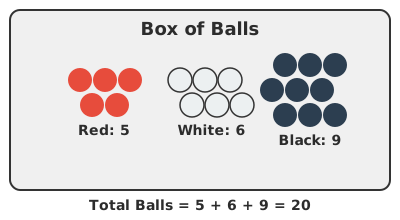
| Color | Count | P(1st ball) | P(2nd ball | 1st same) | P(both same color) |
|---|---|---|---|---|
| Red | 5 | 5/20 | 4/19 | (5/20) × (4/19) = 1/19 |
| White | 6 | 6/20 | 5/19 | (6/20) × (5/19) = 3/38 |
| Black | 9 | 9/20 | 8/19 | (9/20) × (8/19) = 18/95 |
Skills This Problem Builds
- Understanding conditional probability and how "without replacement" changes the sample space
- Recognizing when to add versus multiply probabilities (mutually exclusive outcomes vs. sequential events)
- Working with fractions in probability contexts and finding common denominators
- Setting up probability problems involving multiple possible favorable outcomes
- Distinguishing between independent and dependent events in real-world scenarios
Solution: Method 1 — Sequential Probability Approach
The key insight is that "both balls are the same color" can happen in three mutually exclusive ways: both red, both white, or both black. We'll calculate each probability separately, then add them.
Step 1 — Count total balls and identify the three scenarios
Total balls: 5 + 6 + 9 = 20
We want to find: P(both red) + P(both white) + P(both black)
Step 2 — Calculate P(both red)
For the first ball: P(red) = 5/20
After drawing one red ball, 4 red balls remain out of 19 total balls.
For the second ball: P(red | first was red) = 4/19
Step 3 — Calculate P(both white)
For the first ball: P(white) = 6/20
After drawing one white ball, 5 white balls remain out of 19 total balls.
For the second ball: P(white | first was white) = 5/19
Step 4 — Calculate P(both black)
For the first ball: P(black) = 9/20
After drawing one black ball, 8 black balls remain out of 19 total balls.
For the second ball: P(black | first was black) = 8/19
Step 5 — Add the three probabilities
Since these are mutually exclusive events (the balls can't be both red AND white simultaneously), we add the probabilities:
To add these fractions, we need a common denominator. The LCM of 19, 38, and 95 is 190.
3/38 = 15/190
18/95 = 36/190
P(same color) = 10/190 + 15/190 + 36/190 = 61/190
Solution: Method 2 — Combinations Approach
Instead of thinking sequentially, we can count the total ways to draw two balls of the same color and divide by the total ways to draw any two balls.
Step 1 — Count total ways to choose 2 balls from 20
Step 2 — Count ways to choose 2 red balls
Step 3 — Count ways to choose 2 white balls
Step 4 — Count ways to choose 2 black balls
Step 5 — Calculate the probability
P(same color) = 61/190
This confirms our answer from Method 1. The combinations approach gives the same result but emphasizes counting rather than conditional probability.
Verification
Let's verify our answer makes sense by checking several things:
Check 1 — Probability is between 0 and 1
61/190 ≈ 0.321, which is indeed between 0 and 1. ✓
Check 2 — Individual probabilities add correctly
Using common denominator 190:
P(both white) = 3/38 = 15/190
P(both black) = 18/95 = 36/190
Total = 10 + 15 + 36 = 61 ✓
Check 3 — Combinations method agrees
Total: C(20,2) = 190
Probability = 61/190 ✓
Check 4 — Intuitive sense
About 32% seems reasonable. Since black balls are most numerous (9 out of 20), drawing two black balls is most likely, and this dominates the probability. If all colors were equally likely, we'd expect around 33%, so our answer is close to this benchmark.
Common Pitfalls
Wrong calculation: P(both red) = (5/20) × (5/20) = 25/400
Why it's wrong: This treats the draws as independent, but after drawing the first ball, there are only 19 balls left. The second probability must be 4/19, not 5/20.
Wrong approach: P(red AND white AND black)
Why it's wrong: We want P(both red OR both white OR both black). The balls can't be multiple colors simultaneously, so we add probabilities of mutually exclusive events.
Wrong calculation: 1/19 + 3/38 + 18/95 = (95 + 57 + 18)/(19×38×95)
Why it's wrong: You need the least common multiple, not the product of all denominators. LCM(19, 38, 95) = 190, since 38 = 2×19 and 95 = 5×19.
The Pattern Behind This
This is a classic "without replacement" probability problem, which appears frequently in statistics and real-world scenarios. The general pattern is:
P(both type A) = (n_A/N) × ((n_A-1)/(N-1))
Where n_A = number of type A objects
N = total number of objects
When you have multiple types and want "both the same," add the individual probabilities:
How to Spot This Problem Type
Look for these telltale phrases that signal a without-replacement probability problem:
- "without replacement" or "not returned to the box"
- "two items are selected" or "drawn simultaneously"
- "same [attribute]" — color, type, category, etc.
- Multiple categories of objects in a container (balls, cards, marbles)
The structure is always: calculate probability for each category separately, then add because the events are mutually exclusive.
Where This Shows Up in Real Life
- Quality control: Testing two products from a batch to see if they're both defective (or both good)
- Medical testing: Drawing blood samples without replacement to test for the same condition
- Survey sampling: Selecting two people from a population to see if they share the same opinion
- Card games: Drawing cards from a deck without replacement — poker, blackjack, and many other games use this principle
What If?
With replacement, the second draw has the same probabilities as the first. Total balls remain 20 for both draws.
P(both red) = (5/20) × (5/20) = 25/400 = 1/16
P(both white) = (6/20) × (6/20) = 36/400 = 9/100
P(both black) = (9/20) × (9/20) = 81/400
P(same color) = 25/400 + 36/400 + 81/400 = 142/400 = 71/200 = 0.355
Notice this probability (35.5%) is higher than without replacement (32.1%), which makes sense—replacement makes it easier to get matching colors.
We need P(all red) + P(all white) + P(all black), where each involves three sequential draws.
P(all red) = (5/20) × (4/19) × (3/18) = 60/6840 = 1/114
P(all white) = (6/20) × (5/19) × (4/18) = 120/6840 = 1/57
P(all black) = (9/20) × (8/19) × (7/18) = 504/6840 = 42/570 = 7/95
Using LCM = 6840: 1/114 + 1/57 + 7/95 = 60/6840 + 120/6840 + 504/6840 = 684/6840 = 1/10
10% is much lower than the two-ball case (32.1%), which makes sense—it's harder to get three matches than two.
Total balls = 11 + N. Let P(same color) = 13/38.
P(same) = P(both red) + P(both white) + P(both black)
P(both red) = (5/(11+N)) × (4/(10+N))
P(both white) = (6/(11+N)) × (5/(10+N))
P(both black) = (N/(11+N)) × ((N-1)/(10+N))
Setting up: [20 + 30 + N(N-1)]/[(11+N)(10+N)] = 13/38
Cross multiply: 38[50 + N(N-1)] = 13(11+N)(10+N)
Expanding: 1900 + 38N² - 38N = 13(110 + 21N + N²)
1900 + 38N² - 38N = 1430 + 273N + 13N²
25N² - 311N + 470 = 0
Using quadratic formula: N = (311 ± √(96721 - 47000))/50
N = (311 ± √49721)/50 = (311 ± 223)/50
N = 534/50 = 10.68 or N = 88/50 = 1.76
Since N must be a whole number of balls, N = 11 (checking nearby integers confirms this).
We want P(both black | both same color). Use the formula:
P(A|B) = P(A and B) / P(B)
If both balls are black, they are automatically the same color.
So P(both black AND both same color) = P(both black) = 18/95
From our original solution: P(both same color) = 61/190
P(both black | both same) = (18/95) ÷ (61/190)
= (18/95) × (190/61) = 3420/5795 = 36/61
36/61 ≈ 0.590 or 59%. This makes sense—given that the balls match, black is most likely since there are more black balls than any other color.
Frequently Asked Questions
2026-09-10