




Probability Without Replacement: Matching Letters
Visualizing the Letter Cards
Before we dive into the mathematics, let's see what we're working with. Each letter gets its own card, and we need to track which letters appear multiple times.
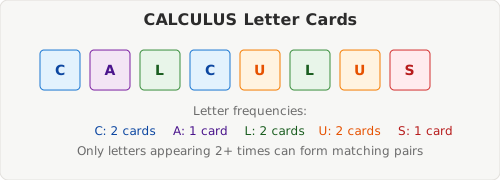
What You Will Learn
- How to count favorable outcomes when letters appear with different frequencies
- The difference between permutations and combinations in probability without replacement
- Why single-occurrence items cannot contribute to "matching" events
- How to systematically organize counting problems by categorizing possible outcomes
- The relationship between total sample space and favorable outcomes in discrete probability
Solution: Method 1 — Favorable Pair Counting
We'll count the number of ways to choose two cards that show the same letter, then divide by the total number of ways to choose any two cards.
Step 1 — Analyze the letter frequencies
First, let's count how often each letter appears in CALCULUS:
| Letter | Frequency | Can form matching pair? |
|---|---|---|
| C | 2 | Yes |
| A | 1 | No |
| L | 2 | Yes |
| U | 2 | Yes |
| S | 1 | No |
Total cards: 2 + 1 + 2 + 2 + 1 = 8
Step 2 — Calculate total possible pairs
When choosing 2 cards from 8 without replacement, order doesn't matter (we just want a pair). This is a combination problem:
Step 3 — Count favorable matching pairs
Only letters appearing at least twice can form matching pairs. Let's count each:
- C pairs: We have 2 C cards, so there's
C(2,2) = 1way to choose both - L pairs: We have 2 L cards, so there's
C(2,2) = 1way to choose both - U pairs: We have 2 U cards, so there's
C(2,2) = 1way to choose both
Step 4 — Calculate the probability
Using the fundamental probability formula:
This fraction is already in lowest terms since gcd(3, 28) = 1.
Solution: Method 2 — Sequential Choice Approach
Think of choosing the cards one after the other. The probability that the second card matches the first depends on what the first card was.
Step 1 — Identify the cases
After drawing the first card, we have different scenarios based on which letter we drew:
- If first card is C, L, or U: There's exactly 1 matching card left among 7 remaining
- If first card is A or S: There are 0 matching cards left among 7 remaining
Step 2 — Calculate conditional probabilities
Let's work through each case:
Step 3 — Apply the law of total probability
The probability of a matching pair is the sum of all successful paths:
Verification
Let's verify our answer by checking that it makes intuitive sense and by using an alternative counting method.
Reasonableness check
We have 8 cards total, and only 3 ways to get matching pairs out of 28 total pairs. This gives us 3/28 ≈ 0.107 or about 10.7%. This seems reasonable since most letters appear only once.
Direct enumeration verification
Let's label the cards as C₁, A, L₁, C₂, U₁, L₂, U₂, S. The matching pairs are:
- {C₁, C₂}
- {L₁, L₂}
- {U₁, U₂}
That's exactly 3 matching pairs out of C(8,2) = 28 total pairs. ✓
Method consistency check
Both methods gave us the same answer: 3/28. ✓
Common Pitfalls
Some students include A and S in their favorable outcomes, reasoning "there's a 1/8 chance of drawing A first, then a 0/7 chance of matching it." While the calculation is correct (giving 0), the error is conceptual — you cannot form a matching pair from a letter that appears only once.
Calculating as if the first card is returned: P = (2/8)² + (2/8)² + (2/8)² = 3 × (4/64) = 12/64 = 3/16. This gives approximately 18.8%, which is too high. Without replacement, we have fewer total outcomes and the conditional probabilities change.
Some students calculate P(first is C and second is C) + P(first is C and second is L) + ... listing all 64 ordered pairs. This counts each unordered pair twice. The correct approach either uses combinations (unordered) or uses conditional probability with the law of total probability.
The Pattern Behind This
This problem belongs to the family of "sampling without replacement" problems. The general pattern for finding matching pairs is:
Where:
Nis the total number of itemsnᵢis the frequency of the i-th distinct item type- The sum is over all item types where
nᵢ ≥ 2
For CALCULUS: N = 8, and we have nC = 2, nL = 2, nU = 2 (the others have frequency 1, so they contribute 0 to the sum).
k > 2 items, we'd need to ask whether "at least 2 match" or "all k match" — different problems with different formulas.
How to Spot This Problem Type
Watch for these key phrases that signal a matching-pairs probability problem:
- "Without replacement" — distinguishes from simpler replacement problems
- "Same [attribute]" — color, letter, number, etc.
- Items with repeated values — multiple cards/balls of the same type
- "Two [items] are chosen" — signals we're looking at pair outcomes
Real Applications
This type of calculation appears in several practical contexts:
- Quality control: Randomly sampling two products from a batch — what's the probability they have the same defect type?
- Genetics: Drawing two individuals from a population — what's the probability they share the same allele variant?
- Survey analysis: Randomly selecting two responses — what's the probability they give the same answer to a multiple-choice question?
It's easier to find P(all three different) and subtract from 1.
C(8,3) = 8!/(3!5!) = 56 total ways.
We need 3 different letters from {C, A, L, U, S}. First choose 3 letters: C(5,3) = 10 ways. For each choice, count arrangements: if one letter appears twice in CALCULUS, we have 2 choices for that card; otherwise 1 choice. Let's enumerate: choosing {C,A,L}: 2×1×2=4 ways. Similarly for other combinations involving repeated letters.
Favorable outcomes (all different): After careful counting, there are 28 ways to choose 3 cards with all different letters.
P(at least two same) = 1 - 28/56 = 1 - 1/2 = 1/2
Answer: 1/2
With replacement, each draw is independent and the total sample space is 8² = 64.
For letter C: P(both C) = (2/8)² = 4/64
For letter L: P(both L) = (2/8)² = 4/64
For letter U: P(both U) = (2/8)² = 4/64
For letter A: P(both A) = (1/8)² = 1/64
For letter S: P(both S) = (1/8)² = 1/64
P(match) = 4/64 + 4/64 + 4/64 + 1/64 + 1/64 = 14/64 = 7/32
7/32 = 0.21875, which is higher than our without-replacement answer of 3/28 ≈ 0.107. This makes sense since replacement gives more opportunities for matches.
Answer: 7/32
MISSISSIPPI has: M(1), I(4), S(4), P(2). Total = 11 cards.
C(11,2) = 11×10/2 = 55 ways to choose 2 cards.
From I: C(4,2) = 6 ways
From S: C(4,2) = 6 ways
From P: C(2,2) = 1 way
M appears once, so 0 ways.
Total: 6 + 6 + 1 = 13
P(matching) = 13/55
13/55 ≈ 0.236 or about 23.6%. This is higher than CALCULUS because MISSISSIPPI has more repeated letters.
Answer: 13/55
Let the repeated letter appear 3 times, and there are n total distinct letters. Then there are 3 + (n-1) = n + 2 = 6 total cards, so n = 4 distinct letters.
Total ways to choose 2 from 6: C(6,2) = 15
Ways to get matching pairs: C(3,2) = 3 (from the repeated letter only)
So P(match) = 3/15 = 1/5 ✓
We have 4 distinct letters total, with one appearing 3 times and three appearing once each: 3 + 1 + 1 + 1 = 6 cards total.
The problem asks which letter appears 3 times, but we can only determine the structure: there are 4 distinct letters, with one of them appearing 3 times.
Answer: 4 distinct letters, with any one of them appearing 3 times
Frequently Asked Questions
2026-09-06